

Wellhead Extension & Repair in Gainesville and Across North Florida
FL Water Well Contractor License #5016 · FGWA · NGWA · NCFWA Member · Google 5.0 Rated · Wisetack Financing
If your wellhead sits below grade, took damage in a tropical storm, or you can see an open seal where there should not be one, you are on the right page. Wellhead extension raises the casing 12 inches or more above grade, so flood water cannot overtop it and contaminate your source water. This is the durable answer for properties along the Suwannee, Santa Fe, and St. Marys river basins and FEMA-designated flood zones in Bradford and Baker counties. Perry-Pump Repair Service is a family-owned, state-licensed well pump shop based in Gainesville, serving 17 North Florida communities. Eric Perry is a 3rd-generation water well specialist; the Perry family has been working North Florida wells for more than 50 years.
This page also covers casing repair and liner installation for cracks, joints, and worn seals, plus cap-and-seal restoration. Every fix brings the well back to a sound, sealed condition under applicable Florida state code. No service call fee, no diagnostic charge on routine residential, warranty on the invoice before you sign.
Call (352) 320-2412 Mon. - Fri. 8 AM - 5 PM. After hours, leave a message, and we will return the call at our earliest availability.
FREE SERVICE CALL
$0 service-call fee + $0 diagnostic on routine residential work.
Casing Repair & Liner
Cracks, joints, and worn seals, usually from the original installation.
Code-Compliant
Work performed to applicable Florida state code.
17 North Florida Cities
Gainesville HQ to Lake Butler, Starke, Newberry, Lake City, and beyond.
Flood-Zone Specialty
Suwannee, Santa Fe, St. Marys basins + Bradford/Baker rural lots.
FDEP-Licensed #5016
Fully state-licensed Water Well Contractor - public registry.
Three Wellhead Failures We See Most Often
Across 15+ years of personal experience and three Perry-family generations of wells, almost every wellhead repair call traces back to one of three failures. Two of them get worse every storm season; the third often goes unnoticed until it has already let surface water in.
Wellhead below grade or below flood elevation.
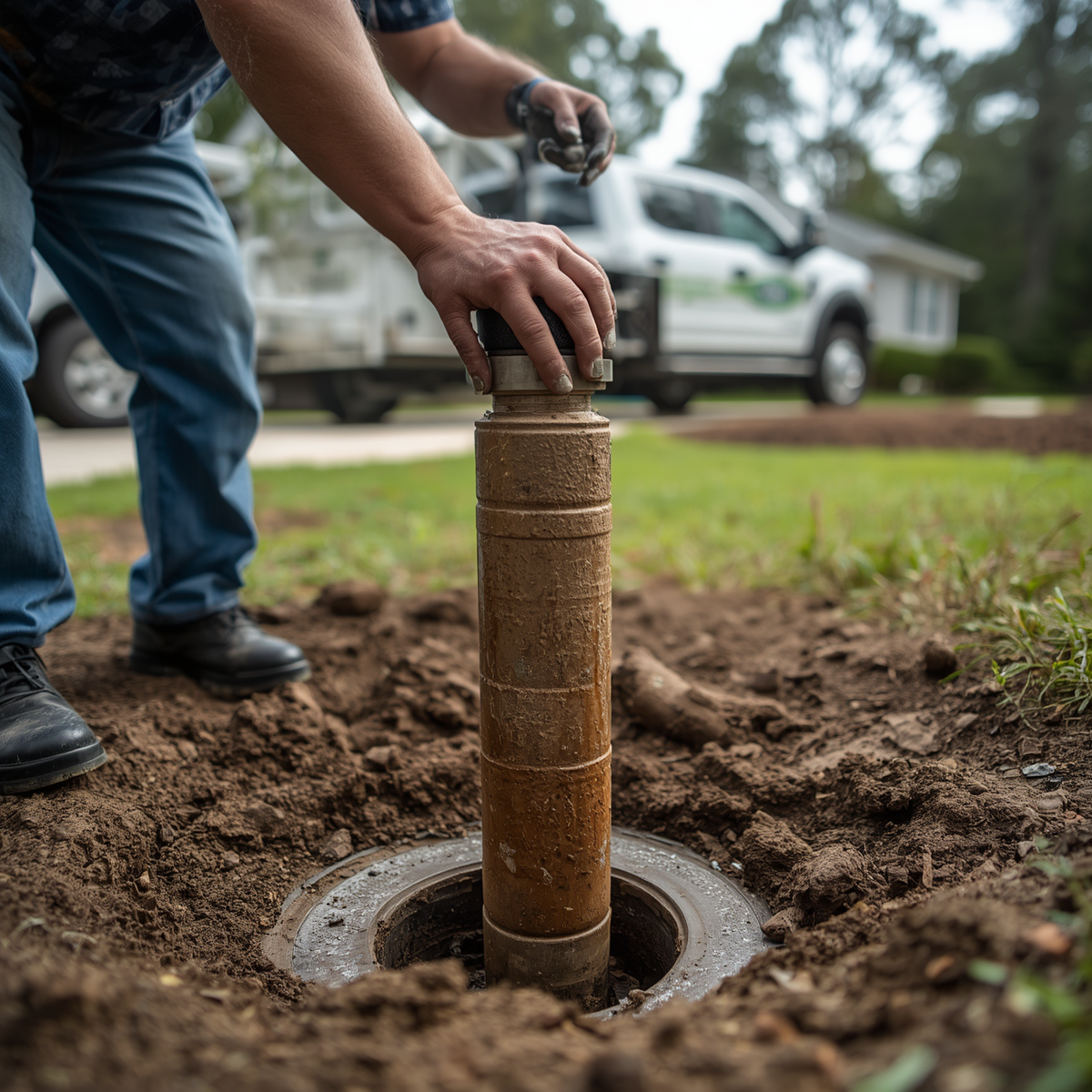
If the top of your casing is less than 12 inches above finished grade, surface flooding from a tropical storm or river-basin overflow can overtop the seal and contaminate your source water. Signs after the fact: cloudy water, sediment, a sudden change in taste or smell. Common on Suwannee, Santa Fe, and St. Marys basin properties and lower-elevation rural lots in Bradford and Baker counties. The fix is an extension: raising the casing 12 inches or more above grade, ideally above Base Flood Elevation, where the lot geometry allows.
Cap-and-seal failure (the sanitary barrier is compromised).
The wellhead cap and seal keep insects, debris, surface water, and animals out of your water. When the cap is cracked or the seal is compromised, the well is no longer sealed even if the water tests fine today. We repair it so the wellhead is properly sealed to applicable Florida code.
Casing damage: usually an installation issue, sometimes accelerated by karst.
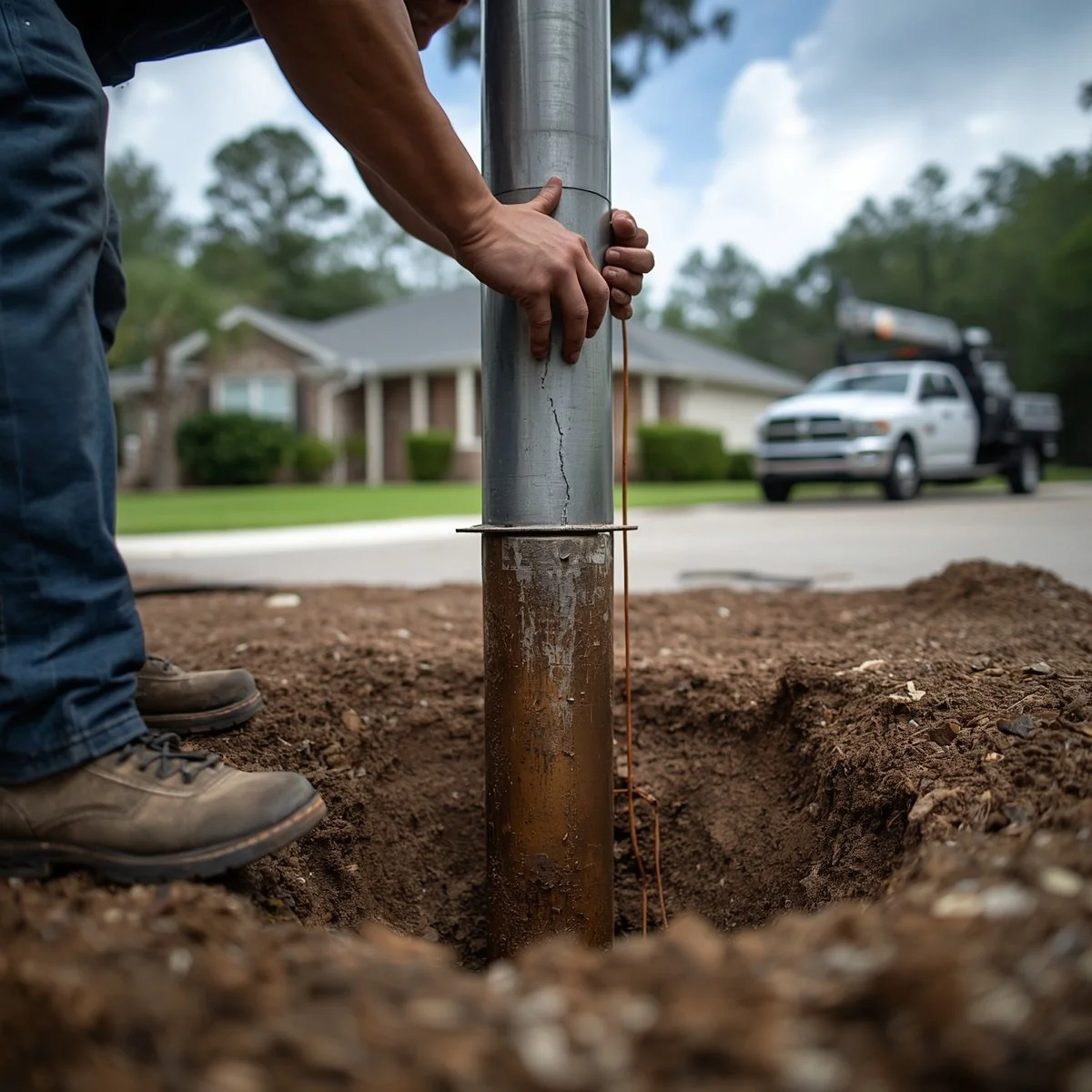
Most casing problems trace back to the original installation: a poor joint, the wrong materials, or a seal that was not done to spec. Repair is usually a spot fix on a small crack or a liner through the damaged section. Full casing replacement is rare and is new-well work, which we refer to a driller.
Symptoms and Failures We See Across the Service Area
If any of these sound like what you are dealing with, call us. Many wellhead diagnoses start on the phone with a few questions and a couple of photos sent over before we drive out.
-
• Wellhead sits at grade or only an inch or two above finished grade
• Property is in a FEMA-designated flood zone (A, AE, V)
• Standing water reaches or covers the wellhead during heavy rain
• Recent tropical-storm or hurricane water marks visible on the casing
• Cloudy or off-color water after a flood event
• Sediment in the first pour following a major rain
• Wellhead in a low spot relative to the surrounding lot
-
• Cap visibly cracked, broken, or missing pieces
• Vent screen torn, rotted, or covered with debris
• Conduit penetration loose, weeping, or visibly unsealed
• Insects or insect bodies inside the cap when removed
• Lawnmower or string-trimmer damage to the seal
• Old galvanized cap rusted through at the rim
• Vandalism, livestock, or wildlife damage to the cap assembly

-
• Visible crack or split at a threaded joint near grade
• Casing leaning or shifted - subsidence around the wellhead
• Soil depression or sinkhole indicator near the casing
• Roots visibly entering or exiting the casing
• Sudden water-quality change with no other equipment cause
• Sand or fine sediment increases, suggesting a screen or wall breach
• Older steel casing showing pitting at the surface section
-
• Casing knocked out of plumb by debris during a named storm
• Cap dislodged or missing after a wind event
• Surface water surrounded the wellhead for 12+ hours
• Pump tripped and the system has not restarted
• Pressure system runs, but water tests or looks contaminated
• Insurance adjuster requested documentation of damage
• Neighboring wells reported contamination after the same event
What Actually Happens When You Call About a Wellhead
From the phone call to the final invoice, here is the path most wellhead customers walk. A lot of the planning happens before we drive out, since parts and casing stock have to be confirmed for the right diameter and depth.
Phone diagnostic + photos.
Call (352) 320-2412 Mon-Fri 8 AM - 5 PM. We will ask about flood-zone status, current cap height above grade, any storm damage, and water quality changes. Send a couple of photos of the existing wellhead if you can, as it helps us confirm casing diameter and material before we quote. After hours, leave a message; we return at our earliest availability.
Schedule + parts confirmation.
Wellhead extensions and cap-and-seal work usually land within the same week. Casing diameter, material (PVC vs steel), and the right cap have to be stocked or ordered, so the visit gets planned a few days out. Post-storm emergencies move to the top of the queue.
On-site sanitary inspection - no service-call fee.
We arrive in a marked Perry-Pump truck and walk the wellhead, casing condition, cap assembly, conduit penetration, and immediate surroundings. The full sanitary inspection is part of the visit. If anything looks like a permit situation, we tell you up front. When a permit is required for the work we perform, Perry-Pump pulls it — you don’t file anything.
Plain-language quote on the spot.
Wellhead extension + cap-and-seal sanitary repair typically runs $1,600 to $2,400. Casing repair for small cracks or joint repair costs a few hundred to about $1,500, depending on access. Liner installation for a damaged section is more substantial and quoted per situation. Prices reflect current material costs and are confirmed at the time of your quote.
Sanitary install (same visit on most jobs).
Extension, cap, and seal work is usually completed in the same visit, once the parts are on the truck. Casing repair varies: a spot joint repair finishes the same day; a full liner section can run longer. We replace what is degraded and leave the rest alone; no upsells for the sake of an invoice.
FDEP-spec verification + written warranty.
Final height above grade verified, cap seated and sealed, conduit penetrations checked, annular space (if disturbed) re-grouted to spec. Workmanship parts + labor warranty for the term on the invoice. If shock chlorination is recommended after a contamination event, we will tell you. That work refers out to a specialist; Perry-Pump does not perform shock chlorination in-house.
Follow-up + photos for insurance.
Photos of the finished work, invoice copy, and a one-page summary go to the homeowner. If the work is part of a storm-damage claim, the homeowner takes the documentation to their adjuster. Perry-Pump does not coordinate insurance claims.
Wellhead Extension & Repair Pricing: What Things Cost
Every wellhead is different. Casing diameter, material, height needed, access, and what is damaged all move the number. Ranges below are accurate as of writing; we will quote the current number on the call. Routine residential diagnostic is free.
Diagnostic
$0 service call fee + $0 diagnostic charge on routine residential calls. The full sanitary inspection (elevation check, cap assessment, conduit and seal check, casing condition walk) is part of the visit, not a separate line item.
Wellhead extension + cap-and-seal sanitary repair (the core service)
Wellhead extension to 12+ inches above grade + cap-and-seal sanitary repair: $1,600-$2,400
Cap-and-seal restoration only (existing height already compliant): lower end of the range
Vent screen replacement, sealed-conduit re-do, sanitary inspection - part of the install
Post-storm wellhead inspection (often combined with cap-and-seal): typically same-visit
Related work that sometimes pairs with a wellhead job
Annular space re-grouting if surface seal is disturbed during repair: included with most installs
Pressure tank inspection (post-storm cycling stress on the system): inspection no charge
Pressure switch replacement if the storm damaged the contacts: a few-hundred-dollar range
Drop pipe inspection if intrusion suspected at depth: pump pull quoted separately
Casing repair
Spot repair on a small crack or single joint separation: a few hundred dollars range
Multi-joint repair or larger crack work: typically up to about $1,500, depending on access
Liner installation through a damaged section: more substantial - quoted per situation
Full casing replacement: rare; usually new-well territory and referred out to a driller
Wisetack financing on larger combined jobs (extension + cap-and-seal + casing repair + related work). Application takes minutes; terms are shown before you sign. Military and first-responder discounts case-by-case by scope; ask when you call. Prices are subject to change because our suppliers have been very volatile with pricing lately.
Our Reviews
Why homeowners choose Perry-Pump
Fully licensed and insured. Florida Water Well Contractor License #5016.
Experienced well repair specialists. Third generation, 50+ years working North Florida wells.
Quality workmanship and straightforward customer service.
Free service call and $0 diagnostic on routine residential work.
5-year parts and labor warranty on the Pressure Package and most residential submersibles, in writing on the invoice.
Seven North Florida Conditions That Shape Wellhead Extension and Casing Repair
Working wellheads in North Central Florida means working around seven specific local conditions that do not apply the same way in other regions. These shape where we extend, how high we go, when we recommend liner work, and what we plan for during storm season.
1
Floridan Aquifer wells dominate at 100 to 400 ft
Almost every residential well in our footprint draws from the Floridan Aquifer at 100 to 400 ft. The sanitary seal at the casing top protects the whole water column down to the screened interval, which is why the FDEP code treats the wellhead, cap, conduit, and grouted annular space as one system.
2
Hurricane and tropical storm season (June to November) damages wellheads directly
Wellheads that sit low or in a flood zone can take on surface water during heavy rain, which is the main reason a wellhead needs raising and resealing. We handle that work year round, whether the trigger was a named storm or an ordinary rainy week.
3
Summer lightning peaks, and electrical hardware mounted at the wellhead
Nearby lightning strikes that surge the power line can damage any electrical hardware mounted at the wellhead: junction boxes, conduit penetrations, and control boxes on 3-wire systems, same as age and corrosion can. We check the whole assembly on every wellhead visit, not just after a named storm.
4
Casing cracks usually trace back to installation quality — karst just accelerates it
North Florida sits on karst limestone, but a well-built casing handles normal soil movement without cracking. When we do see hairline cracks at threaded joints or root-intrusion pathways, it almost always traces back to the original installation — karst subsidence just speeds up the timeline on a casing that was already marginal. Eastern Alachua County and the Suwannee River basin see this often. Liner installation through the damaged section is the right fix when the rest of the casing is sound.
5
Iron, sulfide, and hardness corrode older steel casing from the inside
Most North Florida wells produce water with measurable iron, sulfide, and hardness. The chemistry accelerates internal corrosion on older galvanized and steel casing, especially through the surface section where oxygen exchange is highest. Liner work makes sense when the wall has been compromised.
6
Fire ants and other pest pressure on the wellhead enclosure
Fire ants find any unsealed conduit opening, and they are a recurring cause of pump-control failures. Cap-and-seal restoration includes sealed conduit penetrations and pest-blocking foam in the electrical entry.
7
Flood-zone properties along Suwannee, Santa Fe, St. Marys, and Bradford/Baker rural lots
FEMA designations hit hardest along the Suwannee River from Branford through Bell into Gilchrist County, the Santa Fe corridor through High Springs and Brooker, and the St. Marys basin along the Baker County edge from Macclenny to Glen Saint Mary. Lower-elevation rural lots in Bradford and Baker also commonly sit in Zone A or AE. Extension above grade, and where lot geometry allows above Base Flood Elevation, is the durable answer.
Seven Technical Topics Where the Code, the Geology, and the Storm Track Meet
Seven places where the easy answer is not the right one. One-line take? Call us. The actual reasoning is here.
-
The annular space is the gap between the casing wall and the borehole, filled with bentonite grout from the surface down 20+ ft on a residential Floridan well. That grout column prevents surface contamination from migrating down the outside of the casing toward the screened interval. When we extend a casing, we re-grout the disturbed surface section to the same spec.
-
Karst limestone means the ground here moves a little over time, and it's worth knowing the surface signs: a shallow depression near the wellhead, a circle of greener or browner grass, casing that's shifted off plumb, or fresh subsidence in the area. None of these damages a well-built casing on their own — a sound install handles normal soil movement — but on a marginal casing they're worth catching early. We flag what we see on routine inspections. We don't do soil studies, but we know what to look at around the wellhead.
-
After a named storm, we check seven things: cap integrity, vent screen, conduit seal, casing alignment, evidence of flood water around the wellhead, debris in or on the cap, and water-quality change. If contamination is suspected, we recommend shock chlorination, performed by a specialist, not by Perry-Pump. If a permit applies to the work, we pull it and file it with the Water Management District as your licensed contractor. It’s part of the job, not something we hand back to you.
-
All wellhead and casing work we do is performed in accordance with applicable Florida state code. Most of our work brings older wells back into current, sealed condition.
-
FEMA zones that matter: Zone A (1% annual flood risk, no detailed elevation studies), Zone AE (adds a specific Base Flood Elevation), Zone V (coastal high-hazard with wave action). FDEP minimum is 12 inches above grade; in AE zones, we extend above the published BFE where lot geometry allows. Sometimes 14, 18, or 24 inches is the right number.
-
A wellhead cap and seal have to keep out insects, debris, water, and animals. When any part fails, we repair it so the wellhead is sealed to code.
-
Small cracks or a single joint separation get a spot repair. A damaged section with multiple intrusion paths gets a liner installation: a smaller-diameter casing section is slid inside the existing casing through the damaged interval and sealed. Full casing replacement is rare. It is effectively a new well, and we refer that out to a driller.
Frequently Asked Questions
-
Extension + cap-and-seal sanitary repair typically runs $1,600 to $2,400. Casing repair for small cracks or a single joint lands a few hundred up to about $1,500, depending on access. Liner installation is more substantial; call for a quote. Prices are subject to change because our suppliers have been very volatile with pricing lately.
-
Three situations: wellhead sits below 12 inches above grade (FDEP minimum), property is in a FEMA flood zone (A, AE, or V), or surface water has reached or overtopped the wellhead during heavy rain or a named storm. The durable answer is raising the casing above where the water reaches.
-
All of our wellhead and casing work is performed in accordance with applicable Florida state code. Most of our work brings older wells back to a sound, properly sealed condition.
-
Small damage gets a spot repair. A damaged section with multiple intrusion paths gets a liner. Full casing replacement is rare and usually new-well territory; we refer that out to a driller. Most casing calls get fixed without drilling a new well.
-
Typical residential extension + cap-and-seal finishes the same day once parts are confirmed. Planning and parts stocking may push the visit out a few days from the call. A spot joint repair finishes the same day; a full liner section can run longer.
-
Depends on your policy. Standard policies usually cover wind damage but exclude flood damage; flood coverage is a separate NFIP policy or rider. We document with photos, an itemized invoice, and a one-page summary. That is what most adjusters need. The adjuster makes the coverage call; Perry-Pump does not coordinate insurance claims.
-
Sometimes, depending on the Water Management District and the scope of work. When one is required, we handle it. As a state-licensed Florida Water Well Contractor (License #5016), Perry-Pump pulls the permit and files with the appropriate WMD — St. Johns, Suwannee River, or Southwest Florida, depending on the county. You don’t need to visit an office or fill out paperwork.
-
Workmanship parts and labor for the term on the invoice. Cap-and-seal, extension materials, and conduit penetrations are covered for the stated term. Casing liner work has its own term shown on the invoice. Always in writing, explained up front.
-
17 communities: Gainesville (HQ), Lake Butler, Lake City, Alachua, Newberry, High Springs, Starke, Keystone Heights, Branford, Trenton, Waldo, Hawthorne, Glen Saint Mary, Bell, Brooker, Raiford, and Melrose. Flood-zone properties along the Suwannee, Santa Fe, and St. Marys basins, plus Baker rural lots, are a real share of this work.
-
Yes, through Wisetack on larger combined jobs. Application takes minutes, terms shown before you sign. We do not push financing on smaller repairs; for the bigger sanitary restoration jobs, it is a real option.
Ready to Protect Your Wellhead? Call Perry-Pump Today.
Whether your wellhead is below flood elevation, your cap took damage in the last named storm, or you want a sanitary inspection before storm season starts - call (352) 320-2412, and we'll get you on the schedule. Routine residential work has no service-call fee, no diagnostic charge, and the workmanship warranty goes on the invoice before you sign.