
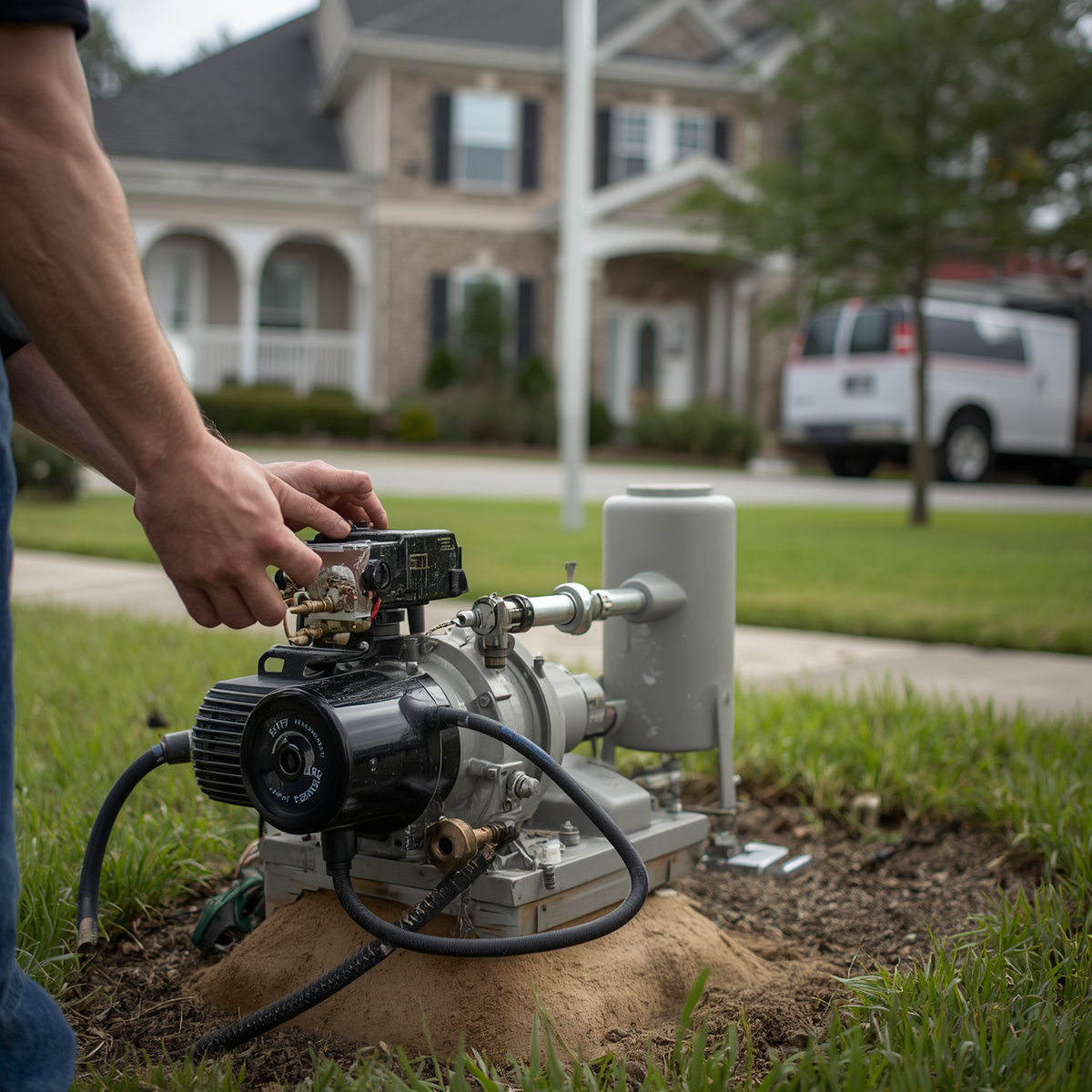
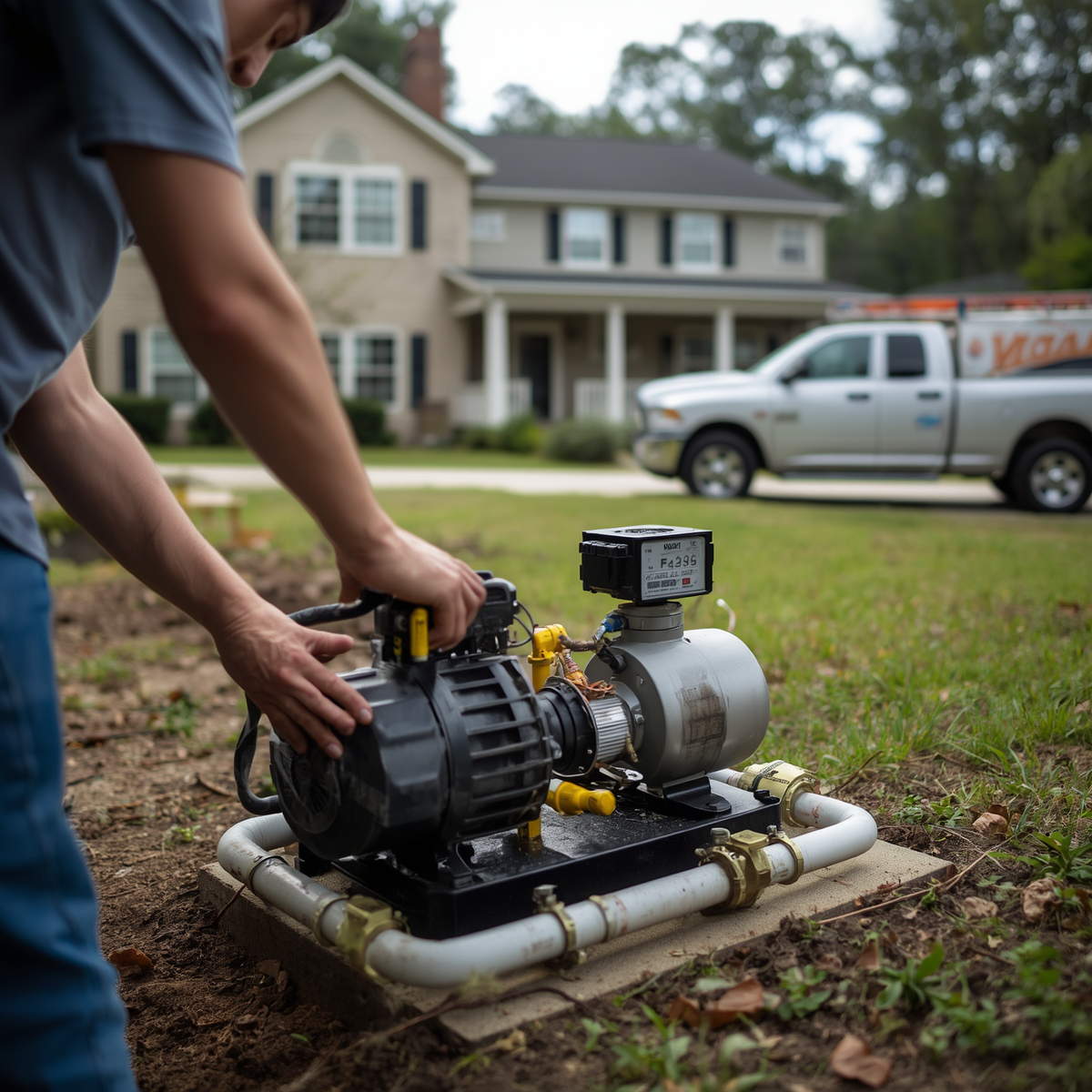

Booster Pump Repair in Gainesville and Across North Florida
FL Water Well Contractor License #5016 · FGWA · NGWA · NCFWA Member · Google 5.0 Rated · Wisetack Financing

If water flows but pressure is weak, long pipe runs to outbuildings, a two-story house with weak upstairs showers, a mobile home park where back lots get nothing at peak: you probably need a booster, or the one you have needs work. Perry-Pump is a family-owned, state-licensed well pump shop in Gainesville serving 17 North Florida communities across 9 counties. Eric Perry is a 3rd-generation specialist; the Perry family has worked North Florida wells for 50+ years.
Boosters do not appear as often as submersibles on the repair schedule, but they represent high-value work. Residential boosters start around $5,000 installed; commercial multi-stage systems for a mobile home or RV park run $20,000 to $30,000 or more. We do both, and we size them so they actually fix the problem instead of adding another piece of equipment.
Call (352) 320-2412 Mon–Fri 8 AM – 5 PM. After hours, leave a message, and we'll return the call at our earliest availability.
FREE SERVICE CALL
$0 service-call fee + $0 diagnostic on routine residential work.
Manufacturer-Authorized
Grundfos, Franklin Electric, Flint & Walling, Clack, Stenner.
Warranty in Writing
Parts and labor on every booster install, terms on the invoice.
17 North Florida Cities
Gainesville HQ to Lake Butler, Starke, Newberry, Lake City, and beyond.
All Pump Types
Single-stage + multi-stage boosters, plus jet, submersible, and irrigation.
FDEP-Licensed #5016
Fully state-licensed Water Well Contractor — public registry.
Three Things That Cause Most Booster Pump Failures, and Why Two of Them Are About How the System Was Set Up
Across 15+ years of personal experience and three Perry-family generations of wells, almost every booster pump that lands on our schedule traces back to one of three things. Two of them are sizing or setup problems, not pump problems.
Bearing wear from continuous duty cycles.
Boosters often run more hours than well pumps, long-runway irrigation, commercial demand, or any system covering a downstream pressure shortfall. Bearings wear from those hours. Symptoms: grinding, whining, rumbling that worsens over weeks; vibration on the pump body; eventual motor heat. Caught early: bearings + seal kit in the few-hundred-dollar range. Caught late: the motor goes too.
Mechanical seal failure between the pump and the motor.
The mechanical seal keeps water in the pump volute from reaching the motor windings. When it fails, water leaks from the pump body and wicks toward the motor. Symptoms: visible leak from the coupling, mineral deposits on the pump body, motor hot, eventual motor failure from water ingress. A few-hundred-dollar repair if caught before the motor takes damage.
Mis-sized pressure tank or switch, short-cycling that burns motors out.
Not really the pump's fault, but it kills boosters early. An undersized downstream tank or a switch with too-narrow cut-in/cut-out cycles the booster every 30-60 seconds, burning the motor and bearings out years early. Commonly, when a booster was added without resizing the tank. Symptoms: pump kicks on constantly, motor is hot, bearings are noisy at 2-3 years on a 10-year pump.

Symptoms and Component Failures We See on Residential and Commercial Boosters

If any of these sound like what you're dealing with, call us. Most diagnoses happen on the phone before we ever drive out.
-
• Low pressure to the upper floors of a two-story house
• Pressure fine at the source but weak at the far end of long runs
• Pressure drops sharply when two or more fixtures run
• Back-of-park lots get no water during peak hours (mobile home / RV)
• Multi-story commercial top-floor fixtures are unusable at peak demand
• Booster runs constantly, and pressure still won't hold
• Pump short-cycles every 30-60 seconds, eats motors
-
• Grinding or whining from the pump (bearing wear)
• Vibration you can feel on the pump body
• Motor running hot to the touch
• Visible water leak from pump-to-motor coupling (mechanical seal failure)
• Mineral deposits or rust streaks on the pump body
• Pump cavitating (rattling, irregular pressure, usually low NPSH)
• Breaker tripping after long run cycles
-
• Downstream pressure tank too small — booster short-cycles
• Pressure switch set with wrong cut-in/cut-out range
• Booster sized too large for the actual TDH, cavitation under low demand
• Booster sized too small for peak demand, runs constantly
• Booster added without checking the source pressure, pulls air on low-source events
• Constant-pressure VFD missing, where one would solve the problem
-
• Booster pump motor (electrical failure, bearing seizure)
• Mechanical seal between pump and motor
• Bearings + seal kit (preventive or post-wear)
• Pressure switch fouled, pitted, or mis-set
• Downstream pressure tank bladder collapsed/waterlogged
• Check valve at booster outlet stuck open or closed
• Booster motor capacitor failed (single-phase residential boosters)
• Pressure relief valve stuck open (commercial systems)
What Actually Happens When You Call Perry-Pump About a Booster
From the phone call to the final invoice, here is how a booster repair or installation walks through the shop. Boosters reward up-front sizing math: we want to know the source pressure, the target pressure, the run distance, and the peak demand before we quote, because the wrong-size booster does not fix the problem.
Phone diagnostic on the call.
Call (352) 320-2412 Mon–Fri 8 AM – 5 PM. Five or six questions (residential or commercial? source pressure? target pressure? any noises?) narrow the cause to bearings, seal, sizing, or controls. After hours, leave a message; we return at our earliest availability.
Schedule + en-route notification.
Most routine residential calls land within the same week, same day if we are already in your area. Commercial visits are scheduled around peak hours so we can see the demand pattern. We will text or call en route.
On-site diagnostic: no service call fee, no diagnostic charge.
Marked Perry-Pump truck; we walk the whole system, source, booster, downstream tank, switch, and demand points. Routine residential diagnostics are no charge. Pressure readings at source and downstream, amp draw, listen for bearings and seal leaks.
TDH and sizing review before we quote a replacement.
If the booster is the wrong size, half of the failed-booster calls, replacing it with the same size, will not fix the underlying problem. We compute the total dynamic head the system actually needs and either rebuild or re-spec. Numbers on paper before the quote.
Plain-language quote on the spot.
No sales script, no push for the most expensive part. If bearings + seal kit fix it, that is the quote. Residential booster: starts at $5,000. Commercial multi-stage: $20,000 to $30,000 or more for property-scale projects. Prices subject to change: suppliers have been volatile lately, and we are upfront about that.
Repair done by the same crew: most residential same-day; commercial scheduled.
The crew that quoted does the job. Residential swaps and bearing/seal rebuilds: usually single-day. Commercial multi-stage: typically multi-day with scheduled downtime. We do not subcontract.
Written warranty + follow-up.
Everything on the invoice before you sign. Residential boosters: 1 yr parts + labor. Commercial: 1 yr. Pressure Package components: 5 yrs. Always in writing. Wisetack terms are shown before signing. Anything off after the visit, call us first.
Booster Pump Repair Pricing: What Things Cost
Every booster installation is different, source pressure, target, run distance, peak demand, residential vs commercial, all move the number. Ranges are accurate as of writing; we will quote the current number on the call. Routine residential diagnostic is free.
Diagnostic
$0 service call fee + $0 diagnostic on routine residential. Commercial site assessments on multi-stage installs include sizing review at no additional charge during the quote stage.
Component-level booster repairs
Bearings + seal kit + labor: a few hundred to about $1,000, depending on pump size
Mechanical seal replacement only: few-hundred-dollar range parts + labor
Booster motor replacement only (residential, motor end of pump): typically $1,000–$2,500
Pressure switch replacement (FSG, Square D, Franklin): a few-hundred-dollar range parts + labor
Pressure tank, downstream booster tank sized to your system's flow rate: about $3,500 installed
Full booster system installs
Residential single-stage booster system: starts at $5,000
Residential multi-stage booster (low-yield wells, multi-story homes): $6,000–$10,000
Commercial multi-stage booster installs (mobile home parks, RV parks, churches, small commercial): $20,000–$30,000-plus
Constant-pressure VFD booster (Franklin SubDrive or Grundfos): scoped on the call
Wisetack financing on residential installs (minutes to apply, terms before you sign). Commercial financing is handled directly. Military and first-responder discounts case-by-case and by scope; ask when you call.
Our Reviews
Why homeowners choose Perry-Pump
Fully licensed and insured. Florida Water Well Contractor License #5016.
Experienced well repair specialists. Third generation, 50+ years working North Florida wells.
Quality workmanship and straightforward customer service.
Free service call and $0 diagnostic on routine residential work.
5-year parts and labor warranty on the Pressure Package and most residential submersibles, in writing on the invoice.
Seven North Florida Conditions That Shape Where Boosters Show Up
Boosters concentrate where North Florida geography and infrastructure create pressure shortfalls downstream. These seven conditions tell us where they are needed, where they fail, and how we install them.
1
Long-runway rural properties, pressure drops with distance
Rural lots in Bradford, Union, Columbia, and Suwannee often run 200+ ft of underground pipe from wellhead to house, outbuildings, or irrigation. Friction losses eat into the source pressure; a booster at the midpoint or demand end keeps fixtures usable.
2
Multi-story homes and properties with elevation gain
Each 2.31 vertical ft of head costs 1 PSI. A two-story home with a hilltop bath might lose 8-12 PSI from the main to the fixture before any flow. Residential single-stage boosters on the cold supply solve this without touching the well, the right answer when only uppermost fixtures are weak.
3
Commercial properties, mobile home parks, RV parks, and small commercial
Mobile home parks, RV parks, churches, and small commercial sites dominate the commercial booster market here. Each has a demand pattern (peak hours, coincident factor, run distance) needing a properly sized multi-stage booster and matched downstream tank. High-value installations.
4
Summer lightning takes out booster control panels and motor capacitors
Direct lightning strikes are rare; nearby strikes that surge the power line can take out single-phase capacitors on residential boosters and damage commercial control panels, same as normal wear can over time. If your booster stopped working, the capacitor and panel are among the first things we test. Surge protection at the disconnect is recommended on every installation.
5
Hurricane and tropical storm season, flooding above the booster
A spring annual inspection is a smart, low-cost way to catch a compromised cap or a debris-fouled vent before it becomes a bigger problem, whatever the eventual cause. We also do sanitary inspections after a storm or flood event when a customer asks for one.
6
Iron, sulfide, and hardness wear booster impellers and seals
Most North Florida water carries iron, sulfide, and hardness, the same chemistry that wears submersible impellers, wears booster impellers, and damages seals. Stainless boosters (Grundfos CR, Franklin stainless multi-stage) hold up significantly better than cast iron in this water: we install stainless where the budget allows.
7
Fire ants in the pressure switch, boosters get them too
Booster pressure switches sit at the surface. A lineman told Eric years ago that insects are attracted to the frequency in pump wiring, borne out by what we pull every rainy season. Pest-blocking foam in the conduit and silicone on every opening.
Seven Technical Topics Most Shops Skip on Boosters
Seven places where the easy answer is not the right one. One-line take? Call us. The actual reasoning is here.
-
Booster switches sense downstream pressure (after the booster) and cycle the booster motor, not the source. Cut-in/cut-out needs enough headroom that normal demand swings do not cycle constantly. We typically run 40/60 or 50/70. The wrong setting is one of the most common preventable causes of bearing wear.
-
Mobile home and RV parks dominate the commercial booster market here, coincident demand at peak, plus long runways to back lots. Churches with multi-story buildings, small commercial with elevated fixtures, and agricultural properties round out the list. Each demands a sizing study before we recommend a system.
-
NPSH is the inlet pressure above the vapor pressure of water. If the source drops too low, well drawdown, irrigation, or municipal fluctuation: NPSH falls below what the booster needs, and the booster cavitates: vapor pockets, rattling, surging pressure. Cavitation pits impellers and bearings over time. The fix is a different water source, a booster with a lower NPSH requirement, or a buffer tank upstream of the booster.
-
Single-stage: simpler, less expensive, modest head increases, two-story cold supply, outbuilding 200 ft from the wellhead. Multi-stage stacks of impellers in series for higher head on the same flow: 3-story commercial, RV park, long-runway irrigation. The right choice is the head pressure the system needs.
-
Pressure drop at distance or elevation: a booster. Fluctuating pressure as fixtures cycle: a constant-pressure VFD on the source pump (Franklin SubDrive or Grundfos). Sometimes both. Adding a booster to a system that really needs a VFD does not fix the underlying problem.
-
Total dynamic head = static (elevation) + friction (pipe runs) + pressure (target PSI). Get any of the three wrong, and the booster is the wrong size. We gather site measurements and compute TDH against the pump curve. The right pump is the one whose curve intersects the system curve near the best-efficiency point. Numbers on paper before we quote.
-
The downstream tank sets drawdown between cut-in and cut-out, same as on a well pump, but the math runs on the booster's flow rate. Undersized means short-cycling and burns motors out early. Residential systems typically need a smaller downstream tank; commercial multi-stage systems need a larger tank or a tank array. We run the flow-rate math on every job rather than defaulting to one size.
Frequently Asked Questions
-
Depends on the problem. Pressure drop at distance or elevation: a booster. Fluctuating pressure as fixtures cycle: a constant-pressure VFD on the source pump. Sometimes both. We diagnose the symptom against the system before quoting; adding the wrong device does not fix the underlying problem.
-
Residential single-stage: starts at $5,000 installed. Residential multi-stage: $6,000-$10,000. Commercial multi-stage (mobile home parks, RV parks, churches, small commercial): $20,000 to $30,000 or more. Component repairs: bearings + seal kit, a few hundred to approximately $1,000.
-
Single-stage uses one impeller, simpler, less expensive, modest pressure increases. Multi-stage stacks of impellers in series for higher head on the same flow: 3-story commercial, RV parks, long-runway irrigation. The right choice is the head the system needs.
-
No. A booster adds pressure, not flow. A 4 GPM well still only sends 4 GPM, just at a higher pressure. Low-yield wells need different solutions: a deeper setting, a lower-flow pump, a storage tank with a transfer pump, or a new well.
-
10-15 years is typical for a properly sized and surge-protected installation. Heavy commercial duty shortens that; misadjusted switches and undersized tanks shorten it more. Stainless boosters (Grundfos CR, Franklin stainless multi-stage) hold up significantly better in iron-heavy Floridan water than cast iron.
-
Yes, mobile home parks, RV parks, churches, and small commercial are a real share of our work. We size to the property's demand curve, install with proper downstream tank capacity, and provide a written warranty. A commercial multi-stage typically costs $20,000 to $30,000 or more.
-
Residential boosters: 1 yr parts + labor. Commercial: 1 yr. Pressure Package components (tank + switch): 5 yrs parts + labor. Always in writing, explained up front.
-
No on routine residential work: $0 service call, $0 diagnostic. Commercial site assessments on multi-stage installs include a sizing review at no additional charge during the quote stage.
-
Likely yes. Service area: Gainesville (HQ), Lake Butler, Lake City, Alachua, Newberry, High Springs, Starke, Keystone Heights, Branford, Trenton, Waldo, Hawthorne, Glen Saint Mary, Bell, Brooker, Raiford, and Melrose. Not sure if we cover your community? Call (352) 320-2412: we will tell you straight.
-
Yes, through Wisetack on residential installs. Application takes minutes, terms shown before you sign. Commercial installs are handled directly; call to scope financing options on multi-stage property-scale projects.
Ready to Solve Your Pressure Problem? Call Perry-Pump Today.
Whether it is a single-story residential pressure drop, a two-story home with weak upstairs flow, or a mobile home park with back-lot pressure that disappears at peak hours, call (352) 320-2412 and we will get you on the schedule. Routine residential work has no service call fee, no diagnostic charge, and the warranty goes on the invoice before you sign.