
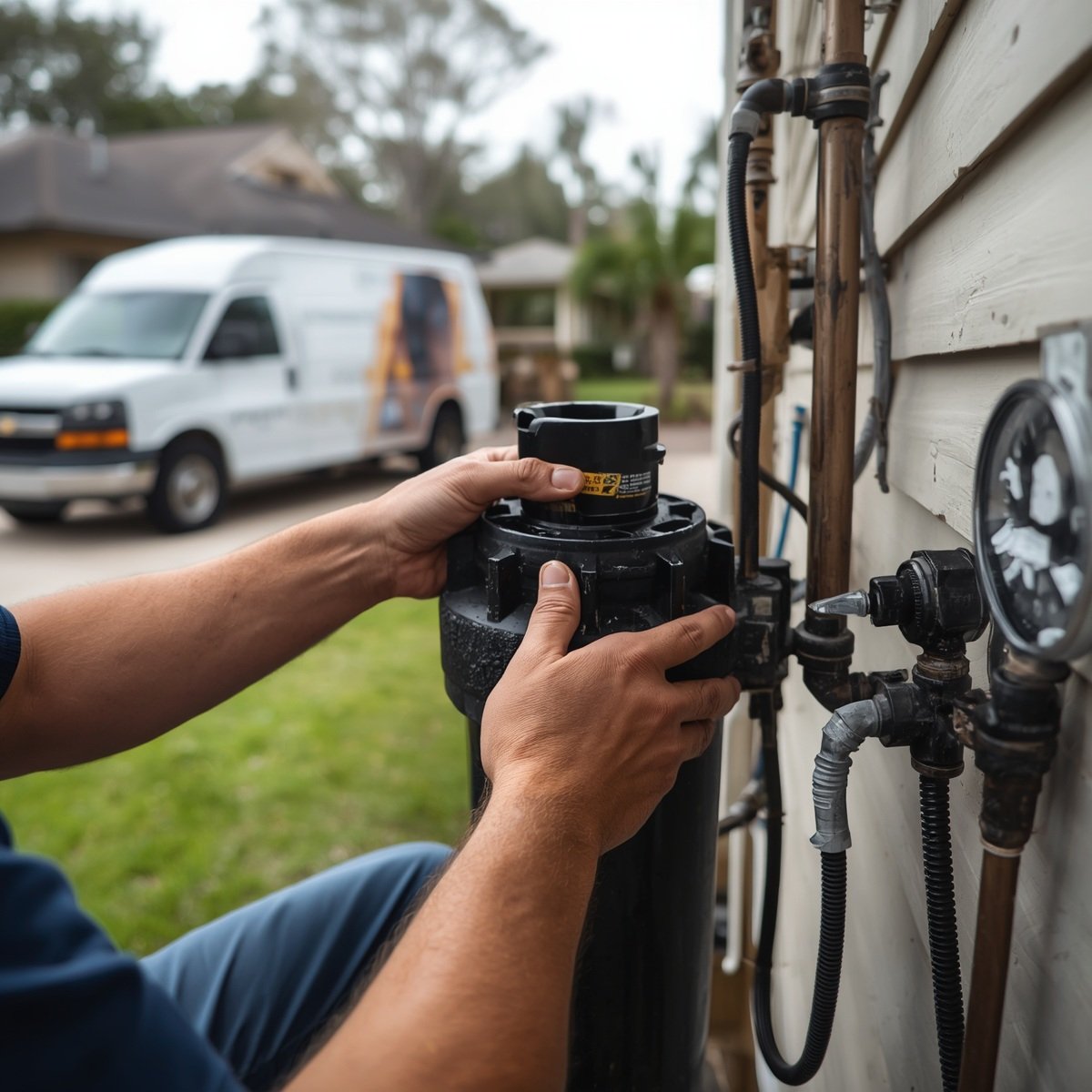

Sediment Filter Replacement in Gainesville and Across North Florida
FL Water Well Contractor License #5016 · FGWA · NGWA · NCFWA Member · Google 5.0 Rated · Wisetack Financing


If your fixtures are running gritty, your filter housing is leaking, or you have no idea when your cartridge was last changed, you are on the right page. Whole-house sediment filtration is the basic water-quality service every Floridan Aquifer well system needs. Perry-Pump Repair Service installs the housing, sizes it correctly to your water, and tells you the replacement interval. Most customers handle cartridge swaps themselves once we set it up; a few prefer we do it on a service call, and we will, but the expectation at install is customer-handled refills.
Perry-Pump Repair Service is a family-owned, state-licensed well pump shop in Gainesville, serving 17 communities across Alachua, Union, Bradford, Columbia, Suwannee, Putnam, Clay, Baker, and Gilchrist counties. Eric Perry is a 3rd-generation water well specialist; the Perry family has worked North Florida wells for more than 50 years. Whole-house installations run about $550. Cracked or leaking housings are usually done in the same visit. No service call fee, no diagnostic charge on routine residential.
Call (352) 320-2412 Mon-Fri 8 AM - 5 PM. After hours, leave a message, and we'll return the call at our earliest availability.
FREE SERVICE CALL
$0 service-call fee + $0 diagnostic on routine residential work.
Bypass Valve Standard
Lets you change cartridges without shutting off the whole house.
About $550 Installed
Whole-house Pentek or Big Blue housing + cartridge + connections.
17 North Florida Cities
Gainesville HQ to Lake Butler, Starke, Newberry, Lake City, and beyond.
Sized to Your Water
10-inch standard or Big Blue 20-inch on heavy sediment/iron loads.
FDEP-Licensed #5016
Fully state-licensed Water Well Contractor - public registry.
Three Reasons a Sediment Filter Stops Doing Its Job, and What Each One Means
Across 15+ years of personal experience and three Perry-family generations of wells, almost every sediment-filter call we get traces back to one of three things. Two of them are normal end-of-life; the third means the system was sized wrong from the start.
Cartridge plugged with sediment (the normal end-of-life mode).
Pressure drops noticeably across the filter; flow at the fixtures slows; the downstream pressure gauge reads lower than the upstream gauge by 10 PSI or more. In North Florida's iron-heavy water, this happens every 6 to 12 months on a correctly sized whole-house filter. Most customers handle it themselves: shut the bypass, unscrew the sump, swap the cartridge, restart. We tell you the interval at the time of installation. A handful of customers prefer we handle the swap on a service call, and we will combine it with another visit when we can.
Housing crack or O-ring failure (the leak mode).
Plastic housings crack with age, freeze damage in an unprotected well house, over-tightening at the sump threads, or UV exposure when mounted outdoors. The O-ring at the sump-to-cap joint fails after years of cartridge changes. It gets compressed, cut, or pinched. Either way, you get a slow leak around the housing, usually a steady drip at the seam. Replacement housing or a fresh O-ring is typically a same-visit, few-hundred-dollar repair.
Wrong micron rating or housing size for the water (the design issue).
A 5-micron polish cartridge in heavy iron and silt water clogs in weeks instead of months. A standard 10-inch housing on a property with high sediment load needs constant attention. If you find yourself changing cartridges every few weeks, the system was sized wrong, not failing. Diagnostic is a system audit: we look at flow rate, household demand, current cartridge type and micron rating, water test results, and we resize to a 20-inch Big Blue or a dual-stage layout.

Symptoms and Failures We See Across the Service Area
If any of these sound like what you are dealing with, call us. A lot of filter questions get answered on the phone before we drive out. Sometimes, a photo of the current housing and a quick description of the water is enough to point you in the right direction.
-
• Pressure drop across the filter (upstream gauge reads higher than downstream)
• Weak flow at fixtures that was fine a few months ago
• Pressure recovers when you bypass the filter housing
• Shower flow is weak, even with a full pressure tank
• Cartridge looks dark, packed, or matted when you pull the sump
-
• Slow drip at the sump-to-cap O-ring seam
• Hairline crack visible on the housing body or sump
• Sump threads cross-threaded or stripped from over-tightening
• Freeze damage to the housing after a cold snap
• Bypass valve leaking or stuck

-
• Cartridge clogging every 4 to 6 weeks instead of every 6 to 12 months
• Reddish-brown stain on fresh white cartridge - the iron load the filter can't handle
• Black or gray slime on cartridge - sulfide bacteria, not particulate
• White scaling on fixtures even with filter in service - hardness, not sediment
• Fixtures still running gritty after a fresh cartridge
-
• Customer never told what interval to replace at
• No bypass valve installed - the whole house has to shut off to change a cartridge
• No spare cartridges stocked; replacement takes a special trip
• Storm-related sediment spike after a tropical storm passes
• Cartridge brand and micron rating unknown to the homeowner
What Actually Happens When You Call About a Sediment Filter
From the phone call to the final invoice, here is the path most filter customers walk. The big decision happens early (housing size and cartridge spec), so we spend time on the water-chemistry conversation up front.
Phone diagnostic + water-chemistry conversation.
Call (352) 320-2412 Mon-Fri 8 AM - 5 PM. We will ask about staining, smell, scaling, current filter setup (if any), how often you have been changing cartridges, and whether you have had a water test in the last few years. A free water test is on the table when the symptoms point to iron, sulfide, or hardness rather than particulate. After hours, leave a message; we return at our earliest availability.
Schedule + parts on the truck.
Most sediment installs land within the same week. Pentek and Big Blue housings, common 10-inch and 20-inch cartridges in string-wound, spun, and pleated formats, bypass valves, and standard plumbing fittings ride on the truck, so the installation is one visit.
On-site water-system walk - no service-call fee.
We arrive in a marked Perry-Pump truck and walk the pressure tank, switch, wellhead, and current filter setup (if any). Quick look at the cartridge condition, the housing seals, and the existing micron rating. If symptoms suggest iron, sulfide, or hardness rather than sediment, we say so straight. Sediment filtration handles particulate, not dissolved chemistry.
Plain-language quote on the spot.
Whole-house sediment installation is about $550 with housing, cartridge, bypass valve, and plumbing connections. Cracked housing replacement is typically a few-hundred-dollar same-visit job. System resize to Big Blue 20-inch adds parts plus labor. Prices are subject to change because our suppliers have been very volatile with pricing lately.
Install with a bypass valve - same visit on most jobs.
Whole-house housing mounts on the supply line downstream of the pressure tank. A bypass valve is installed standard on every job, so you can change cartridges without shutting off the whole house. Pressure-tested at installation, we run a fixture and confirm flow before we pack up.
Replacement interval written down + cartridge stock recommendation.
Before we leave, we tell you the interval to plan on: 6 to 12 months, typical for our water, sometimes shorter for heavy iron and sediment loads. We recommend keeping one or two spare cartridges in the well house so the swap takes 10 minutes when the time comes. If you would rather we handle the swaps, we will set up a reminder and combine it with your next pump-system check.
Follow-up + cross-sell when chemistry needs treatment.
If the water test shows iron, sulfide, or hardness above what a sediment filter can handle, we will quote a treatment add-on: iron removal, softener, or sulfide neutralizer upstream. The sediment filter still does its job; the treatment handles the chemistry.
Sediment Filter Pricing: What Things Cost
Every install is different. Housing size, cartridge spec, and mount location all move the number. Ranges below are accurate as of writing; we will quote the current number on the call. Routine residential diagnostic is free.
Diagnostic
$0 service call fee + $0 diagnostic charge on routine residential calls. The filter-system audit (housing, cartridge condition, micron rating, water-chemistry review, and recommendation) is part of the visit, not a separate line item.
Whole-house sediment filter install (the core service)
Whole-house sediment filter install (Pentek or Big Blue housing + initial cartridge + bypass valve + plumbing connections): about $550
Dual-stage layout (coarse 50-micron + polish 5-micron in series): adds a second housing and connections.
Housing replacement (cracked, leaking, or freeze-damaged)
Replacement housing same brand and size: a few hundred dollars, same-visit range typical
O-ring + cap-seal replacement only: lower end - we keep O-rings stocked
System resize and treatment cross-sell
Upgrade from 10-inch to Big Blue 20-inch (chronic clogging on heavy-sediment water): housing + connections + labor
Free water test on suspected iron, sulfide, or hardness symptoms
Water treatment quote (iron removal, softener, sulfide neutralizer): separate quote, since sediment filtration does not fix dissolved chemistry
Cartridge replacement service call (when you prefer we do it)
Cartridge cost per swap: a few dollars per cartridge
Service-call labor: standard residential rate - we combine with another visit when we can
Wisetack financing on larger combined treatment + filter packages. Application takes minutes; terms are shown before you sign. Military and first-responder discounts case-by-case by scope; ask when you call. Prices are subject to change because our suppliers have been very volatile with pricing lately.
Our Reviews

Why homeowners choose Perry-Pump
Fully licensed and insured. Florida Water Well Contractor License #5016.
Experienced well repair specialists. Third generation, 50+ years working North Florida wells.
Quality workmanship and straightforward customer service.
Free service call and $0 diagnostic on routine residential work.
5-year parts and labor warranty on the Pressure Package and most residential submersibles, in writing on the invoice.
Seven North Florida Conditions That Shape How We Size and Service Filters
Working sediment filtration in North Central Florida means working around seven specific local conditions that do not apply the same way in other regions. These shape what size housing we install, what cartridge we recommend, and when we pivot the conversation to water treatment instead.
1
Floridan Aquifer wells dominate at 100 to 400 ft, with sediment load varying widely by depth
Almost every residential well in our footprint draws from the Floridan Aquifer at 100 to 400 ft. Sediment load varies widely. Some wells run nearly clear; others run gritty year-round. Depth, screened interval, and casing condition all move the load. We size it according to what the water actually carries, not a default.
2
Hurricane and tropical storm season (June to November) spikes sediment loads
Flooding can stir up source-water sediment and pack a cartridge faster than usual. Cartridges that were fine in May can be packed by September regardless of storms, so we recommend keeping one or two spares on hand year round.
3
Summer lightning peaks (related to filtration mainly through the bigger picture)
Lightning, age, and normal wear take out control boxes and switches more often than they touch filters directly. Either way, a filter swap is a chance to eyeball the tank, switch, and wellhead, too, so nothing gets missed.
4
Karst geology and casing shifts can change sediment loads suddenly
North Florida sits on karst limestone. When slow subsidence opens new pathways or shifts the casing, sediment load at the wellhead can change suddenly. A system that ran fine for years starts pushing grit. That is a wellhead inspection conversation, not just a filter swap. We look at both.
5
Iron, sulfide, and hardness: the chemistry sediment filtration does not fix
Most North Florida wells produce water with measurable iron (reddish staining), sulfide (rotten-egg smell), and hardness (white scaling). A sediment filter handles particulate matter (silt, fine sand, rust flakes), not dissolved iron, sulfide, or hardness. If your fresh white cartridge turns orange-brown in days, the issue is iron, and you need treatment upstream. We say so straight, run a free water test, and quote treatment rather than a bigger filter.
6
Fire ants in pump-control hardware (related but not directly a filter issue)
Fire ants find unsealed conduit at the wellhead and pressure switch, the #1 cause of sudden switch failures in our footprint. Filters live indoors, so ant pressure is lower, but the same site visit lets us check pest entry at the wellhead.
7
Flood-zone properties along Suwannee, Santa Fe, St. Marys, and Bradford/Baker rural lots
Flood-zone properties carry two filter-relevant risks: increased sediment load post-flood, and contamination that a sediment filter does not address. We recommend a cartridge replacement plus a sanitary inspection at the wellhead. The filter swap alone is not the whole answer when surface water reaches the seal.
Seven Technical Topics Where Most Filter Installs Pick a Default
Seven places where the easy answer is not the right one. One-line take? Call us. The actual reasoning is here.
-
Coarser (50-micron) catches sand and visible silt; finer (5-micron) polishes out fines that would otherwise reach the fixtures. Standard play on heavy or iron-bearing water is a 50-micron coarse upstream + 5-micron polish downstream. Coarse takes the load, polish takes what is left. Drop a 5-micron into heavy sediment water, and you clog in weeks; run only a 50-micron and fines pass through.
-
String-wound is the workhorse: fiber over a core, good for general sediment at low cost. Spun (melt-blown) is dense polypropylene with a consistent micron rating, good for fine particulate, but with a lower dirt-holding capacity. Pleated cartridges have many times the surface area, last longer between changes, and cost more. They are the right call on heavy-sediment applications where you would otherwise swap monthly.
-
Standard 10-inch housing is the default residential install. It handles typical household flow (8 to 10 GPM) and typical sediment load. Big Blue 20-inch has about four times the cartridge volume, handles higher flow without pressure drop, and lasts much longer on heavy-sediment water. The trade-off is cost and mounting space. We upgrade when the water audit says we should, not by default.
-
Whole-house filtration installs downstream of the pressure tank, before anything else, protecting the water heater, washing machine, irrigation valves, and every fixture. Point-of-use sits at a single fixture (kitchen sink, fridge) and only protects that one. Whole-house is the default; point-of-use is an add-on for drinking polish.
-
Sediment filtration handles particulate matter. It does not remove dissolved iron, hydrogen sulfide, or hardness. Reddish-brown stain, rotten-egg smell, or white scaling are treatment problems, not filter problems. We are direct about the boundary, run a free water test, and quote the right treatment upstream.
-
A bypass valve lets you change the cartridge without shutting off the whole house. Three-valve bypass is the cleanest: one inlet, one outlet, one bypass between. We install bypass valves on every whole-house system as standard practice. Skipping it to save a few dollars makes every future swap a hassle.
-
Indoor mount in a heated utility room is the gold standard. Well-house mount works if freeze-protected with insulation or heat tape; an unprotected well house in a cold snap will crack a plastic housing. Outdoor mount adds UV degradation, and housings get brittle over a few years. Freeze protection is the bigger risk.
Frequently Asked Questions
-
Whole-house sediment install is about $550 with housing, initial cartridge, bypass valve, and plumbing connections. Big Blue 20-inch upgrades for heavy-sediment water are at the upper end of the range. Cracked housing replacement is typically a few-hundred-dollar same-visit job. Prices are subject to change because our suppliers have been very volatile with pricing lately.
-
6 to 12 months, typical in North Florida water. Some properties run shorter intervals (heavy iron, heavy silt loads); some run longer (clean water and lower household demand). We tell you the interval at install and recommend stocking one or two spare cartridges in the well house, so the swap takes 10 minutes when the time comes.
-
Yes, and most customers do. Shut the inlet, open the bypass, unscrew the sump (the supplied wrench helps), pull the old cartridge, drop in the new, lubricate the O-ring lightly if it looks dry, screw the sump back on hand-tight, reverse the bypass. A few customers prefer we do it on a service call; we will combine it with another visit when we can.
-
Depends on flow rate, household demand, and sediment load. Standard 10-inch housing with a 5-micron or 20-micron cartridge handles typical residential water. Big Blue 20-inch with a 50-micron coarse is the right call on heavy-sediment or iron-bearing water. We size at install based on the water audit and your household demand, not a default.
-
No. Sediment filtration handles particulate matter (silt, fine sand, rust flakes), not dissolved iron, hydrogen sulfide, or hardness. If your water stains reddish-brown, smells like rotten eggs, or scales white on fixtures, those are treatment problems and need a separate iron-removal system, sulfide neutralizer, or softener. We run a free water test and quote the right treatment when symptoms point that way.
-
Pentek and Big Blue cartridge housings are the industry standards for whole-house residential sediment filtration. Cartridges are string-wound, spun (melt-blown), or pleated, depending on what the water and the household demand call for.
-
Usually one of two things. The micron rating is too fine for the water. A 5-micron cartridge in heavy sediment will clog in weeks. Or the load is dissolved iron, not particulate, and the cartridge is carrying chemistry it was never designed for. We audit, size, and if the issue is iron, we quote upstream treatment rather than a bigger filter.
-
Workmanship parts AND labor for the term on the invoice. Housing manufacturer warranty is covered separately by the manufacturer (Pentek and Big Blue both stand behind their housings). Cartridges are consumables - not under warranty - that's the swap-interval conversation. Always in writing, explained up front.
-
17 communities: Gainesville (HQ), Lake Butler, Lake City, Alachua, Newberry, High Springs, Starke, Keystone Heights, Branford, Trenton, Waldo, Hawthorne, Glen Saint Mary, Bell, Brooker, Raiford, and Melrose. Not sure if we serve your community? Call (352) 320-2412, and we will tell you straight.
-
Yes, through Wisetack on larger combined treatment + filter packages. Application takes minutes, terms shown before you sign. We do not push financing on a standalone $550 filter install; for treatment + filter packages where the total runs higher, it is a real option.
Ready for Cleaner Water? Call Perry-Pump Today.
Whether you need a fresh whole-house install, your housing is cracked and leaking, or you are tired of changing cartridges every few weeks because the system was sized wrong from the start, call (352) 320-2412 and we will get you on the schedule. Routine residential work has no service call fee, no diagnostic charge, and the workmanship warranty goes on the invoice before you sign.