

Constant Pressure Systems in Gainesville and Across North Florida
FL Water Well Contractor License #5016 · FGWA · NGWA · NCFWA Member · Google 5.0 Rated · Wisetack Financing
If your shower pressure drops every time the dishwasher runs, your irrigation lines pulse at startup, or you have been told you need "constant pressure" without anyone explaining what that actually means, you are on the right page. There are three paths to constant pressure: a traditional pressure switch, a Cycle Stop Valve, or a variable frequency drive (VFD). The right answer depends on the equipment and the application; it is not one-size-fits-all. Perry-Pump Repair Service is a family-owned, state-licensed well pump shop based in Gainesville, serving 17 communities across Alachua, Union, Bradford, Columbia, Suwannee, Putnam, Clay, Baker, and Gilchrist counties. Eric Perry is a 3rd-generation water well specialist; the Perry family has been working North Florida wells for more than 50 years.
For whole-home constant pressure on submersibles, we install Franklin SubDrive and Grundfos VFDs, the two electronic drives we stand behind. For irrigation and small pressure fluctuations, we install a Cycle Stop Valve (CSV), the right mechanical answer when a VFD is overkill. We do not install AquaVar drives. Diagnosis happens on the phone in most cases. No service call fee, no diagnostic charge on routine residential work.
Call (352) 320-2412 Mon. - Fri. 8 AM - 5 PM. After hours, leave a message, and we will return the call at our earliest availability.
FREE SERVICE CALL
$0 service-call fee + $0 diagnostic on routine residential work.
Sizing Math Run on Site
HP, flow at depth, voltage - a mis-sized drive trips or burns up.
Right Tool for the Job
VFD for whole-home; CSV for irrigation; honest math behind every quote.
17 North Florida Cities
Gainesville HQ to Lake Butler, Starke, Newberry, Lake City, and beyond.
Drives We Stand Behind
Franklin SubDrive and Grundfos VFDs - we do not install AquaVar.
FDEP-Licensed #5016
Fully state-licensed Water Well Contractor - public registry.
Three Failure Modes That Drive Most Constant Pressure Calls
Across 15+ years of personal experience and three Perry-family generations of wells, almost every constant-pressure trouble call traces back to one of three things. Two are component-level failures; the third is a system mismatch that no part swap can fix.
VFD electronics failure (usually post-lightning).
Electronic drives are sensitive to power surges, and North Florida lightning makes this the most common drive failure we see. A nearby strike surges the controller and takes out the inverter, rectifier, or logic board. Diagnostic: drive shows a fault code or stays dark, pump will not modulate. Replacement is typically a same-week job once parts are confirmed.
Mechanical wear in a Cycle Stop Valve (CSV).
CSVs are mechanical, with a spring-loaded valve that throttles flow before the tank to hold steady pressure. Spring wear, internal seal wear, or a sticky valve stem all show up as pressure that no longer holds steady. The classic symptom is a creeping pressure drop over months instead of sudden failure, often paired with the pump starting to short-cycle. The fix is a CSV rebuild or replacement, which is meaningfully less invasive than a VFD repair.
Pump-drive mismatch (the wrong tool for the job).
A VFD sized wrong for the pump, or a CSV used to mask undersized-tank issues, will short-cycle the pump or trip on overload, no matter how many times you swap parts. We see this when customers install a drive themselves or hire a generalist who does not run the math. Diagnosis is a system audit, not a part swap.
Symptoms and Failures We See Across the Service Area
If any of these sound like what you are dealing with, call us. Most constant-pressure diagnoses happen on the phone before we ever drive out.
-
• Shower pressure drops sharply when the dishwasher or washer starts
• Two-bathroom morning showers fight each other for pressure
• Pressure surges high then drops low within seconds
• Large home with three or more occupants and persistent pressure complaints
• Existing submersible is the right pump, but the system needs to modulate, not cycle
-
• Sprinkler heads pulse at zone startup
• Drip lines surge then settle every cycle
• Small pressure fluctuations on a system that doesn't need a full VFD
• Horse property, small acreage, or single-zone irrigation lateral

-
• Drive controller dark, no display, breaker tripped
• Fault code displayed on the controller after a thunderstorm
• Drive starts, runs for seconds, then faults out
• Pump runs full-speed all the time (drive bypassed itself)
• Burnt-electronics smell at the controller enclosure
-
• Pressure creeps down by a few PSI per month
• Valve audibly chatters at low flow
• External leak at the valve body or fitting
• Pressure stays high, but flow rate drops
What Actually Happens When You Call About Constant Pressure
From the phone call to the final invoice, here is the path most constant-pressure customers walk. The first decision is not "VFD or CSV." The first question is "Do you actually need either one?" We try to do as much of that thinking as we can before we drive out.
Phone diagnostic - VFD, CSV, or tank-and-switch.
Call (352) 320-2412 Mon-Fri 8 AM - 5 PM. Three or four questions (what is the actual symptom? whole-home or irrigation? what is the existing pump and tank? did this start after a storm?) narrow the right tool before we drive out. After hours, leave a message; we return at our earliest availability.
Schedule + en-route notification.
Most constant-pressure quotes and drive failures land within the same week, same day if we are already in your area. Post-lightning drive failures move to the top. We will text or call en route.
On-site system audit - no service-call fee.
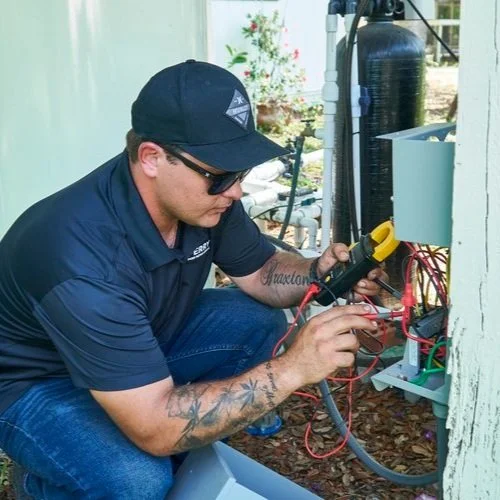
We arrive in a marked Perry-Pump truck and walk the wellhead, drive enclosure (if one is installed), tank, switch, and panel. For a new installation, we measure pump HP, well depth, voltage, and tank pre-charge. For a failed drive, we test input voltage, output voltage, and motor cable insulation before pulling anything. Routine residential diagnostics are no charge.
Honest "do you need this" recommendation.
If your symptom is a $300 switch replacement, that is the quote. If a waterlogged tank, that is the quote. Drives represent a real investment: $4,000 to $5,000 added on a VFD retrofit, a full new system with VFD around $9,000 to $10,000 starting. A CSV install is meaningfully less. We tell you straight which tool fits.
Install or replace
sizing math run on the spot. VFD installs include HP match, flow-at-depth verification, voltage check, motor cable sizing, and tank pre-charge to spec. CSV installations include flow-rate verification and pressure-setting on the valve. Drive replacements on existing systems get the surge-protection conversation, since North Florida lightning is real. Prices are subject to change because our suppliers have been very volatile with pricing lately.
Written warranty + commissioning paperwork.
Everything goes on the invoice before you sign. Most residential submersible systems with VFDs: 5-year parts and labor on the system; the drive itself carries its own manufacturer warranty layered on top. CSV installs carry a 1-year parts + labor warranty on the valve with a manufacturer warranty layered on top. Wisetack terms are shown before signing.
Follow-up - call us first if anything's off.
call us first if anything is off. Pressure swing returned, drive faulting, valve chattering, or any warranty question after the visit, call us first. We answer warranty calls same-day on average; a small drive issue caught fast is cheaper than a burnt motor or fried controller later.
Constant Pressure System Pricing: What Things Cost
Every constant-pressure decision is different. Whether the existing pump and tank stay, what brand drive fits the application, and whether new wiring or surge protection is part of the scope, all move the number. Ranges below are accurate as of writing; we will quote the current number on the call. Routine residential diagnostic is free.
Diagnostic
$0 service call fee + $0 diagnostic charge on routine residential calls. System audit, drive fault-code read, and sizing math are part of the visit, not a separate line item.
VFD retrofit on an existing submersible system
Franklin SubDrive or Grundfos drive added to a working base submersible install: $4,000-$5,000 add-on
Drive + new tank + new switch + sizing math (full pressure-system upgrade): mid to upper end of the retrofit range
Surge protection at the wellhead (inline device + dedicated grounding): quoted with the drive
Drive-only replacement after lightning damage (existing wiring intact): quoted per drive model
Cycle Stop Valve installation on existing system
CSV install on a working tank-and-switch system: call for quote - depends on existing setup
CSV is meaningfully less than a VFD retrofit; the right tool for irrigation and small fluctuations
Includes flow-rate verification, valve pressure-setting, and leak-check at full pressure
Full new submersible system with VFD
Submersible pump + drop pipe + drive + install + reset pressure: roughly $9,000-$10,000 starting
The math: $5,000 base submersible system + $4,000-$5,000 drive add-on
Whole-home or large-property new construction installs land at the upper end
Related work that often pairs with a constant-pressure decision
Pressure tank replacement (drives still need a small tank, sized to your system, not a default model): from ~$1,000 installed
Pressure switch replacement when paired with the drive install: a few-hundred-dollar range parts + labor
Wellhead extension + cap-and-seal sanitary repair (when drive enclosure needs to come above flood elevation): $1,600-$2,400
Control box capacitor works on the existing pump (if lightning hits the whole system): under $500 typical
Wisetack financing on larger jobs (minutes to apply, terms before you sign). Military and first-responder discounts case-by-case by scope; ask when you call. Prices are subject to change because our suppliers have been very volatile with pricing lately.
Our Reviews
Why homeowners choose Perry-Pump
Fully licensed and insured. Florida Water Well Contractor License #5016.
Experienced well repair specialists. Third generation, 50+ years working North Florida wells.
Quality workmanship and straightforward customer service.
Free service call and $0 diagnostic on routine residential work.
5-year parts and labor warranty on the Pressure Package and most residential submersibles, in writing on the invoice.
Seven North Florida Conditions That Shape Drive Choice and Drive Lifespan
Working constant-pressure systems in North Central Florida means working around seven specific local conditions that do not apply the same way in other regions. These shape the tools we recommend, how we install them, and how often we see them fail.
1
Floridan Aquifer wells dominate at 100 to 400 ft
Almost every residential well in our footprint draws from the Floridan Aquifer at 100 to 400 ft. Submersible systems dominate at those depths, which is where VFDs make the most sense. Jet systems and shallow setups usually take a CSV or stay on a traditional switch.
2
Hurricane and tropical storm season (June to November) hits drive electronics
Storm season damage is not just downed lines. When power comes back after an outage, the surge and the cycling can stress drive electronics, and we see a spike in drive faults two to six weeks after a named storm. We diagnose and replace drive components the same way year round, whether the cause was a storm or ordinary wear.
3
Summer lightning peaks in July and August, and VFD drive failures spike
Electronic drives are sensitive components. Direct lightning strikes are rare; nearby strikes that surge the power line can take out drive inverters, rectifiers, and logic boards, same as age and electrical faults can. Surge protection at the wellhead reduces but does not eliminate the risk, and we recommend it on every new drive install. If your drive stopped working, the controller is one of the first things we check.
4
Karst geology and casing shifts change well drawdown profiles over time
North Florida sits on karst limestone. Over the years, subsidence and water-table shifts change how much a well draws down between cycles. A system that worked fine on a traditional switch for years can develop pressure-swing symptoms as the drawdown profile shifts. Sometimes the right answer is to add a VFD, not because the pump failed, but because the well now needs modulation.
5
Iron, sulfide, and hardness stress CSV internals more than VFDs
Most North Florida wells produce water with measurable iron (reddish staining), sulfide (rotten-egg smell), and hardness (white scaling). The chemistry accelerates wear on mechanical CSV internals: spring fatigue, seal degradation, valve-stem buildup. VFDs do not touch the water at all and are not affected the same way. On heavy-chemistry wells, we factor that into the recommendation.
6
Fire ants in switches and conduit get into drive enclosures, too
The same North Florida pest pressure that fouls pressure-switch contacts gets into drive enclosures and CSV conduit fittings. A lineman told Eric years ago that insects are attracted to the frequency in the pump wiring. We install pest-blocking foam in every conduit penetration and silicone every opening on drive installs.
7
Flood-zone properties drive enclosure-elevation decisions
Suwannee, Santa Fe, and St. Marys river basins, plus lower-elevation rural lots, sit in FEMA flood zones. Drive electronics must be sited above flood elevation. Submerged controllers are a write-off. Sometimes the constant-pressure decision drives a wellhead-extension recommendation, too.
Seven Technical Topics Where Drive Choice Actually Matters
Seven places where the easy answer is not the right one. One-line take? Call us. The actual reasoning is here.
-
Traditional switch is the default: cheapest, cycles between cut-in and cut-out PSI, fine for most homes. CSV is mechanical and throttles flow before the tank, ideal for irrigation. VFD is electronic and modulates pump speed to hold a target pressure across any flow rate, ideal for whole-home constant pressure. We use VFDs for whole-home, CSV for irrigation. No one-size-fits-all.
-
Eric's locked stance: We do not install AquaVar drives. Franklin SubDrive and Grundfos drives are what Eric stands behind based on field experience and warranty fulfillment. Brand discipline matters on a $5,000 drive that has to live through North Florida lightning seasons.
-
Three numbers have to match: HP rating, flow at depth, and input voltage. A drive rated for a 1 HP pump will not carry a 1.5 HP load. It trips on overload within minutes of first run. A drive sized too big runs the pump hot at the low end of its speed range. We run the math before we quote, not after we install.
-
A Cycle Stop Valve throttles the flow before the tank to hold steady pressure. It is not a substitute for a properly sized pressure tank. You still need a tank. It is not the right tool for whole-home constant pressure in a busy household. A VFD does that better. It IS the right tool for irrigation pulse smoothing and small-fluctuation correction.
-
Customers are sometimes told that a VFD eliminates the pressure tank. That is not accurate. A small tank (typically 2-4 gallons) is still required to absorb micro-cycles and prevent the drive from hunting at zero flow. The tank just gets a lot smaller. Any customer who is told "no tank needed" is being given bad information.
-
North Florida lightning makes whole-system surge protection a real conversation for any electronic drive install. Inline surge devices at the drive input, dedicated grounding, and a whole-house surge protector at the main panel together reduce risk significantly. Direct strikes win every time, but layered protection tilts the odds.
-
Before pulling any pump, we test the drive in place. Fault code on the controller, input voltage at the drive input, output voltage at the motor terminals during a forced start, and motor cable insulation with a megger. That ladder rules out drive vs cable vs motor without an unnecessary pump pull.
Frequently Asked Questions
-
A pressure system that holds output pressure steady across changing demand, so the shower does not drop when the dishwasher starts. Two main approaches: an electronic variable frequency drive (VFD) that modulates pump speed, or a mechanical Cycle Stop Valve (CSV) that throttles flow before the tank. Traditional pressure switches just cycle the pump on and off between cut-in and cut-out PSI. Not truly constant.
-
Depends on the equipment and the application. Whole-home constant pressure on a busy household with multiple fixtures: VFD (Franklin SubDrive or Grundfos). Irrigation pulse smoothing or small-fluctuation correction: CSV. Sometimes the right answer is neither, and a properly sized tank-and-switch combo is all you need. We tell you straight on the phone.
-
VFD retrofit added to an existing submersible system: $4,000-$5,000 add-on. Full new submersible system with VFD: roughly $9,000-$10,000 starting. CSV install on existing system: meaningfully less than a VFD retrofit (call for quote, depends on the existing setup). Prices are subject to change because our suppliers have been very volatile with pricing lately.
-
Franklin SubDrive and Grundfos VFDs for electronic constant pressure. Cycle Stop Valve for mechanical. We do not install AquaVar drives. Franklin and Grundfos are what Eric stands behind based on field experience and warranty fulfillment.
-
No. A small tank (typically 2-4 gallons) is still required to absorb micro-cycles and prevent the drive from hunting at zero flow. The tank just gets a lot smaller. The storage role shifts to the drive, but the cushion role stays with the tank. Any customer who is told "no tank needed" is being given bad information.
-
A nearby lightning strike surged the power line and took out the drive electronics: inverter, rectifier, or logic board. Electronic drives are the most lightning-vulnerable component at the wellhead. Surge protection at the wellhead reduces but does not eliminate the risk. A whole-house surge protector at the main panel layered on top tilts the odds further.
-
Generally, yes. A CSV install on an existing system is meaningfully less than a VFD retrofit. But cost is not the only deciding factor. A CSV used on the wrong application (whole-home constant pressure on a busy household) will not deliver what the customer expects. We pick the right tool first, then talk about cost.
-
Most residential submersible systems with VFDs: 5-year parts and labor on the system; the drive itself carries its own manufacturer warranty layered on top. CSV installs carry a 1-year parts + labor warranty with a manufacturer warranty layered on top. All warranties go in writing on the invoice before you sign.
-
17 communities: Gainesville (HQ), Lake Butler, Lake City, Alachua, Newberry, High Springs, Starke, Keystone Heights, Branford, Trenton, Waldo, Hawthorne, Glen Saint Mary, Bell, Brooker, Raiford, and Melrose. Not sure if you are in our footprint? Call (352) 320-2412, and we will tell you straight.
-
Yes, through Wisetack on larger jobs. Application takes minutes, terms shown before you sign. We do not push financing on a small CSV install; for VFD retrofits and full new systems with drives, it is a real option.
Ready to Solve the Pressure Problem? Call Perry-Pump Today.
Whether your morning showers fight the dishwasher, your sprinklers pulse at startup, or your existing drive went dark after a thunderstorm, call (352) 320-2412, and we will get you on the schedule. Routine residential work has no service call fee, no diagnostic charge, and the warranty goes on the invoice before you sign.