
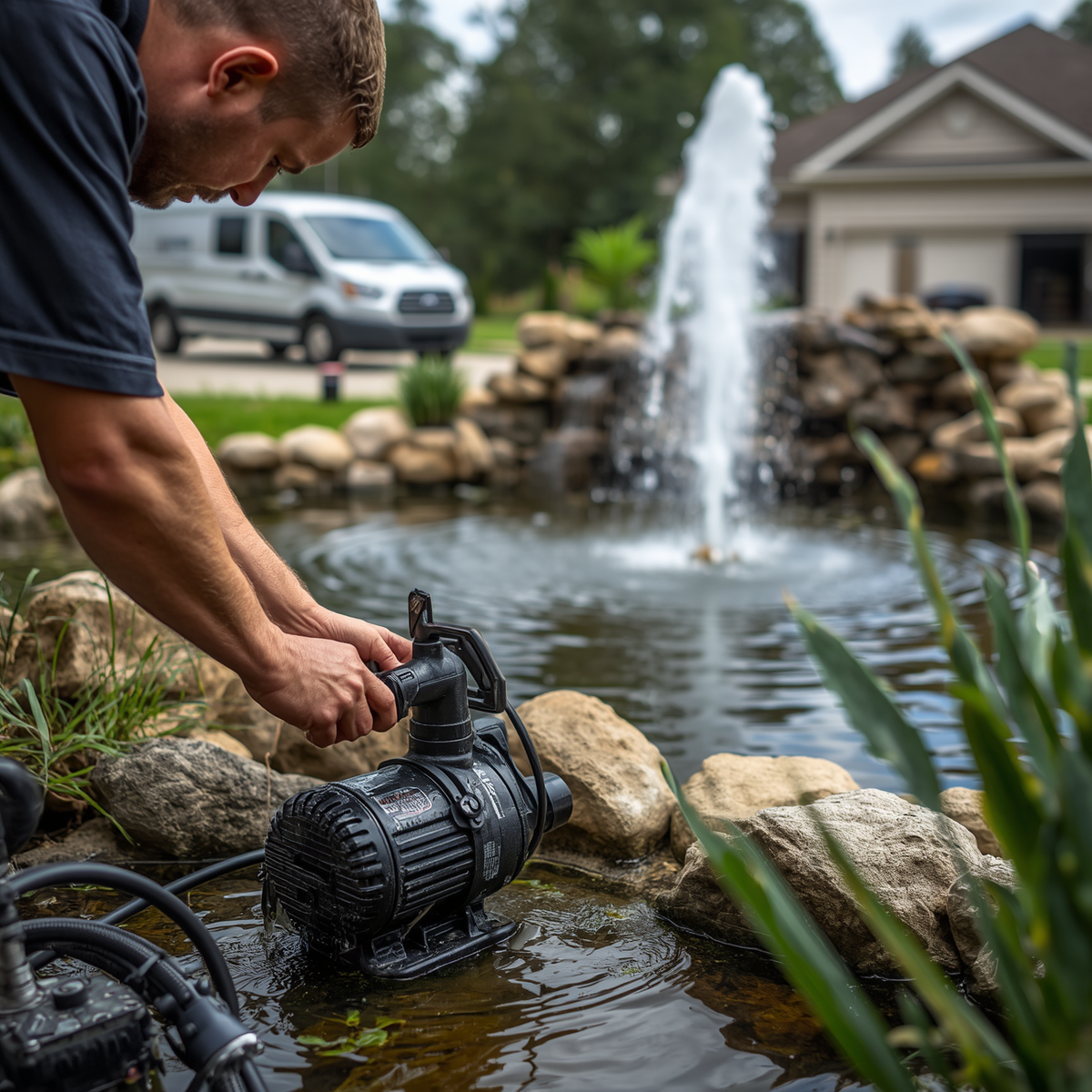

Pond Pump Repair in Gainesville and Across North Florida
FL Water Well Contractor License #5016 · FGWA · NGWA · NCFWA Member · Google 5.0 Rated · Wisetack Financing


If your koi pond pump will not move water, your backyard water feature has gone quiet, or the aerator pump on your small-acreage pond shorted out after a summer storm, you are on the right page. Perry-Pump Repair Service handles pond pump repair and replacement for decorative residential ponds, water features, and small-acreage aerator pumps across 17 North Florida communities. We are a family-owned, state-licensed shop based in Gainesville. Eric Perry is a 3rd-generation water well specialist; the Perry family has worked on North Florida pumps for 50+ years.
Pond pumps are smaller and less expensive than well pumps, and that changes the math. When the motor is at the end, replacement often beats rebuild; motor seal labor can exceed the cost of a comparable new pump. We tell you which way the math runs up front. No service call fee, no diagnostic charge on routine residential work.
Call (352) 320-2412 Mon-Fri 8 AM - 5 PM. After hours, leave a message, and we'll return the call at our earliest availability.
Free Service Call
$0 service-call fee + $0 diagnostic on routine residential work.
Tubing + Fittings Too
Pond-side plumbing leaks diagnosed and repaired on the same visit.
Repair-vs-Replace Honesty
We tell you which way the math runs before the work starts.
17 North Florida Cities
Gainesville HQ to Lake Butler, Starke, Newberry, Lake City, and beyond.
Decorative + Aerator Pumps
Koi ponds, water features, and small-acreage aerator pumps.
FDEP-Licensed #5016
Fully state-licensed Water Well Contractor - public registry.
Three Failures That Drive Most Pond Pump Calls in North Florida
Across three Perry-family generations of pumps, almost every pond pump call we get traces back to one of three things. Two are usually same-visit fixes; one is the replacement-decision call.
Impeller fouled with debris: leaves, algae mats, snail shells.
The most common pond pump call in our market. Leaves, algae mats, snail shells, or plant matter wedge into the impeller blades or block the intake screen. The pump runs, but no water moves through the waterfall, fountain, or filter return. Usually a same-visit fix: clean the impeller, replace the intake screen, and add a coarse pre-filter. North Florida's warm-weather algae and biofilm load make this the dominant ongoing pond pump issue in our footprint.
Motor seal failure: water in the motor housing.
On submersible pond pumps, especially, the seal between the pump body and motor housing fails over time. Water enters the motor cavity, the windings short, and the pump will not start, sometimes tripping the GFCI before it goes silent. This is the replacement-decision call: on smaller pumps, the labor to pull, dry, reseal, and rebuild often exceeds the cost of an equivalent new pump. We quote both and tell you which way the math runs.
Tubing or fitting leaks in the pond-side plumbing.
The pump runs fine, but the water level keeps dropping, or the fountain stops flowing. The cause is almost always a cracked tubing connector or a split in the flexible line, usually at under-rock connections where stress concentrates. A diagnostic walk of the line finds the leak; the repair is same-visit in most cases.

Symptoms and Failures We See Across the Service Area
If any of these sound like what you're dealing with, call us. Most pond pump diagnoses start on the phone.
-
• No power at the outlet (GFCI tripped or breaker open)
• GFCI trips immediately when the pump is plugged in (motor seal failure)
• Motor hums but the impeller doesn't spin (seized impeller, jammed by debris)
• Capacitor failure on capacitor-start pond pumps (won't start under load)
• Outdoor cord damaged or chewed by rodents at the junction
• Wet plug-and-cord connector after heavy rain
• Internal motor winding short (often after extended underwater operation)
-
• Fouled impeller - leaves, algae mats, snail shells wedged in the blades
• Blocked intake screen - debris coating the mesh
• Kinked or pinched flexible tubing on the discharge side
• Broken or cracked fitting at the pump outlet
• Air-locked pump after the water level dropped below the intake
• Check valve stuck closed on systems that have one
• Pump installed below the recommended depth, so it has lost prime
-
• Tubing leak in the pond-side plumbing (we diagnose the pump side)
• Cracked tubing connector under the rock work or hidden plant cover
• Worn O-ring at the pump-to-tubing fitting
• Splash-out from a waterfall feature misaligned after a heavy storm
• Evaporation in mid-summer is mistaken for a leak (we confirm before quoting parts)
• Liner leak (out of our scope - we diagnose so you can call a pond builder)

-
• Bearing wear on older submersibles - whining or grinding noise
• Mis-mounted external pump on a soft surface - vibration transfer
• Debris in the housing knocking against the impeller
• Pump running dry intermittently - intake screen lifted out of water
• Cooling jacket fouled with biofilm on submersibles
• Cavitation from undersized intake plumbing
-
• Aerator drive motor seized or shorted
• Drive belt slipping or broken on belt-driven aerator units
• Intake screen clogged with algae or debris
• Diffuser or fountain nozzle plugged - pump fine, output blocked
• Outdoor controller wet or shorted after a storm
• Pump operating outside its design depth after the pond level changed
What Actually Happens When You Call About a Pond Pump
From phone call to final invoice, here is the path most pond pump customers walk. We narrow the cause on the call so the visit is short and the right decision gets made on repair vs replace.
Phone diagnostic - pump, plumbing, or aerator.
Call (352) 320-2412 Mon-Fri 8 AM - 5 PM. A few quick questions (does the pump run? Is water moving? Did the GFCI trip?) narrow the cause before we drive out. After hours, leave a message; we return at our earliest availability.
Schedule + en-route notification.
Most pond pump calls land within the same week. Storm-season failures and shorted aerator pumps move higher on the schedule because the fish biology matters: low oxygen is a real risk. We will text or call en route.
On-site diagnostic: pump pulled, intake checked, plumbing walked.
We arrive in a marked Perry-Pump truck and walk the system: pump body, intake screen, discharge tubing, junction box, and aerator if relevant. Routine residential diagnostics are no charge; we tell you what we are seeing as we look.
Honest repair vs. replace call on the spot.
Smaller pond pumps frequently make more economic sense to replace than to rebuild. We run the math out loud: replacement parts and labor for a motor seal job vs an equivalent new pump, factoring the warranty difference. No sales script. If a $40 impeller and a clean-out fix it, that is the quote. Prices are subject to change because our suppliers have been very volatile with pricing lately.
Repair or replacement on the same visit when stocked.
Impeller swaps, intake-screen replacements, tubing repairs, and most fitting work happen during the same visit. Pump replacement on common residential sizes usually lands within the same week. Specialty aerator units are sometimes ordered through the manufacturer.
Written warranty + final paperwork.
Workmanship parts + labor go on the invoice before you sign, for the term shown on the warranty matrix for that scope. We do not bury warranty language. It is on the page you sign. Wisetack terms are shown before signing on the rare larger combo jobs (pond pump + related well-system work).
Follow-up: call us first if anything is off.
Pump running unevenly, water level still dropping, or aerator output weak after the visit. Call us first. We answer warranty calls the same day on average; catching a small issue fast is less painful than a dead-fish call later.
Pond Pump Repair Pricing: What Things Cost
Pond pumps span a wider price range than well pumps: small fountain pumps and large koi-pond circulators sit at opposite ends of the catalog. Because of that range, pond pump pricing on this page is call-for-quote. We give a real quote on the call once we know the pump make, size, and what is wrong.
Diagnostic
$0 service call fee + $0 diagnostic charge on routine residential calls. The pump pull, intake-screen check, and plumbing walk are part of the visit, not a separate line item.
Pond pump repair (the core service)
Pond pump repair (impeller swap, intake cleaning, seal service): call for quote
Capacitor replacement on capacitor-start pond pumps: call for quote
Outdoor junction box or wet-connector repair: call for quote
Bearing or housing service on rebuildable larger pumps: call for quote
Pond-side plumbing and accessories
Tubing repair or splice on existing flexible line: call for quote
Fitting replacement (cracked connector, worn O-ring at pump outlet): call for quote
Intake screen replacement and pre-filter add-on: call for quote
Foot valve or check valve replacement: call for quote
Pond pump replacement (when repair isn't the math)
Residential pond pump replacement: call for quote - depends on North Florida flow rate, pump type, and brand
Aerator pump replacement on small-acreage ponds: call for quote
External pond pump swap (more accessible, common on larger systems): call for quote
Submersible pond pump swap (simpler, quieter, common on decorative features): call for quote
Wisetack financing on larger combined jobs (rare on pond pump work specifically, but the option exists when a pond pump pairs with a related well-system repair). Military and first-responder discounts case-by-case by scope; ask when you call. Prices are subject to change because our suppliers have been very volatile with pricing lately.
Our Reviews

Why homeowners choose Perry-Pump
Fully licensed and insured. Florida Water Well Contractor License #5016.
Experienced well repair specialists. Third generation, 50+ years working North Florida wells.
Quality workmanship and straightforward customer service.
Free service call and $0 diagnostic on routine residential work.
5-year parts and labor warranty on the Pressure Package and most residential submersibles, in writing on the invoice.
Seven North Florida Conditions That Shape Pond Pump Service
Working pond pumps in North Central Florida means working around seven local conditions that shape what we see fail, when, and what we recommend customers do between visits.
1
Well-fed ponds inherit Floridan Aquifer water chemistry
When the source water for a pond or decorative feature comes from a Floridan Aquifer well (common on rural properties), the iron, sulfide, and hardness load in the water transfers to the feature. Iron stains the rocks and accelerates impeller wear; hardness scales the pump body. We mention upstream treatment when we see the signs on the pump and intake.
2
Hurricane and tropical storm season (June to November) damages pond pumps and aerators
Flooding can wash debris into the pump body and short outdoor junction boxes, and a fish-stocked pond needs its aerator back online quickly no matter what caused the outage. We take pond emergency calls year round and treat a dead aerator with the same urgency whether a storm caused it or the controller simply wore out.
3
Summer lightning peaks: pond pump motors and aerator controllers are vulnerable to surge
Nearby lightning strikes that surge the power line can take out the capacitors on capacitor-start pond pumps and the controllers on electric aerator units, same as ordinary wear can. GFCI protection at the pond circuit reduces but doesn't eliminate the risk. If your pump or aerator stopped working, the controller and the capacitor are among the first things we check.
4
Karst geology and water-table shifts: mostly indirect on pond pumps
Karst affects well-system reliability more than pond pumps directly, but it does shift source-water levels on rural properties that fill a pond from a shallow well. When the source pump struggles, the pond pump can run dry intermittently and overheat. We check the source side when pond-side symptoms don't add up.
5
Iron, sulfide, and hardness in well-fed ponds shorten pump life
On any pond fed from a North Florida well, the chemistry that wears out well pumps wears out pond pumps too. Iron coats impellers; hardness scales the housing and seals; sulfide accelerates seal degradation. A pond pump on iron-heavy water lives toward the lower end of the residential lifespan range.
6
Algae and biofilm pressure in North Florida warm-weather season
Warm-weather algae and biofilm load are the dominant ongoing maintenance tasks on pond pumps in our market. Algae mats and biofilm clog intake screens, foul impellers, and coat the cooling jackets on submersibles. The customers who get the longest pump life are the ones who clean the intake screen on a regular schedule through the warm months. Pre-filters help; they don't eliminate the task.
7
Fire ants in pump junction boxes and aerator controllers
Same North Florida issue we see on well-system electrical: ants get into pump junction boxes and aerator controllers in the rainy season. They don't conduct well and can stop the controller from closing the circuit. We install pest-blocking foam in the conduit whenever we have the box open.
Seven Technical Topics Where Pond Pump Choice Actually Matters
Seven places where the easy answer is not the right one. The actual reasoning is here.
-
Black flexible tubing routes easily around rock work and is standard on most residential decorative ponds. Reinforced PVC handles higher pressure and lasts longer in sun-exposed runs. Thin-walled tubing fails at the fittings; under-rock connections are the typical leak point because they crush slowly over the years. We upgrade thin-walled runs when they will not hold a fresh clamp.
-
A coarse pre-filter ahead of the pump intake saves the impeller from leaves, snail shells, and plant matter. Mesh sizing is a trade-off: too coarse and debris reaches the impeller; too fine and the screen blocks fast and starves the pump. We size to the pond's debris load (heavy leaf cover = coarser pre-filter and more frequent cleaning), and we walk owners through clean-out intervals on the visit.
-
Florida code requires GFCI protection on outdoor wet-location circuits, including pond pumps and aerator controllers. The trip is the safety feature working, not always the pump failing. Common nuisance-trip causes: summer humidity in the receptacle, a wet plug-and-cord connector, and an aging GFCI. We check all three before quoting any pump work.
-
Rule of thumb: turn the pond volume over once per hour for a fish-stocked pond, less for a low-fish-load decorative feature. A 1,000-gallon koi pond requires approximately 1,000 GPH at the discharge head; a backyard fountain with no fish requires a smaller size. Oversized pumps waste energy and stress the plumbing; undersized pumps starve filtration and let algae take hold.
-
Submersibles drop into the pond, install simply, run quietly, and disappear visually, good for small to mid-size decorative ponds. External pumps sit dry, are more accessible for service, run cooler, and tend to last longer on larger systems. We pick by pond size, accessibility, and service-cycle preference.
-
Pond pump math is different from well pump math. The labor to pull, dry, reseal, and rebuild a smaller motor often runs more than the cost of an equivalent new pump, and the new pump comes with a fresh warranty. We tell you which way the math falls on your specific pump before any work starts.
-
Aerator pumps add dissolved oxygen by spraying water in a fountain pattern or injecting air through a diffuser. They keep fish alive in warm-weather, low-oxygen conditions and reduce algae a little by surface mixing. They do not correct water chemistry (pH, nitrate, hardness) and do not replace biological filtration. We repair existing aerator pumps; we do not install new pond aeration systems.
Frequently Asked Questions
-
Pond pump pricing is call-for-quote because residential pond pumps span such a wide catalog. We give you a real number on the call once we know the pump make, size, and what is wrong. $0 service call fee, $0 diagnostic on routine residential. Prices subject to change: suppliers have been very volatile lately.
-
On smaller residential pond pumps, replacement is frequently the right call: the labor to pull, dry, reseal, and rebuild often runs more than an equivalent new pump, and the new pump comes with a fresh warranty. On larger external pumps, the rebuild math is more often worth it. We run the numbers out loud before any work starts.
-
Rule of thumb: turn the pond volume over once per hour for clean water in a fish-stocked pond, less for a low-fish-load decorative feature. A 1,000-gallon koi pond wants a pump in the 1,000 GPH range at the discharge head; a backyard fountain with no fish can be sized lower. We size to the actual feature, not a default.
-
No. We do not install new pond aeration systems from scratch: that includes windmill aerators, electric aerator systems with diffusers, and solar aerator systems. We do repair and replace existing aerator pumps you already have on your pond. For a new aeration system installation, you will want a pond-specialist installer.
-
No. Consistent with our solar policy across the catalog, economics and reliability do not compare favorably to standard electric in North Florida. For an off-grid specialty job, call us, and we can walk through alternatives.
-
Residential pond pumps typically run 3 to 7 years, depending on duty cycle, water chemistry, and maintenance. Iron and hardness from a well-fed pond shorten the high end. Pumps on a timer outlast continuous-duty pumps. Routine intake-screen cleaning in warm months extends lifespan more than any single equipment choice.
-
Three common causes. Motor seal failure (water in the housing) is the primary cause; the GFCI is protecting you from a real electrical fault. A wet plug-and-cord connector at the junction box trips intermittently, especially after rain. And the GFCI itself ages out over the years and starts nuisance-tripping in summer humidity. We diagnose all three on a service call before quoting pump work.
-
Workmanship parts + labor go on the invoice for the term shown on the warranty matrix for that scope. We do not bury warranty language. It is on the page you sign. Pond pump warranty terms vary by manufacturer and pump class; we explain the specific warranty for your job before you sign.
-
17 communities: Gainesville (HQ), Lake Butler, Lake City, Alachua, Newberry, High Springs, Starke, Keystone Heights, Branford, Trenton, Waldo, Hawthorne, Glen Saint Mary, Bell, Brooker, Raiford, and Melrose. Not sure if you are in our footprint? Call (352) 320-2412, and we will tell you straight.
-
Yes, through Wisetack on larger combined jobs (pond pump paired with a related well-system repair, for example). On a single small pond pump swap, financing is not usually worth the application; we will tell you if it makes sense for your specific quote.
Ready to Get Your Pond Pump Running Right? Call Perry-Pump Today.
Whether your koi pond pump won't move water, your waterfall feature has gone quiet, or your aerator pump shorted out after a storm - call (352) 320-2412,and we'll get you on the schedule. Routine residential work has no service-call fee, no diagnostic charge, and the workmanship warranty goes on the invoice before you sign.