
Why Does My Well Pump Turn On and Off Rapidly?
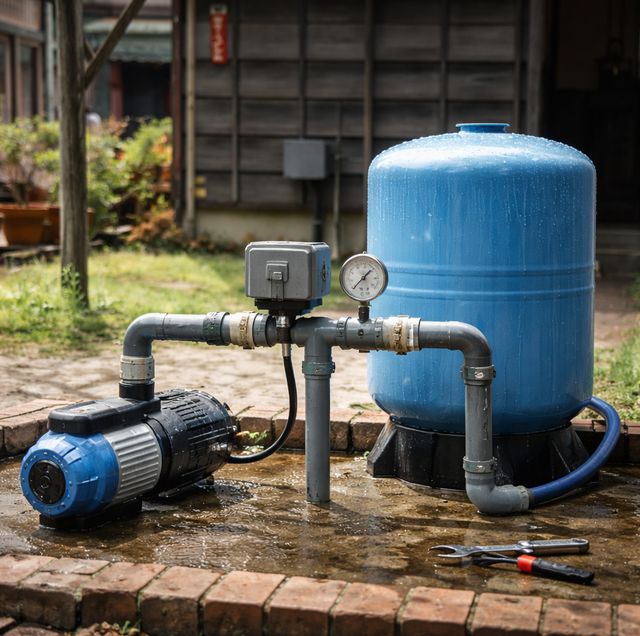
A healthy well system runs the pump in steady stretches, then lets it rest. So when you hear the pump clicking on, off, on, off in quick bursts every few seconds, something has broken the rhythm. That rapid on-off pattern is called short cycling, and it is more than a nuisance. Each start is the hardest moment in a pump motor's life, and short cycling forces hundreds of them an hour. Left alone, it can turn an expensive submersible or jet pump into scrap in a matter of weeks.
The reassuring part is that short cycling almost always traces to one part of the system. Knowing which part tells you how urgent the fix is and roughly what it will take.
What Short Cycling Actually Is
Your well does not send water straight from the pump to your taps. Instead, the pump fills a pressure tank, and that tank feeds the house between pump runs. The tank works because it holds a cushion of compressed air, usually separated from the water by a rubber bladder. As water enters, it squeezes the air; the air pushes back, keeping the water under pressure. That stored pressure is what lets you flush a toilet or rinse a plate without the pump firing every single time.
The pump follows two set points on a pressure switch: it kicks on at the cut-in pressure (commonly 30 or 40 psi) and shuts off at the cut-out pressure (commonly 50 or 60 psi). A good tank holds enough water between those two numbers that the pump runs a minute or more per cycle. When the tank stops storing water, the gap between cut-in and cut-out collapses, and the pump slams between on and off in seconds. That is short cycling: the buffer is gone, so the pump does all the work with none of the rest.
The Number One Cause: A Waterlogged Pressure Tank
By a wide margin, the most common cause is a waterlogged pressure tank. "Waterlogged" means the air cushion is gone, and water has filled the space it should occupy. This happens in two ways: an older non-bladder tank slowly loses its air charge, or a bladder tank ruptures, mixing water and air. Either way, there is no compressed air left to store pressure, so the smallest draw drops the pressure to cut-in, the pump surges on, hits cut-out almost instantly with nowhere to put the water, and shuts off. Repeat every few seconds.
You can confirm it. The tank's pre-charge (the air pressure with no water in it) is supposed to sit about 2 psi below the pump's cut-in pressure. So a 30/50 system wants roughly 28 psi of pre-charge. To check it, turn off the power to the pump, open a faucet or the tank drain to empty the tank, then press a tire gauge onto the Schrader air valve on top of or on the side of the tank. A reading far below target, or a spurt of water out of that air valve, means the tank has failed and needs recharging or, if the bladder is torn, replacing.
| What you notice | Likely cause |
|---|---|
| Pump cycles on/off every few seconds | Waterlogged pressure tank (lost air charge or ruptured bladder) |
| Cycling even after the tank is recharged correctly | Faulty or clogged pressure switch |
| Cycling with a drop in water volume or damp spots | Clogged, kinked, or leaking supply line |
| Cycling plus pressure that bleeds off when idle | Leak in the system or a failed check valve |
| Short, fast runs on a newer, correctly charged system | Pump oversized for the tank |
The Other Usual Suspects
If the tank pre-charge is correct and the pump still short cycles, work down the list. The pressure switch, the small box that reads pressure and tells the pump when to start and stop, can foul or fail: the contacts pit and the sensing port clog, so it misreads pressure and toggles the pump erratically. A leak anywhere between the pump and your fixtures, or a check valve that no longer holds, lets pressure bleed off while nobody is using water, which trips the pump again and again. And a pump that is simply oversized for its tank fills the tank so fast that it reaches cut-out before it has run long enough to matter, so it short-cycles even with everything else healthy, which is usually cured by adding tank capacity rather than swapping the pump.
There is also one more wrinkle worth naming as one factor, not the headline: the fine sand and silt common in sandy groundwater can pack into the pressure switch's sensing port and into screens and check valves, nudging an otherwise sound system toward erratic cycling. It rarely acts alone, but it can be the thing tipping a marginal switch over the edge.
Why Short Cycling Costs You Twice
Short cycling is not a state to tolerate while you get around to it, and the reason is mechanical. Starting draws a heavy inrush of current and puts the most strain on the motor windings and, on submersibles, the start components. A pump built to start a few dozen times a day is instead starting thousands of times, so the windings overheat, the bearings wear, and a motor with years of life left can burn out in weeks. It costs you a second way on the power bill: those repeated high-draw starts pull far more electricity than steady running, so a short-cycling system quietly runs up your energy use the whole time it is failing. Fixing the trigger early, most often recharging or replacing a waterlogged tank, protects both the pump and the meter.
Frequently Asked Questions
Rap your knuckles along the side of the tank from top to bottom. A healthy tank sounds hollow near the top, where the air sits, and solid and dull toward the bottom, where the water is. If the whole tank thuds heavily and dulls all the way up, the air is gone, and it is waterlogged. If it still rings hollow up top, yet the pump keeps cycling, suspect the switch instead. Rocking the tank tells you the same thing: a light top and heavy base means air is present, while a uniformly heavy tank that resists tipping has flooded its air space.
Yes. Modern bladder and diaphragm tanks keep the air sealed behind rubber, so they hold their charge for years and usually only fail when that rubber tears. Older galvanized air-over-water tanks have no barrier at all, so the water is in direct contact with the air and slowly absorbs it, which is why those tanks waterlog far faster and often need air added on a schedule. If your tank is a plain galvanized cylinder with no visible bladder fitting, expect to recharge it more often than a newer captive-air unit.
A restriction on the supply side of that one fixture, not a tank or switch fault. When a single faucet, toilet fill valve, or appliance line is partly clogged or has a failing valve, it draws water in a stuttering trickle that keeps nudging pressure across the cut-in point, so the pump pulses only while that fixture is open. If everything else runs steadily, leave the tank alone and inspect the aerator, screen, or shut-off feeding that fixture. Constant cycling with nothing running is the opposite signal and points back to the tank, switch, or a leak.
It can. Beyond worn contacts, the switch has a small diaphragm and sensing port that can jam part-open or clog partway, so it senses a false pressure swing and toggles the pump even though the tank is fine. Fine sand packing at the port is a frequent trigger. A check valve that flutters rather than seating cleanly produces the same rapid hammering because the pressure keeps rebounding past the switch's set point. Tapping the switch lightly while it chatters sometimes frees a stuck diaphragm long enough to confirm the switch is the culprit before you replace it.
Each start sends an inrush of current several times the running load through the windings, and thousands of those spikes a day cook the winding insulation until it breaks down. On a jet pump, the start capacitor and its switch take the beating, overheating, and eventually failing, while the starting contacts pit and weld. Submersible motors add wear to the thrust bearing that carries the pump's weight, since it is loaded hardest at each startup. That is why a motor rated for years of normal duty can fail in weeks once it is cycling.
It depends on the cause. If the pump is oversized for the tank, a larger tank or a second tank plumbed alongside gives the pump a longer run before cut-out and stops the cycling. A cycle-stop valve takes a different approach: it holds pressure steady and lets the pump run continuously at the rate you are drawing, so it keeps the motor off the start-stop treadmill even with a small tank. Neither one fixes a waterlogged tank, a clogged switch, or a leak, so confirm the actual trigger first rather than adding hardware over a fault that a repair would cure.
Working Through a Short-Cycling Well
When a well pump turns on and off rapidly, the buffer that is supposed to smooth demand has stopped working, and the pressure tank is the first and most likely place to look; a waterlogged tank that has lost its air charge or ruptured its bladder is the classic culprit. If the pre-charge tests are correct at about 2 psi below cut-in, move on to the pressure switch, then to leaks and the check valve, and finally to whether the pump is simply too big for the tank. Because every wasted cycle wears the motor and pulls extra power, the cheapest move is to diagnose it in that order and act before a tank-or-switch repair becomes a pump replacement.
If your well pump is cycling on and off rapidly, get the cause found and fixed before the motor pays for it. Perry-Pump Repair Service LLC serves Lake Butler, Gainesville, and Alachua. Call (352) 474-7142.
