
What Is a Constant Pressure System? The Fix for Weak Well Pressure
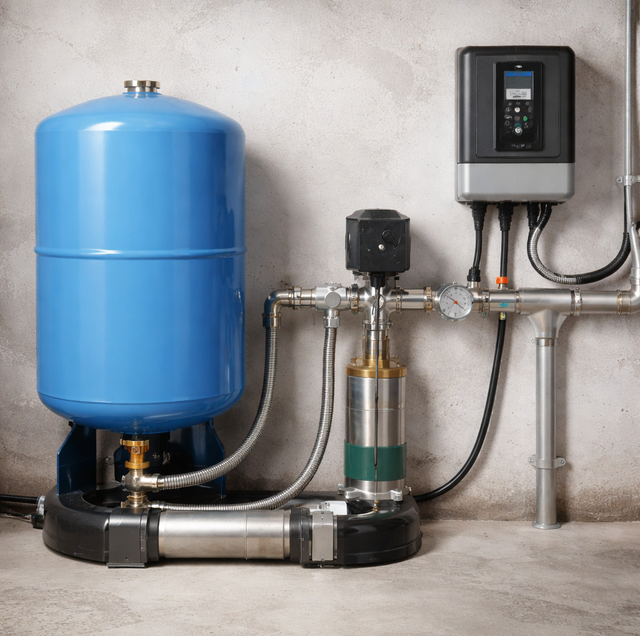
Quick Answer: A constant pressure system uses a variable-frequency drive (VFD) to speed the pump up and down so it holds one steady pressure no matter how many fixtures are running. A standard well system, by contrast, lets pressure rise and fall between a low cut-in and a high cut-out point. Constant pressure is worth it for homes with weak or fluctuating pressure, big households, long or multi-story plumbing runs, and irrigation. It will not fix a weak well or a clogged screen.
You turn on the shower, the pressure feels fine, and then someone flushes the toilet or the washing machine starts to fill. The stream weakens. A minute later, it climbs back up. If you are on a private well, that rise and fall is not a fluke. It is the way most well systems are built to work, and a constant pressure system is the equipment that changes it.
Before you decide whether you need one, it helps to understand what your current system is actually doing when the pressure swings.
How A Standard Well System Handles Pressure
A conventional private well runs on three parts working together: a fixed-speed pump down in the well, a pressure tank, and a pressure switch.
The pump has one speed. It is either fully on or fully off. It does not modulate. The pressure switch is what decides when it runs, and it works on a two-number range often written as something like 40/60. The lower number, the cut-in, is the pressure at which the switch turns the pump on. The higher number, the cut-out, is where it shuts the pump off. So on a 40/60 setting, the pump kicks on when pressure in the system falls to 40 psi and stops when it builds back to 60.
The pressure tank sits between the pump and your fixtures. Inside is a rubber bladder or diaphragm with air on one side and water on the other. As the pump pushes water in, the air compresses and stores energy. When you open a faucet, that stored pressure pushes water out without the pump needing to run for every small draw. The tank is what keeps the pump from switching on and off constantly.
Here is the catch. Because the pressure is always traveling between the cut-in and cut-out numbers, what comes out of your taps is never truly constant. It is a slow oscillation. Run one fixture, and the swing is gentle. Run two or three at once, or open a hose bib while a shower is going, and demand more than what a single fixed speed can supply. Pressure sags toward the cut-in point, and you feel it as a drop.
What A Constant Pressure System Does Differently
A constant pressure system keeps the pump and the well, but adds a variable-frequency drive, usually called a VFD. The drive is an electronic controller that varies the electrical frequency sent to the pump motor, which in turn varies the pump's speed.
Think of it like the cruise control in a car. On a standard system, you are stuck alternating between the gas pedal floored and the engine off, so your speed keeps bouncing between too fast and too slow. Cruise control instead feathers the throttle constantly, easing off on a downhill and adding power on a climb, to hold one steady speed. The VFD does the same for water pressure: it reads the pressure in real time and adjusts pump speed hundreds of times to hold your chosen set point.
When one fixture opens, the pump runs slowly. When the washer starts filling, and the demand jumps, the drive spins the pump faster to match it, so the pressure at your set point barely moves. The shower does not dip when the toilet refills, because the pump simply works harder for those few seconds instead of waiting for a switch to trip.
That steady behavior is the whole point, and it produces a handful of real benefits.
The Benefits Worth Paying Attention To
Steady, city-like pressure — This is the headline. Instead of a range, you get one number that holds through most normal household demand. For people coming off a well that sags every time two taps open, the difference is obvious the first day.
Better multi-fixture performance — Because the pump can accelerate to meet demand, running the dishwasher, a shower, and an irrigation zone at once no longer means everyone loses pressure. The system shares water without the collapse.
Gentler on the pump — A fixed-speed pump slams from a dead stop to full speed every cycle, and that inrush of startup current plus the mechanical jolt is hard on the motor and the check valve over the years of use. A VFD ramps the motor up smoothly, provides a soft start, and then holds a steady run rather than repeatedly stopping and slamming back on. Less hard cycling generally means less of the wear that shortens a pump's life.
A much smaller pressure tank — Since the drive responds instantly to demand, you no longer need a large tank storing a big cushion of pressurized water for the pump to draw down. Most constant pressure setups use a small tank, sometimes only a couple of gallons, which frees up space in the well house or utility area.
The Tradeoffs You Should Weigh
No system is all upside, and a constant pressure setup carries real costs beyond the obvious one of buying more equipment.
The most important thing to understand is what a VFD cannot do. It controls how the pump runs. It does not create water. If your well only yields a limited number of gallons per minute, or the screen at the bottom is partly clogged with sand and sediment, the drive will command the pump to speed up to hold pressure and simply run into the ceiling the well imposes. You cannot pull more water out of the ground than the aquifer feeds into the well, no matter how smart the controller is.
There are also more electronics in the system. The VFD is a sophisticated component, and like any electronic control, it can fail, especially in an area where lightning and power surges are common. A standard pressure switch is a simpler, cheaper part to replace. The drive is not, and it wants proper surge protection.
Finally, the whole thing depends on a correctly sized pump matched to the drive and to the well's actual output. An undersized pump cannot deliver the pressure you set no matter how fast it spins. This is why sizing is a job for someone who can test the well's yield and match the components, not a guess.
Bigger Tank Versus A Variable-Frequency Drive
People often ask whether they can get the same result more cheaply by installing a larger pressure tank. It is a fair question, and the honest answer is that a bigger tank helps one problem while leaving the main one in place.
A larger tank stores more pressurized water, so the pump cycles on and off less often. Fewer cycles are a real relief for pump life. But the pressure still rises and falls between the cut-in and cut-out settings, because the pump is still fixed-speed and the switch still governs it on the same two-number range. You have made the swings less frequent, not eliminated them. Open two fixtures, and the pressure still sags toward cut-in.
A VFD changes the mechanism itself. It is not storing more water to smooth the swings; it is removing the swings by varying pump speed. That is the real dividing line. Choose a bigger tank if your complaint is a pump that clicks on and off too often. Choose constant pressure if your complaint is that the pressure itself is never steady.
Who Actually Needs One
Constant pressure is not a mandatory upgrade for every well. Plenty of homes with modest, single-story plumbing and no simultaneous-demand problems run happily on a standard tank for decades. The upgrade earns its keep in specific situations:
- Homes where the pressure noticeably drops whenever a second fixture opens
- Large households where showers, laundry, and the kitchen often run at the same time
- Multi-story homes, where every floor of height puts pressure
- Long plumbing runs from the well to the house or to outbuildings
- Properties with irrigation, which adds steady, heavy demand on top of household use
- Anyone simply worn out by pressure that dips and surges through everyday use
If you see yourself in more than one of those, a constant pressure system is worth a serious look. If none of them describe your home, your money may be better spent elsewhere.
One honest caveat runs through all of it. A constant pressure system improves how existing water is delivered. It does not solve a low-yielding well, a clogged well screen, or the wear that hard, sandy, or mineral-heavy water inflicts on any pump. Sand still abrades impellers. Scale still builds. Those problems need their own fixes, and a drive layered on top of an unaddressed well problem will disappoint.
A Note On Safety And Installation
A constant pressure conversion is a job for a licensed well and pump professional, and not only because of the plumbing. The VFD is wired into your electrical supply and carries live voltage even when the pump is not visibly running. The pressure switch and the drive enclosure should stay closed. Do not open either one to poke around or "reset" it yourself. Sizing the pump to the well, matching it to the drive, and setting the target pressure correctly all depend on measurements most homeowners are not equipped to take. Getting any of those wrong wastes the investment or damages the equipment.
Frequently Asked Questions
A bigger tank stores more water, so the pump cycles on and off less often, which is easier on the motor. But the pressure still rises and falls between the cut-in and cut-out settings because the pump remains at a single fixed speed. A VFD instead varies the pump speed to hold a single target pressure, so the swings disappear rather than just spacing out. The tank reduces how often pressure moves; the drive removes the movement.
Only if the pump and the well can actually supply the pressure you want. A VFD holds a target by adjusting pump speed, but it cannot manufacture water. If the well yields only a few gallons per minute, or the intake screen is partly plugged with sand, the drive will run the pump toward its limit and still fall short. Weak-well and clogged-screen problems have to be diagnosed and fixed on their own before a drive can do its job.
Generally, yes. A fixed-speed pump jolts from full stop to full speed on every cycle, and that startup inrush of current plus the mechanical shock is one of the harder things a pump motor endures. A VFD ramps the motor up gradually, a soft start, then holds a steady run instead of repeatedly stopping and slamming on. Cutting the hard cycling and the inrush tends to extend the working life of the pump compared with constant on-off operation.
Usually a small one, yes. Even a VFD system keeps a modest tank to buffer very small draws, like a single toilet fill valve topping off, so the drive is not forced to spin the pump up for every tiny demand and short-cycle itself. That buffer tank is much smaller than the tank a standard system needs, often just a few gallons instead of the larger drawdown tank a fixed-speed setup relies on.
It stops, exactly like any electric well pump. The VFD, the pump motor, and the pressure switch all need electricity, so no power means no water, regardless of how the system is configured. Constant pressure does not change that. If your area loses power often, the answer is a backup generator sized to start and run the pump, not a different pressure system.
The water quality mostly wears on the mechanical side. Sand acts like a fine abrasive on the impellers and seals, and mineral-heavy water leaves scale that builds up inside the pump over time, so those parts still degrade whether or not a drive is installed. Good filtration ahead of the system and a well-maintained, sound system protects the pump and, by extension, the money you put into the constant-pressure equipment. The drive itself is more threatened by lightning and power surges than by the water.
Ask us to test your well yield and size the right constant pressure setup — steady water and a pump that lasts. Perry-Pump Repair Service LLC serves Lake Butler, Gainesville, and Alachua. Call (352) 474-7142.
