

Pressure Switch & Control Box Replacement in Gainesville and Across North Florida
FL Water Well Contractor License #5016 · FGWA · NGWA · NCFWA Member · Google 5.0 Rated · Wisetack Financing


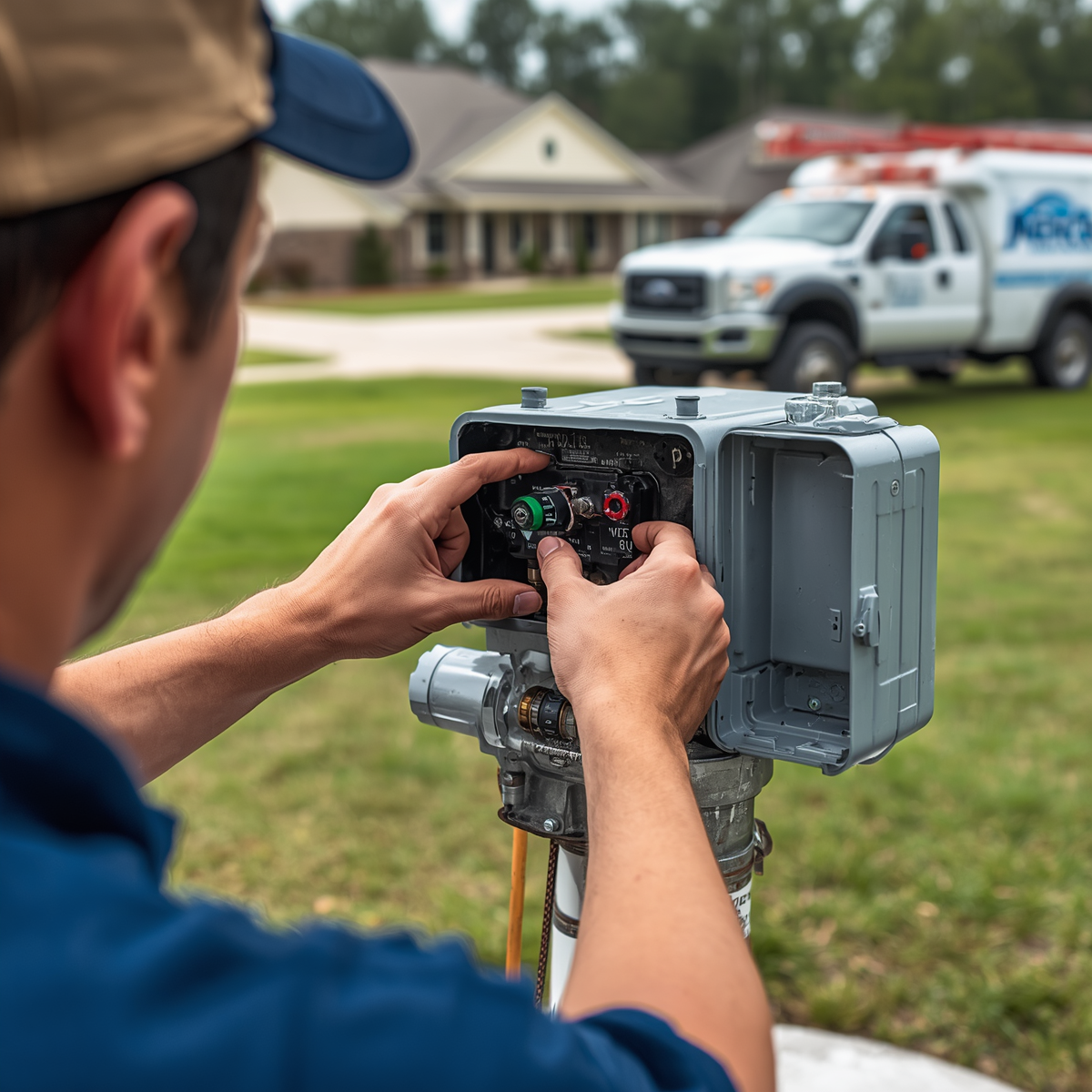
If your water was running fine yesterday and the pump just will not start today, the first thing we check is not the pump. It is the pressure switch and the control box. In North Florida, the single most common cause of a sudden, no-warning failure is fire ants wedged in the switch contacts. After that come pitted contacts from normal wear, and on 3-wire submersible systems, a control box capacitor blown by a nearby lightning strike. All three are a few-hundred-dollar repair, a fraction of a full pump replacement. Perry-Pump Repair Service is a family-owned, state-licensed well pump shop based in Gainesville, serving 17 communities across 9 North Florida counties. Eric Perry is a 3rd-generation water well specialist; the Perry family has been working North Florida wells for more than 50 years.
Switch and control box diagnosis happens fast, usually under an hour at the wellhead. We carry FSG and Square D pressure switches on every truck and stock Franklin and Pentek control box parts for 3-wire submersibles. Pest-blocking foam in the conduit and silicone on every opening goes on at no extra charge. No service call fee, no diagnostic charge for routine residential work, and the warranty goes on the invoice before you sign.
Call (352) 320-2412 Mon-Fri 8 AM - 5 PM. After hours, leave a message - we'll return the call at our earliest availability.
FREE SERVICE CALL
$0 service-call fee + $0 diagnostic on routine residential work.
FSG + Square D On the Truck
Both residential switch brands carried as standard stock.
5-Year Warranty
Pressure Package - parts AND labor on tank + switch.
17 North Florida Cities
Gainesville HQ to Lake Butler, Starke, Newberry, Lake City, and beyond.
Fire-Ant Mitigation
Pest-blocking foam + silicone at every opening on every job.
FDEP-Licensed #5016
Fully state-licensed Water Well Contractor - public registry.
Three Failures That Drive Most Sudden No-Water Calls
Across 15+ years of personal experience, almost every "the water just stopped" call traces back to one of three failures at the switch or the control box. None of them is the pump.
Fire ants in the pressure switch contacts: the #1 North Florida cause.
A lineman told Eric years ago that insects are attracted to the frequency of the electrical flow through pump wiring, and what we pull out of switches every rainy season confirms it. Insects do not conduct electricity well, so an ant's body wedged between the points stops the contacts from fully closing. Eric has personally seen the head of a fire ant stuck between the contacts, preventing them from fully closing and leaving a client without water. Mitigation: pest-blocking foam in the conduit, silicone on every opening. Honest qualifier: nothing is foolproof.
Pitted, burned, or fouled contacts (general wear).
Every cycle puts a tiny electrical arc between the contact points. Over the years, there have been arcing burns and pits on the surfaces. Eventually, the contacts will not close fully or chatter intermittently, causing pressure jumps, random cycling, and a buzz from the cover. A new switch is a few-hundred-dollar repair; we carry FSG and Square D on the truck, so most replacements finish on the same visit.
Control box capacitor or relay failure (common after summer lightning).
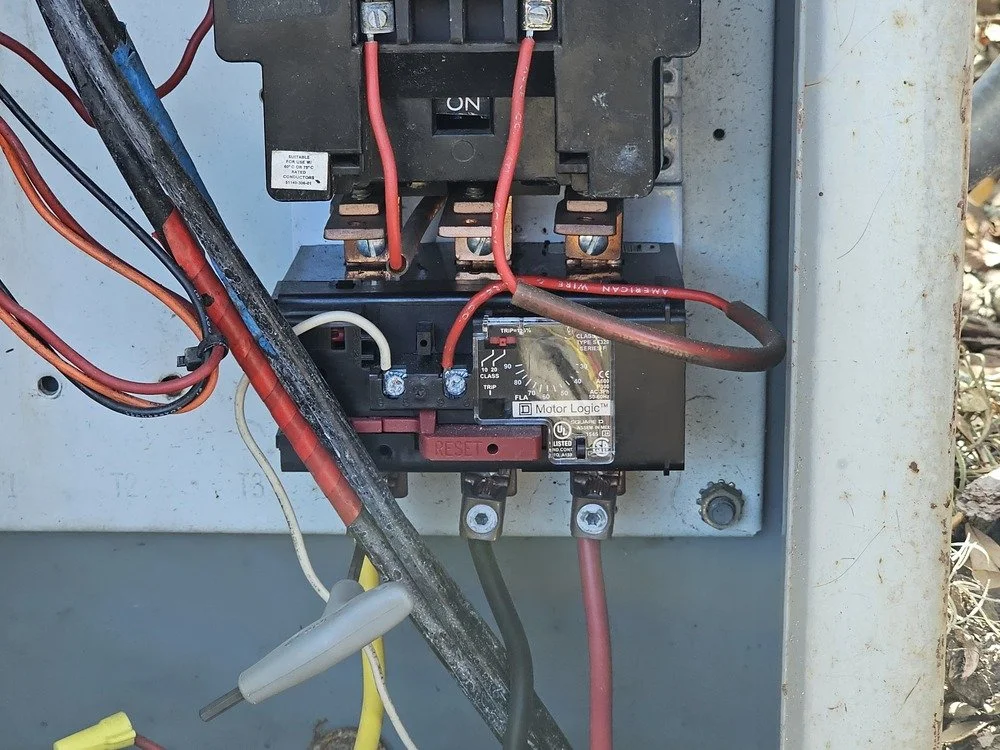
On 3-wire submersibles (Franklin or Pentek box at the wellhead), the start capacitor and relay live above ground inside that box. Both are vulnerable to power-line surges from nearby lightning. North Florida summer storms are at their peak. Pump hums but will not start, or will not hum. The box is the first thing we test before anyone pulls the pump. Capacitor + relay replacement runs under $500 in most cases.

Symptoms and Failures We See Across the Service Area
If any of these sound like what you are dealing with, call us. Most switch and control box diagnoses happen at the wellhead in under an hour.
-
• Pump hums but won't start
• Pump won't shut off, and the cut-out pressure is never reached
• The switch makes a clicking or buzzing sound from the cover
• Pressure jumps erratically between cut-in and cut-out
• Switch points visibly pitted, burned, or have green ant residue
• Cut-in and cut-out PSI drift over weeks
-
• Pump won't start the morning after a thunderstorm
• Audible click from the control box ,but the pump doesn't respond
• Control box hot to the touch (failed capacitor or stuck relay)
• Burn marks or melted insulation inside the control box
• Breaker trips immediately when the pump tries to start
• Start capacitor swollen or vented (bulged top, leaking electrolyte)
• Start relay coil reads out-of-spec on a multimeter
• The box was hit by direct or near-direct lightning

-
• Wire lugs at the switch corroded green from iron-laden water vapor
• Conduit not sealed - ants, wasps, or geckos in the enclosure
• Pressure-port nipple corroded or partially blocked with scale
• Bare wire showing inside the conduit at the switch entry
• Pump motor short condition misdiagnosed as a switch problem
-
• Intermittent starting on an older 2-wire submersible
• No control box at the wellhead - start components are inside the motor
• When the start components fail on a 2-wire, the pump itself must be pulled
• Bad capacitor on a 2-wire = pump pull, not a switch or box repair
What Actually Happens When You Call About a Switch or Control Box
From the phone call to the final invoice, here is the path most switch and control box customers walk. We try to do as much of the diagnostic work as we can before we drive out, so the visit is short, and the repair is right the first time.
Phone diagnostic - switch, control box, or pump.
Call (352) 320-2412 Mon. - Fri. 8 AM - 5 PM. Three or four questions (did the water stop all at once? Does the pump hum? Do you have an electrical box at the wellhead? Was there a recent thunderstorm?) narrow the cause to a switch, a control box, or the pump. After hours, leave a message; we return at our earliest availability.
Schedule + en-route notification.
Most routine switch and control box calls land within the same week, or the same day if we are already in your area. No-water emergencies move to the top. We will text or call en route.
Open the switch to inspect contacts, lugs, conduit, and enclosure.
We arrive in a marked Perry-Pump truck, kill the power at the panel, and open the switch. Visual inspection of contacts (pitting, burns, and ant residue), lugs (corrosion), and the conduit entry tells us most of what we need to know in five minutes. Routine residential diagnostics are no charge.
On 3-wire systems, test the control box before anything else.
If there is a Franklin or Pentek box at the wellhead, the capacitor and start relay get tested with a multimeter. Both have spec ranges that tell us pass or fail. We test the box before we ever talk about pulling the pump.
Plain-language quote on the spot.
If a new FSG or Square D switch fixes it, that is the quote. Control box capacitor + start relay together: under $500 in most cases. Full control box: a few hundred dollars to about $1,000, depending on the HP. Prices are subject to change because our suppliers have been very volatile with pricing lately.
Install same-visit, seal the enclosure, leak-check, and written warranty.
Switch and capacitor replacements are stocked on the truck for residential systems, and most jobs finish on the same visit. Pest-blocking foam goes in the conduit, silicone on every opening. Cut-in and cut-out pressures are set or verified before we leave. Pressure Package: 5-year parts and labor on switch + tank, written on the invoice before you sign.
Follow-up - call us first if anything's off.
Call us first if anything is off. Pressure not right, unusual cycling, or warranty question after the visit, call us first. We answer warranty calls the same day on average; a small issue caught fast is cheaper than a burnt motor later.
Pressure Switch & Control Box Pricing: What Things Cost
Every system is different. 2-wire vs 3-wire, HP rating, switch brand, and whether the tank is being quoted at the same time all move the number. Ranges below are accurate as of writing; we will quote the current number on the call. Routine residential diagnostic is free.
Diagnostic
$0 service call fee + $0 diagnostic charge on routine residential calls. Switch inspection, lug check, conduit inspection, and (on 3-wire systems) control box capacitance and relay testing are part of the visit, not a separate line item.
Pressure switch replacement (the most common repair)
FSG or Square D residential pressure switch replacement: a few-hundred-dollar range parts + labor
Switch + new pressure-port nipple where the old one is corroded or scaled: mid-range
Switch + enclosure cover + conduit reseal (pest-blocking foam, silicone openings): mid-range
Cut-in/cut-out PSI recalibration on a working switch: included with most service calls
Control box repair (3-wire submersible systems only)
Start capacitor replacement: under $500 typical
Start relay replacement: under $500 typical
Capacitor + start relay together (common after lightning): under $500 typical
Full Franklin or Pentek control box replacement: a few-hundred dollars to about $1,000, depending on HP
Control box rebuild on a hard-to-find older model: quoted per situation
Combined switch + tank work (the Pressure Package)
Pressure switch + standard residential Amtrol Well-X-Trol bladder tank (sized to your pump's run time): switch few-hundred + tank ~$1,000 installed
Pressure switch + a higher-drawdown whole-house or irrigation tank (sized to your system's demand): switch few-hundred + tank ~$3,500 installed
Pressure Package 5-yr parts + labor warranty applies on combined jobs
Wisetack financing on the larger combo jobs. Military and first-responder discounts case-by-case by scope - ask when you call.
Our Reviews

Why homeowners choose Perry-Pump
Fully licensed and insured. Florida Water Well Contractor License #5016.
Experienced well repair specialists. Third generation, 50+ years working North Florida wells.
Quality workmanship and straightforward customer service.
Free service call and $0 diagnostic on routine residential work.
5-year parts and labor warranty on the Pressure Package and most residential submersibles, in writing on the invoice.
Seven North Florida Conditions That Shape Switch and Control Box Service
Working with pressure switches and control boxes in North Central Florida means working around seven specific local conditions. These shape what we install, how we seal it, and how often we see components fail.
1
Floridan Aquifer wells dominate at 100 to 400 ft, with 3-wire submersibles common
Almost every residential well in our footprint draws from the Floridan Aquifer at 100 to 400 ft. At those depths, 3-wire submersibles are the common configuration, with a Franklin or Pentek box at the wellhead on most properties. Control box service is a regular call.
2
Hurricane and tropical storm season (June to November) abuses switches and boxes
When power cycles back on after an outage, the switch can take rapid-fire on-off pulses the contacts were not designed for, and surface flooding can short-circuit poorly sealed enclosures. We see a real spike in calls 2 to 6 weeks after a named storm, and we handle those the same way we handle any other switch failure: same-visit diagnosis, most repairs under $500.
3
Summer lightning peaks in July and August, and control box failures spike
Direct lightning strikes on a wellhead are rare. What is not rare is a strike a quarter-mile away that surges the power line into the control box, and the start capacitor and start relay are usually the first to fail, same as they can from age. On 3-wire systems, the control box is one of the first things we test on any no-start call.
4
Karst geology and casing shifts sometimes change cycling patterns
North Florida sits on karst limestone. Subsidence can shift the casing enough to change drawdown profiles, which changes how often the switch cycles. A switch that ran fine for a decade can start short-cycling. The right answer is often tank + switch work together.
5
Iron, sulfide, and hardness corrode switch hardware fast
Most North Florida wells produce water with measurable iron, sulfide, and hardness. The chemistry attacks the brass pressure-port nipple, the wire lugs at the switch terminals, and any exposed copper inside the enclosure. Lug corrosion causes intermittent failures that mimic bad contacts. Pulling and cleaning lugs is part of every switch service call.
6
Fire ants in pressure switches: Eric's signature North Florida angle
The local condition that drives the most sudden-failure calls we run. Insects are attracted to the frequency of electrical flow in pump wiring. Mitigation is pest-blocking foam in the conduit and silicone at every opening on every job.
7
Flood-zone properties stress switch and control box enclosures
Suwannee, Santa Fe, and St. Marys river basins, plus lower-elevation rural lots, sit in FEMA flood zones. Surface flooding overtops low wellheads and can soak the switch enclosure and the control box if either was not installed high enough. Switch and control box replacement is sometimes part of the post-flood recovery scope, along with wellhead extension and cap-and-seal.
Seven Technical Topics Where Switch and Control-Box Choices Actually Matter
Seven places where the easy answer is not the right one. One-line take? Call us. The actual reasoning is here.
-
Pest-blocking foam in every conduit run at the switch entry; silicone on the cover gasket, conduit fittings, and wire-pull holes. The seal degrades over the years from UV and temperature swings, so inspecting and re-sealing every couple of years is the durable answer.
-
Lug corrosion is one of the most under-diagnosed causes of intermittent switch behavior. Wellhouse water vapor (especially on iron-heavy systems) oxidizes the lug surface and creates a high-resistance connection. Symptoms mimic a bad switch: will not start consistently, voltage drops under load, and the pump runs hot. We pull and clean every lug on every service call.
-
Switch and tank wear in parallel. A tank with weak pre-charge cycles the pump more often, which pits switch contacts faster; pitted contacts hold the pump open longer, which works the tank harder. By the time one component is failing, the other is usually showing wear too. We open the switch and tap the tank on every visit, quoting them together when both are due is cheaper than two trips, and the 5-year Pressure Package warranty covers both.
-
Pressure switches are sold with a default cut-in/cut-out (40/60 PSI is the most common residential setting; 30/50 is the older standard). The pre-charge on the tank should be set to cut-in PSI minus 2, so a 40/60 system runs a 38 PSI tank pre-charge. Set the cut-in too high, and the tank yields less drawdown and the pump short-cycles. Set it too low and house fixtures feel weak. We verify the setting on every install.
-
Both are workhorse residential switches in standard 40/60 and 30/50 configurations. FSG has slightly heavier construction at the diaphragm and is what Eric reaches for first on North Florida flood-zone or coastal properties. Square D Pumptrol is the long-running standard; parts are easy to find, and replacement is fast. We carry both; the right pick depends on the installation location.
-
2-wire submersible pumps keep the start capacitor and start components inside the motor itself. There is no above-ground control box. The good: simpler install, fewer above-ground parts to fail. The bad: when the start components fail, the pump has to be pulled to replace them. 3-wire submersibles use a separate Franklin or Pentek control box at the wellhead with the start capacitor and relay above ground, making it easier to service and faster to diagnose. Most replacements at 1 HP and up go 3-wire.
-
On 3-wire submersibles, the box is the first thing we test after a no-start. Capacitance test on the start capacitor: healthy reads close to rated microfarad; failed reads a fraction of spec or open. Resistance test on the start relay coil. Five minutes with a multimeter catches the failure before anyone touches the pump.
Frequently Asked Questions
-
Few-hundred-dollar range parts + labor on a standard residential FSG or Square D switch. Corroded port nipples or conduit resealing add to the mid-range. Prices are subject to change; our suppliers have been very volatile with pricing lately.
-
The four big symptoms: the pump hums but will not start, the pump will not shut off, the switch makes an audible clicking or buzzing from the cover, or the pressure jumps erratically. Opening the cover usually shows the cause: pitted contacts, ant residue, or a corroded port. We inspect for all three on every service call.
-
Fire ants in the switch contacts are one of the most common causes of sudden well pump failure we see in North Florida. Insects are attracted to the frequency of electrical flow through pump wiring; the rainy season is the peak. Our mitigation consists of pest-blocking foam in the conduit and silicone at every opening.
-
FSG and Square D for residential. Both come on every truck, so most replacements happen on the same visit. We pick FSG first on North Florida flood-zone and coastal properties where build quality matters; Square D for fast, straightforward swaps.
-
A control box is the small metal enclosure mounted at the wellhead on 3-wire submersible systems. It holds the start capacitor and relay above ground. Franklin or Pentek box near the casing = 3-wire. No box at the wellhead = 2-wire (start components inside the motor downhole).
-
Capacitor and start relay replacement together: under $500 in most cases. Full Franklin or Pentek control box replacement: a few hundred dollars to about $1,000, depending on HP. Prices are subject to change because our suppliers have been very volatile with pricing lately.
-
A surge protector at the wellhead reduces the risk of capacitor and relay damage from nearby strikes, but does not eliminate it. Direct strikes overwhelm any surge device. We install surge protection as an add-on when a customer asks, but we will not promise it stops all storm damage.
-
5 years parts and labor on the pressure switch and pressure tank, written on the invoice before you sign. For 3-wire submersibles, the residential submersible warranty covers wire, control box, and pump together, typically 5 years parts and labor.
-
17 communities: Gainesville (HQ), Lake Butler, Lake City, Alachua, Newberry, High Springs, Starke, Keystone Heights, Branford, Trenton, Waldo, Hawthorne, Glen Saint Mary, Bell, Brooker, Raiford, and Melrose. Not sure if you are in our footprint? Call (352) 320-2412, and we will tell you straight.
-
Yes, through Wisetack. Application takes minutes, terms shown before you sign. We do not push financing on a few-hundred-dollar switch swap; for the larger control box or combined switch + tank jobs, it is a real option.
Ready to Get Your Water Back On? Call Perry-Pump Today.
Whether your water stopped without warning, your switch is buzzing, or your control box has not worked since the last thunderstorm, call (352) 320-2412, and we will get you on the schedule. Routine residential work has no service call fee, no diagnostic charge, and the warranty goes on the invoice before you sign.