
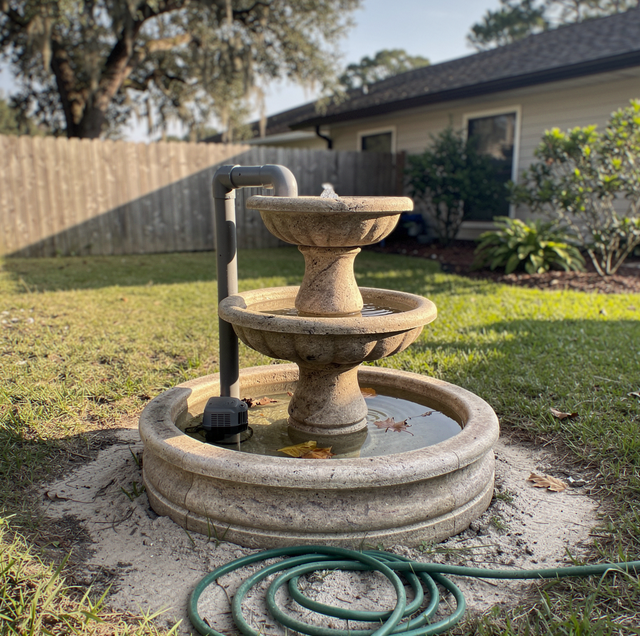
A tiered fountain asks one pump to do a specific job: lift water the full height to the top bowl through a single riser tube, then let the lower tiers fill on their own as that water spills back down and overflows from level to level. No tier below the top has a separate feed from the pump. The pump has to push water to the top, and everything below the top fills because the design lets it. That single-path setup is also why the pump can run, sound normal, and still fall short: the motor turning and the impeller spinning only proves the pump is working, not that the water it moves is completing the climb. Anything that steals flow anywhere between the basin and the top outlet shows up the same way: at the top outlet, wherever along the path the loss sits.
What the fountain is doing at the top tier matches where the flow is likely being lost along that path:
| What You See | Where the Flow Is Likely Lost |
|---|---|
| Pump hums, the lower bowl stirs, but the top stays dry | A clogged intake screen or debris fouling the impeller, cutting the pump's output before it can finish the lift |
| The top trickles, then stops as the basin level falls | The basin dropping low enough that the pump starts drawing air along with water |
| Flow sputters and spits in bursts | Air entering the system, either from a low basin or a loose or cracked fitting along the riser |
| The top ran fine until the fountain was cleaned or reassembled | Air trapped in the pump housing when it went back into the basin, or the riser tube kinked or knocked off its fitting when the tiers were restacked |
| Water reaches the top but spills out the side of the column | A cracked section or a loosened connection in the column, letting water escape before it reaches the bowl |
Lift Height Against What the Pump Can Push
A pump's output falls as the height it has to lift rises, and at its maximum lift the flow reaches zero. It has to hold that push for the entire time the fountain runs, against the full vertical rise from the basin to the top outlet. Anything that adds resistance along the way- a narrowed passage, a bend that should be a straight run, debris sitting in the flow path- effectively raises that lift without changing the pump itself. A pump that used to clear the top with room to spare can fall just short once enough small resistance builds up somewhere between the basin and the bowl, even though nothing about the pump's rated output has changed.
A Clogged Intake Screen or Debris in the Impeller
A fountain pump draws water through an intake screen or a pre-filter cage before it reaches the impeller, and that screen is there specifically to keep debris out of the pump. Leaves, mulch, and grit from the basin collect on the screen over time, and as the mesh narrows, less water reaches the impeller during the same running time. The pump still spins at the same speed and still moves some water, but with less volume feeding the impeller, the push it can generate drops, and the top tier is the first place that shortfall shows up. Debris that gets past the screen and lodges directly against the impeller vanes has the same effect from the inside: the impeller can no longer move a full volume of water per rotation, so the pump's output falls at the exact lift it used to clear without trouble.
A top tier that fades gradually fits a loading intake screen, a riser narrowing with buildup or a wearing impeller; one that stops right after cleaning or restacking fits a tube knocked loose or pinched, or a flow adjuster bumped down.
The Riser Tube
The riser tube is the single conduit that carries all the flow from the pump to the top outlet, making it the component where any restriction directly reduces what reaches the bowl. A kink anywhere along its length, a crack that lets pressure escape into the column, or a connection that has slipped off its fitting all cut what reaches the top: part or all of the water the pump pushed out escapes or stalls before the bowl. Mineral and algae buildup narrows the tube's bore from the inside over time, the same way the intake screen narrows from debris, and a bore that has gradually closed down can hold back flow long before the tube looks blocked from the outside. If the top tier ran full right up until the fountain was cleaned and restacked, the riser tube's connection is the first suspect: a tube can get pinched under a tier or seated slightly off its fitting during reassembly. Every hands-on check of the pump, tubing, or fittings starts with the pump unplugged at the outlet, and the pump is removed from the basin by its housing, never by its cord. A heavy stone or cast tier stays in place: unstacking tiers to reach the tube is work for the repair technician.
A fountain pump that trips its GFCI has an electrical fault in standing water, and each reset re-energizes it: an electrocution risk to anyone reaching into the basin. The technician unplugs the pump and traces the fault.
A Flow Adjuster Turned Down
A flow adjuster, built into some fountain pumps as a dial or valve at the intake or outlet, trims how much water goes up the riser, so a fountain can run a low, quiet flow on the same pump. On some pumps it throttles the flow; on others a diverter returns a share to the basin, where it can pass for normal circulation while the top runs dry. Turned down during setup or bumped during cleaning, either type leaves less water to make the climb.
A Low Basin That Lets the Pump Draw Air
A submersible fountain pump depends on being fully covered by water to operate cleanly. As the basin level drops from evaporation, wind carrying spray past the bowl's edge, or water simply not being topped off, the pump eventually sits at or above the waterline and starts drawing in air along with whatever water remains. Air mixed into the flow breaks it into an inconsistent, sputtering stream that cannot sustain the climb to the top even though the pump is still turning. A pump running short of water for any length of time is also working against its own cooling, since the water it moves is what carries heat away from the motor; a pump found running with a low or empty basin is switched off at the outlet.
A Worn Impeller or a Pump That Has Lost Output With Age
Grit and sediment pulled in with the water wear on the impeller's vanes over the life of a pump, a slow process with no single point at which it becomes obvious. As the vanes lose their original shape, the volume of water the impeller moves per rotation falls even with a clean screen, a clear tube, and the flow adjuster wide open. That produces the same outward symptom a blockage does: the pump runs, sounds normal, and still cannot complete the same lift it used to clear easily. The difference sits inside the pump: nothing is stuck or narrowed anywhere between the basin and the top, and the pump itself is simply moving less water than it once did.
Repair or Replace the Fountain Pump
A cleared screen, a straightened or reseated riser tube, or a flow adjuster turned back up restores flow without touching the pump itself. Wear inside the pump is a different category: the loss comes from the impeller or the motor, and which of the two has worn decides whether a part or the whole pump is replaced.
Frequently Asked Questions
Tubing length inside the column adds its own friction loss, separate from the vertical lift itself, and a run that is tightly coiled to fit inside a narrow column adds more of that resistance than one that runs in a gentler path. On a column with a long or twisted run, that friction can be enough to keep water from the top.
Yes. A valve that has partly seized or collected debris or scale inside its body can restrict flow at a fully open setting, and a dial that feels stiff to turn is one sign of that.
Yes, if the pump has come to rest higher than it should, propped up on accumulated debris or settled silt at the bottom of the basin. The water volume may look adequate at the surface, while the pump itself sits close enough to the waterline to draw in air along with the water.
On some tiered fountains, a small nozzle or diffuser cap sits at the top outlet as a separate part fitted to the riser tube. That fitting can work loose or collect debris on its own, producing the same dry-top symptom as a riser problem even when the tube itself is clear.
Air drawn in while the basin was low can stay trapped in the pump's housing, and an impeller spinning in a pocket of air moves no water. Until that air clears from the housing and the riser, the top tier stays dry or sputters even with the basin back at a normal level.
On some magnetic-drive fountain pumps, yes. The impeller sits in a chamber outside the sealed motor and lifts out as its own part, so a worn one can be swapped while the motor stays in service. The motor windings are sealed against water and are not rebuilt, so a pump whose motor has failed is replaced.
Hire fountain pump repair — intake screen, impeller, riser tube, and flow adjuster on tiered, statuary, and wall fountains. Perry-Pump Repair Service LLC serves Lake Butler, Gainesville, Alachua, and Lake City. Call (352) 320-2412.
