
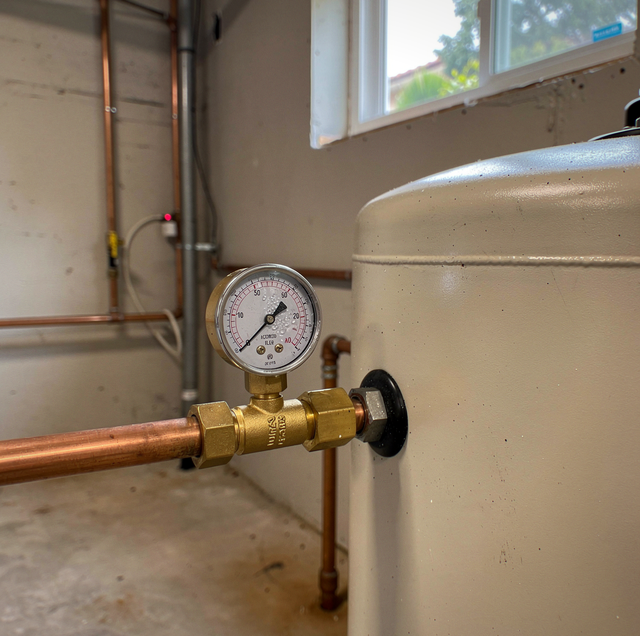
A well pump can make a noise before it fails. The trouble is that from inside the house, a click, a chatter, and a hum all register the same way: the pump is making a noise. Each of those sounds belongs to a different part of the system, and the moment it happens, plus what the needle on the pressure gauge does at the same time, narrows the search to one part before anyone opens a cover.
| Sound | When it happens | What the gauge does | Likely part |
|---|---|---|---|
| Rapid clicking at the tank | Every few seconds while a tap runs | Swings from low to high and back, over and over | Tank no longer holding a water reserve |
| One click, then silence | When a tap opens, and pressure falls | Stays low and never climbs | Control box parts, a wire splice, the drop cable, or the motor |
| Steady hum, no water | Right after the click, without letup | Does not move | Motor powered but not turning: start components, low voltage, or a jammed pump end |
| Hum, then the breaker trips | After a stretch of hum, or at the instant of the click | Does not move, and the pump's breaker is off at the panel | Stalled motor holding its starting current, or a short in the cable or motor |
The sound indicates something is wrong, the timing shows which stage of the start failed, and the gauge determines whether any water moved. You can gather all three standing beside the tank.
Where the Sound Is Coming From
On a submersible system, the motor sits down in the well, underwater, out of earshot. Everything you hear at the surface comes from equipment above ground: the pressure switch on the pipe beside the tank, the control box on the wall or post if your system has one, and the piping itself as water starts and stops. So on a submersible, a hum at the box with a silent wellhead is the box's parts working against a motor you cannot hear.
A jet pump or a booster is different. Its motor is mounted at the surface, exposed, and the hum you hear is the motor itself.
The gauge on the tank tee supplies the rest of the evidence. A climbing needle means the pump is moving water, whatever it sounds like. A needle that holds still means no water is moving, even if the motor sounds healthy.
Rapid Clicking at the Tank
Rapid, evenly spaced clicks track the tank, not the switch.
Run a shower and watch the needle. If it swings the full distance between two numbers every few seconds, the tank has stopped storing water between starts.
A different pattern sounds similar and means something else. If you hear a burst of rapid chatter, a buzzing rattle lasting a moment right as the pump starts or stops, while the needle sits at one number, the tank is not the cause. The contacts are bouncing instead of closing cleanly, which points to the switch's own contacts, a pressure signal pulsing at the switch, or a relay in the control box that is not getting enough voltage to hold itself closed.
Either version costs the motor something: each click is a start, and a start is the moment the motor draws its heaviest current and heats its windings.
Before calling, run a shower and use your phone's stopwatch to time the gap between clicks, then write down the lowest and highest numbers the gauge needle reaches. Those two readings separate a tank problem from a switch problem.
One Click and Then Silence
A lone click, followed by quiet, proves one thing: the switch closed and sent power to the pump. Silence afterward means that power stopped somewhere between the switch and the motor, or reached a motor that could not respond. The candidates sit in a line along the circuit: the relay, overload protector, and terminals inside the control box; the splice where the surface wiring joins the drop cable at the wellhead; the cable running down the well; and the motor windings at the bottom, whose thermal protector can hold a hot motor off until it cools.
What happened just before the silence changes where the search begins. A surge from a nearby lightning strike arrives on the same wires that feed the pump, and the parts it hurts are the electrical ones: the components in the control box and the thin insulation on the motor windings. So a click and no start right after a thunderstorm puts the control box and the motor at the front of the line. On a system that has not seen a strike, fed by a supply that holds level, a surge is a minor suspect, and the same click-and-silence points to wear instead: contacts pitted by years of starts, a corroded splice, a worn-out motor. The sound is identical in both cases. The history separates them, which is why it belongs in the first thing you tell the technician.
A Steady Hum with No Water
A hum means current is flowing through the motor's windings and the rotor is not turning. On a jet pump, you hear it from the motor. On a submersible, you may hear it at the control box or faintly at the wellhead, while the gauge needle stays exactly where it was.
Three different faults produce that same state, and from outside they are indistinguishable.
The starting circuit: a single-phase motor needs a separate push to begin turning, and the components in the control box or motor housing that supply it can fail.
Low voltage: a motor's starting torque falls off steeply as voltage sags, so a supply that dips at the instant of start can leave a sound motor humming in place. A loose or corroded connection anywhere in the circuit does the same thing from inside the system. With supply holding steady, low voltage drops down the list of suspects. On one that sags during storms, it moves up, and a hum that appears and disappears with the weather is a clue worth passing along.
A jammed pump end: the motor may be fine, and the pump it drives may be locked, so the motor has nothing it can turn.
Whatever the cause, every second of hum is current becoming heat in the windings. On a submersible, the flow of water over the motor while it pumps is part of what cools it, and a stalled pump moves no water.
A Hum That Ends at the Breaker
Measured against the click, the timing of the trip narrows which kind of fault opened the breaker.
Hum first, then the trip: the motor stalled and held its heavy starting current long enough for the breaker to open.
Trip at the instant of the click, with no hum: either current found a path it should not have, or the pump end is seized, and the motor's locked-rotor current opened the breaker before a hum could build. Damaged insulation on the drop cable, a splice that let water in, or a winding shorted to the motor's frame all produce the first. A strike can puncture winding insulation, so an instant trip that starts right after a storm points at the motor or the cable. With no strike in the picture, a chafed cable or a failing splice belongs on the list right beside the motor.
Resetting the breaker sends the same current back through the same damaged point, so a reset repeats the damage rather than testing for it.
When to Shut the Pump Down and Call
Rapid clicking while water still flows means the pump is working hard but working; you can cut water use to a minimum and schedule a visit, knowing every unneeded start adds wear. A hum with a still needle, any trip at the panel, a click with no water that does not clear, or a hot-plastic smell at the switch or the box calls for switching the pump off now.
On a 240-volt pump circuit, the breaker is a double-pole unit in the main panel, two handles joined by a bar, labeled for the well or the pump. Switch it off and leave it off. Turning it off means no water until the visit, and that trade is worth making: a motor that sits idle waits for a diagnosis, while one left humming or retrying keeps adding damage.
Switching off the breaker stops the motor, but the pressure tank and piping still hold water under pressure, and the switch cover and control box hide 240-volt terminals. Opening either one is a technician's work, done after confirming the circuit is dead.
Before the visit, jot down the sound, when it started, and what the gauge showed, because the technician was not there to hear it.
Frequently Asked Questions
Check whether you have a water softener or a backwashing filter. Both regenerate on a timer set by design for overnight hours, and the water they draw wakes the pump, as any tap would. A start at the same time each night matches that timer. Starts at random intervals with every fixture closed, pointing elsewhere, toward a leak in the plumbing or a check valve letting water run back down the well.
Yes, within limits. A constant-pressure system runs the motor through a drive that adjusts its speed to match demand, and the drive's electronics and the motor produce a whine whose pitch tracks your water use. A pitch that rises when a tap opens and falls when it closes is the system working. A drive that stops and displays a fault code is a different matter, and that code is worth writing down.
Many jet pump motors carry a centrifugal start switch inside the motor end. It snaps open as the motor reaches speed and snaps closed again as the shaft coasts down, so a single click at shutdown is part of normal operation. That click becomes worth a call only if it changes, such as a click at startup followed by a hum and no rotation.
A pump motor's starting demand runs several times its running draw, and a generator sized only for running watts sags in voltage at the moment of start. The motor then lacks the torque to turn and hums, or the generator's own breaker trips. If the pump starts cleanly on utility power and hums only on the generator, the generator's size is the problem to look at, not the pump.
Only when the filter sits after the pressure switch but ahead of the tank. Then a clogging cartridge lets pressure spike at the switch before the tank behind it has filled, so the switch reaches its stop setting early and the pump cycles. A filter placed after the tank, as filters are meant to be, lowers the flow at your taps but cannot change what the switch reads.
Yes. A standard two-pole pump motor turns at about 3,450 rpm on 60-hertz household power and makes an even, steady note while it works. The difference between a normal hum and a problem is the gauge: a normal hum comes with a needle that climbs toward the stop setting, then ends with a click as the switch opens.
Describe the click or hum you are hearing — a technician will trace it to the switch, the tank, the control box, or the motor before any part gets replaced. Perry-Pump Repair Service LLC serves Lake Butler, Gainesville, Alachua, and Lake City. Call (352) 320-2412.
