
Bradford and Union Hay: Irrigating Around the Cutting Calendar
Your mower comes Thursday, and you walk your field at first light to be sure. Your growth carries the weight you have waited three weeks for. Your controller still holds last week's pattern and your pump still runs its morning hours, and inside two days you have to pull your water off a crop of yours that is still growing.
Your system spends your season shut off at the moments your crop would most like to drink, then asks for everything you have a week later, on dates you did not pick. Your pump learns nothing of your cutting plan. It knows only that you ran it hard, then not at all, then hard again, and your year holds four more of those for you.
Why the Water Comes Off Days Before the Mower Does
Hay ground in Bradford and Union counties is cut wet and stacked dry, and everything between those two states happens outdoors, on the ground, in whatever weather the week hands you. The target for that dry-down is well established: moisture content for round bales runs about 15 percent, and square bales about 18 percent. No pump moves that number in the helpful direction. Water put on late is water the sun has to take back out of the windrow before a baler can touch it.
So your shutdown date is counted backward from the mower, not forward from your last set. The field has to enter the cut with enough moisture in the soil to hold the crop up and little enough on the leaf to let it cure in the days the forecast gives you. That timing depends on the weather and the mower, and your pump takes its instructions from them instead of the controller.
For the pump, the consequence is blunt. A system that had been running four to eight hours a day goes to nothing for most of a week, and then comes back all at once. Nothing about that is a fault. The plan is working, and it is written into every cut you take.
The Interval Is a Range, So the Shutdown Date Moves
The spacing between cuts follows a known range: each subsequent cut occurs at 3.5- to 5-week intervals, depending on fertilizer and moisture. A week and a half of slack falls within that range, and it varies with how you fertilized and how the rain fell.
You cannot write the whole season into the controller in March and leave it alone. Each cut restarts a countdown whose length nobody yet knows, so the weeks your pump sits idle fall on dates that are not on any February calendar. Whatever you plan to have done to that pump gets planned on short notice.
What the Curing Window Frees You to Schedule
Between the mower and the baler, your field is dry on purpose, and nobody is waiting on water. That is the only stretch of the season when taking the pump out of service costs your crop nothing. Scheduling around that window is how the work gets planned: landing in your area between cuttings, between pulls, or before the next scheduled zone run.
Three to five dry days is room for real work. A pull and inspection, a suction-line repair, a check of the electrical enclosure, a motor swap if the shop has the unit on the truck. What does not fit is anything that requires a part to be ordered from out of state, which is the argument for booking the window as soon as the mower date firms up.
Skip it, and the next opening is somewhere in the middle of regrowth, when every hour the pump is down is an hour the stand is short. Work that would have been unremarkable in a dry field becomes a question about which day of watering you are willing to lose. The window is cheap, and the alternative is not.
What Waits for the Pump When the Baler Leaves?
Pumps on hay ground rarely fail during the idle days. They fail at the restart, because a restart is the first time in a week anything is asked of the machine. The suction line has drained back, or it has not. The packing has dried, or it has not. A coupling that had been loosening before the shutdown has had four quiet days with no change. The first ten minutes after the switch closes is when you find out.
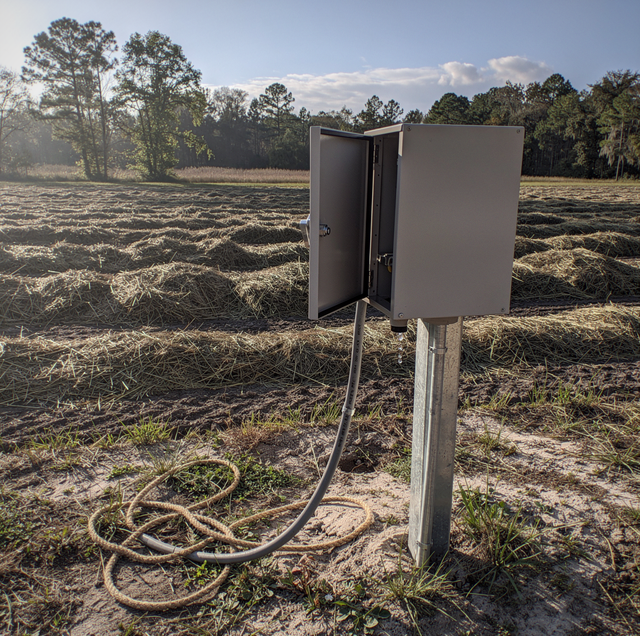
The electrical side of that restart belongs to somebody else. An ag pump's control box sits on a 230-volt or three-phase supply. A grower standing at the field edge with the baler pulling out has every reason to want that cover off, and the pump reset inside five minutes. It is a job with a name on it, and the name is not yours.
Leave the control box cover closed at restart: the start capacitor holds a charge after the disconnect opens, so a pump technician or licensed electrician should check it.
Which is the practical argument for putting the restart and the service visit on the same day. If a technician is already in the field for the curing-window work, the machine comes back up with somebody qualified standing at the box, and you learn on the spot whether it came back up clean.
How Much Catch-Up to Ask For, and How Fast
Regrowth starts the day the stubble is exposed, and a bermudagrass stand pushing new leaves wants water early rather than in plentiful amounts. Bermudagrass crop water use for the region is measured as a depth per day, in inches. That unit is the whole point of it. What the crop is short of after a cut is a depth of water in the root zone, and a depth is a number the soil accepts only so fast.
The pump feels none of that. It feels hours. A longer set to make up four missed days is a request for hours, and the shop's rule on ag motors is that units running four to eight hours daily need a continuous-duty rating: put an intermittent-duty motor on that job, and it burns out in 18 to 24 months where a properly rated one runs 8 to 10 years. Motor class is a subject of its own, and this is not it.
So the shape of a good re-water push is short sets close together, aimed at a depth the root zone can hold, and stopped when the depth is met. The shape of a bad one is a single long run that asks the motor for its worst week of the season and puts most of the water past the roots.
What Three to Five Cuttings Do to One Pump
Run the sequence out across a season, and the pattern is plain. Dry down, shut off, four to seven days cold, restart, catch-up push, then a stretch of ordinary daily running, and the mower comes again. Four of those, maybe five, between the first cut in spring and the last one in fall. Every restart is a fresh chance for a small fault to become an obvious one, and every idle stretch is days nobody spent watching it.
What the cutting calendar leaves you is not a free hand with dates. It leaves you four or five short dry windows a season, each one called a few days ahead by the mower and closed again by the baler. You cannot move them. You can know they are coming, and have the pump ready for the next one.
Frequently Asked Questions
No. Stop far enough ahead that your surface has given up its water while your root zone still holds some. Then hold off even if the mower slips a day or two, because resuming for even a single set wets the leaf you spent the week drying.
Plan on the better part of a week. The field is mown, then cured on the ground, then raked and baled, and the bales have to come off before anything wets your ground again. Weather stretches that. A rain delay during curing keeps your pump off for several more days than you planned.
You can, and it is the most common thing growers do. The limit is the soil, which accepts a depth of water at its own rate and passes the rest below your roots, and the motor, which feels the extra hours directly. Short sets close together put more of the water where you actually want it.
Usually. Length is rarely what fails a window. Notice is. A shop builds its route days before the truck rolls, and your own mowing date often reaches you three days out at best. So call your shop while the date is still a guess and confirm it once the mower is booked, not the other way around.
The idle stretches themselves are easy on your pump. Your restarts carry the load, because most of what it endures under strain, it endures in the first minutes of a run. Four or five of them a season is not many, but each one lands on a machine gone cold for a week, and that is not your ordinary morning start on your watering weeks.
Someone should be there who can watch it come up. Valve positions from a week ago, a suction line that may have drained, a seal that has sat dry: none of that is visible from your house. The machine should come up with a person standing at it, the discharge watched for the first several minutes, and the run left alone once it settles. The electrical enclosure stays closed throughout, and the technician who opens it is the one qualified to. If the shop is already in your field, your restart costs you nothing extra.
If the pump has to come back up between cuttings, book the restart into the curing window — a technician can run it up, watch the first set, and hand the field back ahead of mowing. Perry-Pump Repair Service LLC serves Lake Butler, Gainesville, Alachua, and Lake City. Call (352) 320-2412.
