
How to Protect a Well Pump From Power Surges Before One Hits
A submersible pump motor sits at the bottom of a cased hole, roughly 80 to 400 feet down on most residential wells, bolted under the pump end and hanging on the drop pipe. Getting a hand on it means bringing up every joint of pipe, the drop cable strapped alongside, and the pump.
An electrical fault in a dishwasher costs a service call and a part. The same fault in a submersible motor costs a truck with a hoist, a second set of hands, and half a day of pulling and resetting the pipe before the component is replaced. Labor accounts for most of the loss, which is why prevention is worth more here than on anything else you own.
Why This Motor Is the Hardest One to Protect
Power reaches it over a long conductor: a few hundred feet horizontally from the panel to the wellhead, then several hundred feet straight down inside the casing. Length is the problem. A long run of wire in the earth behaves as an antenna for the electromagnetic field a lightning discharge throws off, and a pulse can be induced into it with no electrical connection to the discharge. Your pump does not need to be hit, and neither does the utility line feeding it. A discharge into a pasture can put a voltage across that drop cable the motor never sees on an ordinary day.
What it damages is almost never mechanical. Submersible windings are copper magnet wire coated in a thin polymer film, wound so tightly that neighboring turns touch with only that film between them. The film is rated for operating voltage with margin, not for a transient measured in thousands of volts, and a pulse that punches through shorts two turns together.
The motor usually keeps running anyway. One shorted turn in a winding of hundreds circulates current in a closed loop; that loop makes heat in one spot, and the heat degrades more film around it. The pump runs another two weeks. Another two months. Then it quits under clear sky, and nobody ties it to the storm that passed in the spring. A well still pumping after a storm is not proof it came through undamaged.
The Control Side Is Where Protection Starts and Where Damage Shows First
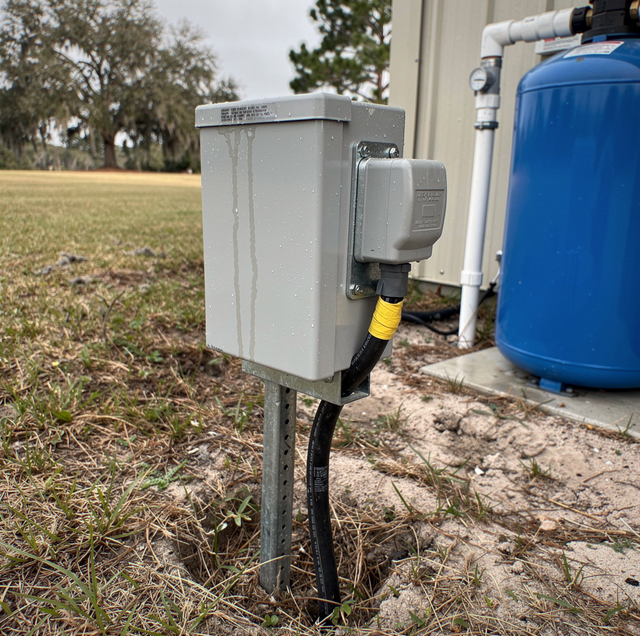
On a three-wire submersible, the start capacitor and start relay do not live down the well. They sit in a control box above ground near the pressure tank, wired between the pressure switch and the drop cable, and that box is the first place surge protection gets fitted. It is already the junction between house wiring and the wire going down the hole.
A two-wire pump changes that. Its starting components are potted inside the motor downhole, so there is nothing above ground to protect except the supply side, and a failed start component there is not a parts swap on a wall. It is a pull.
Surge damage often announces itself here before the motor gives out. A spike that reaches the pressure switch can pit or weld its contacts, and constant-pressure systems add a variable-speed drive whose board can tolerate far less energy than a copper winding can. Read those cheap failures as a warning: something arrived on those conductors, and the motor was on the same ones.
A control box holds a start capacitor that can retain a charge after the disconnect is opened, and the pressure switch carries line voltage on exposed terminals. Neither enclosure is a homeowner inspection point. Leave both closed.
A Surge Arrester at the Disconnect Is the Layer Closest to the Motor
A device fitted at the pump's own disconnect, or at the pressure switch feeding it, sits on the same conductors that continue down the well. Motor manufacturers have recommended that placement for decades, and the reason is distance: a device clamps voltage where it is connected, so the farther upstream it sits, the more wire is left for a transient to build voltage across.
It is also the layer positioned closest to the motor when a surge never came from the utility at all. Energy induced into the buried lateral or the drop cable has already passed the panel and is heading toward both ends of the wire, and a device at the wellhead stands at the end the motor is on.
It still has limits: it cannot shield 300 feet of buried conductor from a field induced along its length. It lowers the peak the winding sees. It does not put the motor in a box.
A Panel Device Covers the Utility Side and Nothing Below It
A device at the service panel monitors the point where all circuits in the building share a single path. Utility switching, capacitor bank operations, a discharge onto pole equipment a mile away: those arrive on the service conductors, and a service-entrance device intercepts them before they reach the well circuit and everything else.
It is not sufficient on its own, and the geometry is why. Every conductor between the panel and the motor is downstream of it. A panel device also passes a residual voltage through by design rather than clamping to zero, and the remainder it carries here is a motor you cannot reach.
Grounding and Bonding Are What Every Other Layer Sits On
A surge protective device does not consume energy. It diverts it. Each one opens a low-impedance path to ground when the voltage crosses a threshold, dumping the transient down that path rather than through the load. If the path is poor, the device has nowhere to send anything, and the money spent buys a green light.
That makes grounding the foundation rather than an accessory, and it is the item most often found wrong. A ground electrode conductor cut during yard work. A clamp at the rod corroded until it is a resistor rather than a connection. A steel casing, already a large conductor reaching below the surface, left unbonded to the grounding system serving the equipment beside it. When two nearby metal objects sit at different potentials during a surge, current crosses between them through whatever bridges the gap. On a well, that is the wiring and the motor.
Whether a given installation requires a specific electrode, bonding jumper, or arrangement is a question for your local authority having jurisdiction and a licensed electrician, and it varies by place. The physics does not. A device that diverts needs somewhere to divert to.
A Direct Strike Is a Different Event Entirely
A direct discharge to the casing, wellhead, or service drop is not what any of these layers are designed for. Lightning peak currents run in the tens of thousands of amperes, far past the standardized surge waveform residential devices are tested against. A direct attachment overwhelms them and carries current through the casing, the pipe, and the water column at once.
Nothing on the market prevents that, and anyone who says otherwise is selling something. What surge protection addresses is the induced and utility-side event, and for every well that takes a direct hit, a great many take an induced pulse from a discharge that landed elsewhere.
Cutting power at the breaker ahead of a storm comes up often, and it does remove the utility path. It does nothing about a pulse induced into the buried cable, which needs no closed circuit to appear, and an open breaker is a small air gap a high-voltage transient can jump. It lowers exposure. It is not protection.
What Gets Blamed on Surges and Is Really Something Else
Low voltage kills more pump motors than spikes do, and it does it quietly. Motors tolerate roughly ten percent above or below their nameplate voltage. Below that, the motor still has to lift the same column of water, so it draws more current, and heating rises with the square of that current. A loose lug at the panel, an undersized or corroded drop cable, or a sustained sag on the line cooks a motor over months without one dramatic event.
Single-phasing is the same failure on three-phase power: lose one phase while the motor runs and the other two carry the whole load, with current on those legs climbing steeply. The residential parallel is a lost leg at a breaker or a burned connection, leaving the motor a fraction of its voltage and the same work to do.
Rapid cycling deserves a mention and then a hand-off. A pressure tank that has lost its air charge strips the buffer out of the system, so the pump starts and stops far more often than it was built to, and every start pulls several times running current through those windings. It is the most common motor killer on a well system; it has nothing to do with the grid, and the tank is where it gets settled.
What You Can Check and Where It Has to Stop
Four things are worth your own eyes. The first is whether any surge protection exists at all: look at the panel for a small module mounted on or beside it, and at the box near the pressure tank or the disconnect at the wellhead. Plenty of systems people believe are protected have nothing fitted.
The second is the indicator on the device itself, a green light or a colored window on most units. It reports that the device has not taken itself out of service. It cannot report how much capacity a decade of transients has already spent, which is why the light being on is a floor and not a clean bill.
The third is the pressure tank, because rapid cycling threatens that motor more than any storm this year. If the pump starts and stops repeatedly while one faucet runs steadily, the tank is not holding its air charge. The fourth is the grounding: a bare copper conductor running to a rod, a clamp at the casing, nothing green and crusted, nothing ending loose in the dirt.
Everything past that is a meter in trained hands, and the good news about a motor you cannot reach is that the tests run from the surface. Never open a well electrical enclosure during a storm, and do not work on the pump circuit yourself to chase a surge question.
Write the installation date on the surge device housing with a paint marker. Capacity is consumed over a device's life, and without a date, nobody can tell which has absorbed a decade of transients from one fitted last month.
Frequently Asked Questions
No, and the two jobs are unrelated. A surge protective device is a diverter, not a power conditioner or a battery backup. It clamps to what makers call a voltage protection rating, commonly a few hundred volts on a 240-volt circuit, and passes that residual through. If the utility drops out, the pump stops with everything else.
They matter more there. The variable-frequency drive that runs a constant-pressure pump is the most surge-sensitive component in the system, and many drives contain internal protection components that are permanently consumed and not user-serviceable. Drive makers commonly specify a protected supply circuit as an installation condition, so skipping one can affect a warranty claim.
Yes, and these are far more numerous than lightning-related events. Large inductive loads switching on and off, including an air conditioning compressor, a welder, or the pump itself, impose repetitive, low-energy transients on the building's wiring. They do not fail a motor in one night. They add up on thin insulation.
Not by depth alone. Exposure scales with the total length of the conductor loop, and on many properties the horizontal run out to the wellhead is longer than the vertical drop. A 500-foot buried lateral to a shallow well can carry more induced-voltage exposure than 200 feet of drop cable.
Insulation resistance of each winding lead to ground, measured at the surface with a megohmmeter at 500 volts. That reading covers the drop cable and the motor together, and the manufacturers' tables put a sound in-well motor between about half a megohm and two, with a new one above two. Below about half a megohm, the insulation is failing whether or not the pump is still running. Winding resistance leg to leg is then checked against the maker's table.
It needs protection, but the stakes differ. A jet pump motor sits in open air, and a failed one can be swapped or rewound without touching a joint of pipe. The labor that dominates a submersible replacement is not there, which changes how much protection the installation warrants.
Have the electrical side of your well checked — grounding, controls, and surge protection looked at as one system by a certified technician, before a storm finds the weak point. Perry-Pump Repair Service LLC serves Lake Butler, Gainesville, Alachua, and Lake City. Call (352) 320-2412.
