
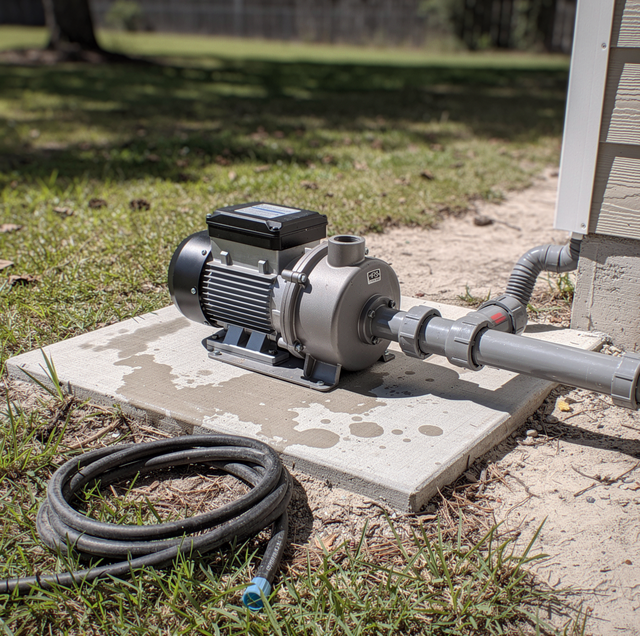
An irrigation pump generates heat every time it runs. Friction at the bearings and shaft seal, resistance losses in the motor windings, and the mechanical work of moving water all convert into heat that has to go somewhere. Under normal conditions, cooling keeps pace with the generation, and the pump settles into a stable operating temperature once the cycle is underway. A pump that shuts off and restarts on its own, hums without turning, or has a housing that reads hot can mean cooling has fallen behind the heat being made, and which sign shows up points toward a short list of causes.
What changes at the pump when each sign appears points to the cause behind it:
| Sign | Likely Cause |
|---|---|
| Pump shuts off and restarts on its own | A thermal overload protector tripping and resetting |
| Hot casing with little water moving | Lost prime or a pump running dry |
| Running with a closed or clogged discharge | Water recirculating inside the housing instead of leaving the system |
| Running dry or losing prime | No water present to carry heat away from the pump |
| Hot motor with a humming start | A stuck rotor or a failing start component holding locked-rotor current |
| Overheating only on long runs | A pump sized wrong for the zone, too little rest between cycles, or a motor not rated for the run length |
What Keeps a Pump Cool
A pump sheds heat through two separate paths, and either one failing on its own is enough to push the pump toward its thermal limit. The first path belongs to the motor: the frame and, on an above-ground unit, a fan pull heat outward into the surrounding air whether or not a drop of water is passing through it. The second path belongs to the water itself. Water moving through the pump carries heat away from the housing and, in some pump styles, passes close enough to the motor to draw heat from it as well on its way to the discharge line.
Winding resistance produces heat whenever current flows, whether or not the pump is doing useful work, which is why a stalled motor drawing full current heats faster than a motor spinning freely under no load. The flow-dependent path is the one that fails quietly, since nothing about the motor itself has to change for it to stop working. Cut the water moving past the pump and the heat that path used to carry away simply stays behind.
Running Dry and Lost Prime
Losing prime removes the flow-dependent cooling path entirely, while the friction and electrical heat sources continue producing at the same rate, so the casing temperature climbs quickly with nothing to carry it off. This is the mechanism behind a casing that reads hot within minutes, even though the motor sounds no different from a normal run.
A hot pump casing can burn on contact, and water sitting inside a dry-running pump can flash to steam under pressure. Shut off power at the breaker and have a technician open the pump rather than checking it by hand.
Whether the water disappeared because of a suction-side air leak, a foot valve that failed to hold, or suction pulled past what the setup can lift is a separate question from what to do right now. What matters here is narrower: a pump found running with no discharge and a hot casing gets shut off at the breaker first, because every minute it keeps turning without water moving through it adds heat with nowhere to go.
Blocked Intake or Discharge
A screen or filter clogged with debris restricts what reaches the pump, in the same way a closed or nearly shut valve restricts what leaves it, and in both cases, less water moves past the housing per minute even though the motor keeps turning at full speed. Sand and sediment are one load on a screen or filter, alongside iron and bacterial growth. Where the water pulled into the system runs clean, the loading stays slight, and the screen does not starve the pump; where the source carries sand and sediment, the screen can clog, and the cooling loss follows.
The discharge side works the mechanism in reverse. Water trapped behind a closed or barely-open valve has nowhere to go and gets driven back through the impeller again and again instead of leaving the system, and reworking the same water repeatedly is its own source of heat, separate from anything sediment contributes.
Motor and Electrical Causes
Three electrical conditions can raise a pump's operating temperature without any mechanical blockage. A motor fed under its rated voltage has to draw more current to produce the same work, and that extra current becomes extra heat in the windings for no additional pumping. A start or run capacitor that has lost capacitance leaves the motor short on the torque it needs to reach full speed quickly, which stretches the high-current start period and heats the winding before the motor ever settles into its efficient operating range.
The third condition sits on the nameplate rather than in a failing part: a winding built for fewer running hours per day than it is now being asked to deliver produces this same slow overheating pattern even with nothing else wrong.
A Pump Sized Wrong for the Zone
A pump chosen for more flow or head than a given zone needs spends its runtime working against resistance it was not built around, and a pump chosen with too little capacity for the same zone spends its runtime straining to reach a pressure it can only approach. Either mismatch can manifest as heat building over a run rather than at startup, because the pump is fighting its own performance curve for the entire time it operates, rather than for a brief moment at the beginning.
A zone that changed after the pump was installed, more heads added, a longer run of pipe, a block combined with another, can turn a pump that ran cool for years into one that now overheats on the same equipment with nothing inside the pump itself having failed. Checking the zone against what the pump was originally sized to move belongs early in the sequence, before any part gets replaced on the assumption that something wore out.
What a Technician Checks
Live readings, voltage under load and running temperatures, are taken by the technician with the pump running and nothing opened, since a voltage drop that only appears once the motor is pulling current is the one that matters here; the breaker goes off before any cover comes off or any part is touched, and even then a run or start capacitor can hold a charge. None of this is homeowner electrical work. Casing and motor temperature get compared against ambient air, since a difference that is large relative to the outside temperature points toward the pump rather than the weather. The zone's demand also gets checked against the pump's original sizing. Prime and suction are confirmed next, followed by measuring discharge pressure against what the zone is supposed to read, which rules out a closed or clogged path in or out of contention. The capacitor and start components are inspected separately from the running windings, since a start-circuit fault and a winding fault produce similar hot-and-humming symptoms for very different reasons.
Note which zone was running, how long the pump had been on, and whether the heat built gradually or came on fast. That detail narrows the cause before a technician ever opens the housing.
Frequently Asked Questions
Yes. A bearing running short of grease adds mechanical drag that shows up as friction heat at the housing before it shows in the current the motor pulls, because the extra resistance is small relative to the motor's overall load until the bearing is close to seizing. A hot housing with an unremarkable ammeter reading can still point to a mechanical cause.
Once, at most. A pump restarted with the cause still in place goes back through the same heat, and every overheat ages the winding insulation; after a trip, it stays off at the breaker until the cause is traced.
An infrared thermometer aimed at the housing from a short distance gives a comparable reading with no contact required. Pointing the same thermometer at the discharge pipe near the pump separates the two possibilities: a discharge pipe as hot as the casing points to water trapped and churning in the pump, while a much cooler pipe points the heat at the motor or bearings.
Yes. A check valve stuck shut downstream dead-heads the pump in the same way a closed valve at the pump does, since either one stops water from leaving the system. Any complete block downstream, whether it is a stuck check valve, a solenoid valve that failed closed, or a fully plugged line, produces the same recirculating-heat pattern; the pump cannot tell one closed point from another as long as no water has anywhere else to go.
Direct sun on an above-ground housing during the hottest stretch of the afternoon raises the pump's starting temperature before the motor ever turns on, which shortens the time it takes a given fault to push the casing to its thermal cutoff compared with an early-morning cycle on the same equipment. Whichever cause is at work keeps producing the same heat either way; the weather only changes how long it takes to show.
Not by default. A technician first checks the winding's insulation to ground and its resistance against the nameplate; a winding that tests sound can go back in service once the source of the heat is fixed, and one that has broken down gets rewound or replaced.
Ask for irrigation pump repair on a pump that runs hot — the heat traced to the intake, the discharge, the motor circuit, or the zone sizing rather than parts swapped on a guess. Perry-Pump Repair Service LLC serves Lake Butler, Gainesville, Alachua, and Lake City. Call (352) 320-2412.