
Jet Pump or Plain Centrifugal: Sprinkler Flow at Risk
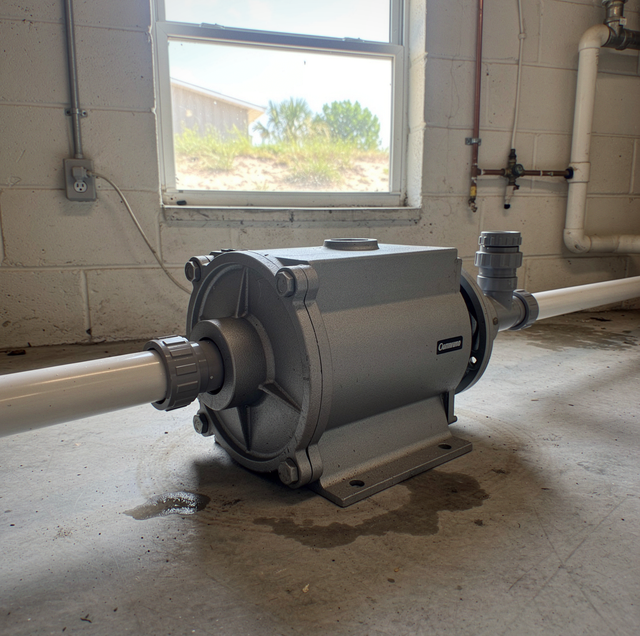
In front of the impeller on a sprinkler pump, there is either a bolted casting holding a nozzle and a venturi throat, or nothing at all except a plain suction flange and an open impeller eye. The whole difference between the two machines a supplier will set in front of you lives in that space, and it has very little to do with size, brand, or horsepower. A jet pump is a centrifugal pump with an ejector added ahead of the impeller; a plain self-priming end-suction pump is the same machine without one. How much lift the pump will hold and how much water reaches your heads at working pressure both come from that one casting. The site conditions you measure pick between them.
Static Water Level Is the First Measurement Worth Taking on Site
The number that the whole choice turns on is the vertical distance from the pump's centerline to the water surface when nothing is running. Trades call that figure the static water level, and it is the one number on the suction side you can take with the pump off. A weighted line dropped at the intake and read against a fixed point at grade gives it; the height of the pump above or below that point is then added or subtracted. The depth of the pond, or the depth of the well, is a different number and does not enter this decision at all.
Static level moves in both directions: a long dry stretch pulls the surface down, and a run of heavy rain brings it up. Take the figure at the low end of what the source does across a year, because that is the condition your pump has to hold, and a wet-end choice made against a high surface will not survive the first time the water drops away from it.
The Vertical Lift From That Water Surface to the Pump Centerline
Static level gives the geometry. Total suction lift adds everything the water has to fight on its way up: the vertical rise itself, every foot of suction pipe, every elbow, every partly blinded screen. All of it is charged against one budget, and the motor does nothing to enlarge it. On the discharge side, the pump pushes with whatever the impeller and motor can produce together. On the suction side, nothing pushes at all except the weight of the atmosphere on the surface of the water, and that weight does not change because you bought a larger pump.
That same asymmetry is why your wet end has to be chosen and not simply sized off a horsepower figure. It also runs into a hard ceiling that no surface pump on the market beats, wherever it sits and whatever an ejector does about it. This piece stays on how the two wet ends behave underneath that ceiling.
Which Wet End Belongs on a Surface-Fed Sprinkler System?
An ejector is an assembly of two fixed parts with a gap between them: a nozzle and, facing it across that gap, the tapered throat of a venturi. A portion of the pump's discharge is piped back to the nozzle rather than going out to the zones. Forcing it through a small orifice trades its pressure for velocity, and the fast stream crossing the gap drags the pressure inside the throat well below anything the impeller eye reaches alone. Atmospheric pressure on the water outside then pushes a fresh column up the suction line behind that stream, and both arrive together at the impeller eye. Nothing in a plain self-priming end-suction pump occupies that space.
What that buys is suction capability, not delivered water. The share sent to the nozzle is water the pump moves, and you never see it at a head, and losing it is the ejector's trade.
The two machines sort on conditions you measure. Where the water surface is close to the pump, and the zones want volume, a plain self-priming end-suction pump gives you more water for the same motor, and nothing an ejector can add. Where the surface sits well down and the flow your heads need is modest, the ejector earns the water it takes, because a plain impeller will not hold suction there at all. Between those two, the answer comes out of your static level, your total lift, and your required flow at pressure, never out of horsepower alone.
Flow at Pressure Is a Different Number From Flow on Its Own
A sprinkler zone is not a tank waiting to be filled. Every head in it is an orifice that passes its rated flow only when held at its rated pressure, so what a zone asks for is a pair of numbers, not a single one. A pump's published capacity is a pair as well: one point on a curve that falls away as the head against it rises. Matching a pump to your zone means putting one point on top of another.
The ejector shows up in that arithmetic a second time. Because part of its output is already spoken for at the nozzle, an ejector-assisted machine meets your demand point lower down its curve than a plain end-suction pump of the same physical size does. Two pumps can both reach the flow rate, but only one of them maintains the pressure. The difference never appears on either machine's nameplate or in a catalog line.
The Intake End Weighs Heavier on an Ejector-Assisted Machine
An ejector is fed from the pump's own discharge, which makes the intake condition part of the wet-end choice and not a maintenance detail to sort out afterwards. Anything that takes discharge pressure away is charged twice on an ejector-assisted machine: once at the heads and again at the nozzle that is supposed to hold the suction together. A plain end-suction pump has no such second account to keep, and it only ever loses water at the heads.
So a screen half blinded with silt, a suction path that is one size too small, or a strainer basket packed with leaf litter means something different on the two machines. On the plain pump you get less water at your heads, and the pump keeps working. On the ejector-assisted pump, the nozzle is starved as well, and the machine begins losing the suction help it was chosen for in the first place.
Two Pumps With the Same Nameplate and Two Different Curves
Horsepower is a motor rating. It describes what the motor can absorb, and it carries no information about the shape of the curve in front of it. Two pumps wearing the same nameplate can sit on different curves, because the impeller diameter, the volute, and whatever occupies the space ahead of the impeller are all different.
Which is why a step up in motor size, on the same wet end, moves your operating point along a curve without changing its shape. If the curve was the wrong shape for the site to begin with, a bigger motor buys a little more of the wrong thing.
The Suction Line Between the Water and the Pump's Own Port
The suction line is the one part of all this you can look over without touching anything electrical. It should be at least as large as the pump's suction port and never smaller. A reducer at the port should be eccentric with its flat side up, so no pocket forms at the top of the taper. And the whole run should rise continuously toward the pump, with no high point anywhere along it.
A sprinkler pump's pressure switch, control box and pump-start relay stay energized between cycles, so leave wiring, capacitor and enclosure work to a licensed technician and keep the cover shut.
That last point matters more than pipe size, because air that collects at a high spot does not clear once the pump runs: velocity in a suction line is too low to sweep a slug of air along. So the pipe between the water and your pump port is supporting a column that only the weight of the atmosphere pushes, and it does that work whether the wet end in front of it was chosen well or poorly.
Frequently Asked Questions
The ejector-assisted machine gives your technician two orifices to clean where a plain end-suction pump has one, and the ejector body has to come off before you can reach either. The same shop lists jet pump repair, booster pump repair, and irrigation pump repair as three separate services, and pond and fountain pump repair besides, on named pages.
Self-priming means the pump can clear air out of its suction line after a stop, using water it has kept in its own casing. It does not mean that your pump fills a dry suction line for you the very first time you ever start it.
With a compound gauge on the suction port while it runs. A vacuum that climbs as more zones open points at the suction path, and that path is the screen, the suction line, and the vertical lift together. A vacuum that holds while your pressure falls off points the other way. It is a reading you should ask for before you let anyone replace your pump.
Not by bolting something on. The ejector needs a return passage from the discharge, and a plain volute is cast without one, so the conversion you want is a new pump. If you see "convertible" on a jet pump, that term refers to its ejector arrangement, and your plain machine has none.
No. A larger motor on the same wet end pushes your pump further out along a curve it was never going to fit, and it can carry the pump past the point it was designed around. Check the service factor on your nameplate: it is the margin your motor has, and a wet-end mismatch spends it very quickly.
Yes, though not around the clock, and the shop will not claim otherwise. Normal hours run Monday through Friday, 8 AM to 5 PM. After hours, a call may reach voicemail, come back at the shop's earliest availability, and usually land on the next available day; no-water emergencies move to the top of the queue. The published refusal list on that same page is short: new well drilling, which goes out to a named driller, and solar pump installation. If you are choosing a wet end partly on who will service it for you afterwards, both are worth your attention.
A sprinkler pump that will not hold suction on a surface source usually points at the wet end rather than the motor — a technician can measure your static level, your total lift, and your delivered flow before anything is replaced. Perry-Pump Repair Service LLC serves Lake Butler, Gainesville, Alachua, and Lake City. Call (352) 320-2412.
