
Sand in Irrigation Water: Failing Well Screen or Worn Pump?
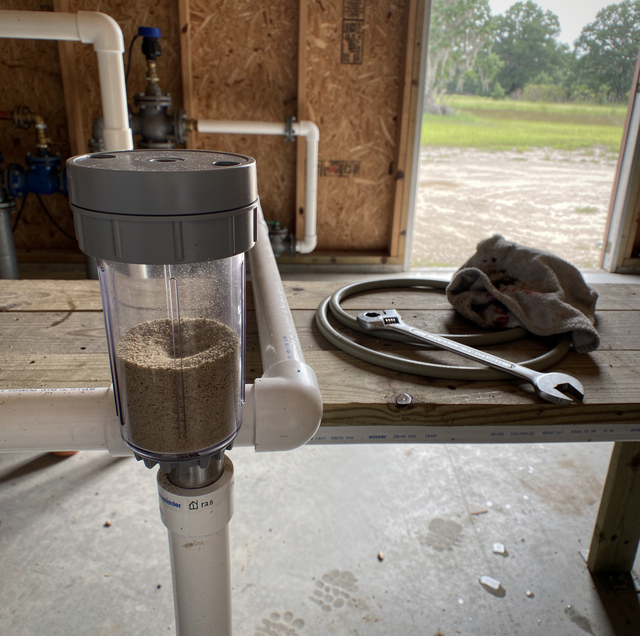
Back the filter housing off after a week of irrigating and tip whatever is sitting in the bottom of the canister into your palm. A gritty tan layer that grinds between finger and thumb like wet sandpaper is the most useful diagnostic sample on the property, and it costs nothing to collect. The fine ring inside a sprinkler head that used to throw a clean fan is the same sample. So is the small pile that comes back in a strainer basket a few weeks after it was last cleared.
Read that material carefully, and it points at a source. Read it carelessly, and the repair goes the way most of these repairs go: grit shows up in the water, the pump is the expensive thing standing closest to the water, the pump gets rebuilt or replaced, and the sand comes back, because the pump was never making it.
What follows is that evidence read in order. What the debris physically is, where a well produces it when nothing is broken, what a pump can and cannot contribute, and what changes partway through a cycle that start it moving.
What the Sand Itself Can Tell You
Not everything that collects in an irrigation system is sand, and sorting the material by hand narrows the search before anyone goes near the well.
Hard angular grains, gray, tan or near-white: True sand and grit. It settles fast, feels abrasive, and does not break down between the fingers. This is formation material, quartz sand and rock fines that came up the well with the water. Spread thin and dry on a white surface, the grains catch light individually, and running a magnet over them leaves them where they lie.
Rust-colored flakes, or a red-brown stain that smears: Iron, either dissolved iron that oxidized once it met air or bacterial growth breaking loose in slugs. It crushes and smears when rubbed rather than grinding. Sand does not. Iron also tends to arrive in pulses rather than steadily, and it often carries a slick feel that formation grit never has.
Bright metallic flecks in brass or bronze color, or a dark gray paste: Not formation material at all. That is equipment shedding its own material. Bronze and brass flecks come off impellers, wear rings and diffusers as they abrade, and a dark gray paste with a greasy feel is bearing and coupling material ground fine. This is the one finding that puts the pump on the suspect list rather than the well.
Quantity is its own clue. A faint dusting reads very differently from a spoonful in a strainer every couple of weeks, and a system that ran clean for years before turning gritty is saying that a condition changed rather than that something wore out slowly.
Sand and cloudiness are not the same complaint. Grit settles out fast and feels abrasive between the fingers, while a haze that stays suspended for hours points to clay or silt, which behaves differently and comes from elsewhere.
Open-Hole Rock Wells Produce Sand With Nothing Broken
Wells in this aquifer are finished in two very different ways, and the difference determines whether anything downhole can be repaired at all.
Some are cased and screened through loose, water-bearing sand. There, a screen and its gravel pack hold the formation back, and both can corrode, abrade, settle, or bridge until they no longer do. That case has a repair attached to it, and the repair belongs to a drilling contractor.
The other case has no screen to fail, and it gets missed constantly. Wells drilled into limestone are commonly finished as open holes, with casing set through the upper material and bare rock below it. Wells into the Floridan Aquifer commonly land somewhere between a hundred and four hundred feet, and the rock they enter is karst: limestone shot through with solution openings, bedding planes and seams, many of them partly filled with sand and clay left behind as the rock dissolved.
If a borehole intersects one of those sand-filled seams or a solution channel packed with sediment, that material is simply part of what the well produces. Nothing broke. There is no screen down there needing replacement and no defect to correct, and no amount of pump work changes what the rock hands over. This is the finding people struggle with most, because every other line of the diagnosis ends in a repair and this one does not. What it changes is the plan. The response is management rather than repair: matching demand to what the well gives cleanly, keeping the intake well above the depth where that material settles, and putting separation and filtration where they protect everything downstream of the pump.
Sand that appears suddenly and in large quantities after years of clean water is worth a service call before the next irrigation cycle. Abrasive water does its damage quickly, and the well side rarely settles back down on its own.
What the Pump Contributes, and What It Cannot
A pump moves sand, wears from sand, and eventually sheds material of its own. What it cannot do is manufacture silica. No part inside a centrifugal or submersible pump is made of quartz, so anything gritty and mineral in the water arrived from outside the pump.
That single fact settles most of these calls, and it is why sorting the debris does more work than any part swap.
What a worn pump does contribute is metal, not sand: Impellers, wear rings, and diffusers give up brass, bronze, or stainless particles as they abrade. Worn bearings and a failing shaft coupling shed dark rubber crumbs and gray paste. Those are separable from formation sand on sight, and if the debris is entirely metallic with no true grit present, the diagnosis really does live in the pump.
What a tired pump contributes indirectly is run time: A pump that has lost efficiency runs longer to deliver the same water, and more total water moved means more total solids delivered, even though nothing about the water itself has changed. The complaint gets worse while the source stays exactly where it was.
In every one of these cases, the pump sits downstream of the problem. It is the component that shows the injury, not the one that causes it.
Velocity and Submergence: Why Grit Arrives Partway Through a Run
Sand that comes and goes inside a single irrigation cycle is not a second source. It is the same source with the velocity turned up.
Water enters a well faster when more is being taken out of it, and faster-moving water carries larger particles. A well that gives clean water at a modest demand can start producing grit as demand climbs, with no physical change in the well at all. That is why adding heads, opening two blocks together, or stretching a schedule can turn a clean system gritty without anything having failed.
Submergence tightens the same screw as the cycle runs on. As a well draws down under load, the water level falls toward the intake. The closer it gets, the faster water has to move through the remaining column to reach the pump, and velocity carries particles. Material that stays put through a short cycle starts moving in the last stretch of a long one, which is why grit in a strainer basket often traces to the tail end of the longest set on the schedule rather than to the whole run.
Two things follow. The timing of when the sand appears within a cycle is a real measurement rather than an impression, and it is worth writing down alongside the run length that produced it. And demand is an adjustable input: splitting one long set into two shorter ones, or moving a block to a different start time, changes the velocity the well sees without anything being touched downhole.
Reading the Evidence Before Anything Gets Pulled
Everything above turns on the material itself, so the sequence starts there rather than at the pump.
Sort the debris first. Angular grit says formation, smearing rust says iron, metallic flecks and gray paste say equipment. Then note when in the cycle it arrives, steadily or only in the last stretch. Then pull the well's construction record, which tells whether there is a screen at all, at what depth, and where the pump was originally set, since without it a good part of this diagnosis is guesswork. A drawdown test measures whether the well is being asked for more than it comfortably gives and whether it belongs in the sequence, but on a sand complaint, it confirms what the debris already indicated rather than leading the way.
The pulled pump is evidence as well, and it is worth reading rather than replacing sight unseen. Abrasion across the stages describes what the pump was fed. The wear pattern is a record of the water, not a cause of it.
Where that lands sorts into three cases. If the material is metallic and no grit is present, the work is pump work and gets handled directly. If the material is formation sand with a screen or casing problem behind it, that is rig work performed by a licensed well drilling contractor, and the honest move is to say so plainly rather than sell a pump that will not fix it. And if the material is formation sand out of an open hole, there may be nothing to repair at all, which turns the useful conversation toward setting depth, demand, and what filtration protects the rest of the system. Knowing which of the three you are in is worth more than any part on the truck, and a handful of grit answers it faster than a quote does.
Frequently Asked Questions
The pressure tank and the switch take the quieter hit. Solids that make it past the pump settle at the bottom of the tank and in the tank tee, and eventually enter the small sensing port that feeds the pressure switch. A partly blocked port makes the switch read pressure late, which shows up as short cycling or a system that will not shut off cleanly. It gets misdiagnosed as a failed switch when the real cause is the sediment sitting in front of it.
Not by itself. Producing solids and producing less water are separate problems, and plenty of wells do one without the other. The symptom that points at supply is air: spitting, surging heads, or a hiss of air in the discharge means the pumping level has reached the intake and the pump is breaking suction. Sand without air behaves like a source problem; sand and air together point at a well being pumped past what it can deliver.
A slug of grit in the first minute or two, followed by clear water, usually means the material was already in the system rather than arriving fresh from the well. Solids settle out inside the drop pipe, the lateral lines, and the low points of the piping while the system sits idle, then get flushed forward the moment flow resumes. Grit that keeps coming steadily through the whole cycle is the pattern that points back to the well.
Yes, and the cooling constraint is the one that surprises people. A submersible motor is cooled by water flowing past its housing on the way to the intake, so it requires a minimum flow velocity across it, as well as sufficient water above it to remain submerged throughout the full drawdown. Set high in a large-diameter casing, that motor can sit in water barely moving even while the pump runs. The fix is a flow sleeve, sometimes called a shroud, which forces water down past the motor before it enters the pump.
Clear the suction-side strainer basket and the downstream filter housing on the same day, then check the two separately after a single irrigation cycle. Material back in the strainer ahead of the pump arrived from the well on that run. A housing that loads up while the strainer stays clean is collecting what was already lying in the laterals and the drop pipe, which was flushed forward by the flow. Two containers, one cycle, and a question that usually takes weeks to answer itself.
The wear pattern is a record. Erosion spread evenly across every stage, with vanes thinned top to bottom, says the pump lived in gritty water for most of its service life. Damage concentrated in the lowest stage or two while the upper stages stay crisp points to intermittent slugs drawn from near the bottom of the well rather than to steady production. Grooved wear rings and clean vanes are a third pattern altogether, and that one is clearance and bearing wear rather than abrasion.
Bring a sample of what is collecting in your filter housing — an honest diagnosis starts with what the debris actually is, not with a new pump. Perry-Pump Repair Service LLC serves Lake Butler, Gainesville, and Alachua. Call (352) 320-2412.
