
Warning Signs Your Sprinkler Pump Is About to Fail
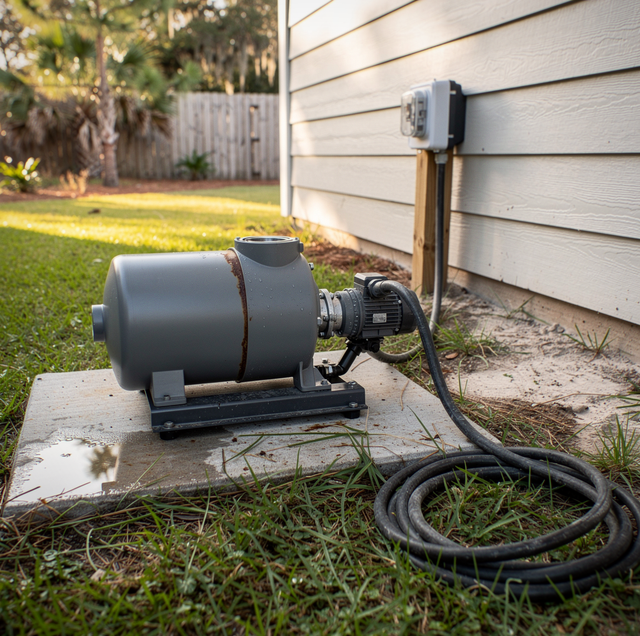
A sprinkler pump almost never goes from fine to dead in one step. It gives notice first, usually more than once, and usually in more than one place. The trouble is that each individual sign is easy to write off on its own: a zone that runs a few minutes longer than it used to, a hum that wasn't there last month, one head that no longer reaches the far side of the bed. None of those feel urgent on their own.
What matters more than naming which part is wearing out is knowing what each sign obligates you to do this week. Some of them cost nothing but a note on the calendar. Some mean picking up the phone before the next watering day. A few mean shutting the system off and leaving it off. Sorting them that way, rather than by which component is at fault, is how you tell an inconvenience from something that needs to stop running today.
Write down which sign showed up first and which zones were running when you noticed it. That order matters more than any single symptom once a technician starts working through what's actually failing.
Sort Every Sign into One of Three Piles
Every warning a sprinkler pump gives lands in one of three piles, and the pile decides what happens next.
Watch it: A small drop in reach at one head, a zone finishing a few minutes late, a hum on start-up that clears the moment the pump catches. Write down the date and keep watering. These belong in the conversation at the next service visit, not in a call of their own.
Book a visit: Weak coverage across every zone at once, a pump that has to be primed again each morning, a pump that starts and stops repeatedly instead of running a full cycle, or a hum that no longer clears. The system is still delivering water, so this is a scheduling conversation rather than an emergency one. None of these reverse on their own, and the wait is not free.
Stop now: Grinding or knocking from the pump housing, any dampness or drip at the shaft, or a breaker or GFCI that trips when the pump starts. Shut the system off at the disconnect and leave it off until it has been looked at. Each of these can escalate from a part to an assembly quickly, and in the electrical cases, as far as the motor windings.
The rest of this article works through where these show up, and each section ends with the pile they land in.
What You Notice at the Sprinkler Heads
The heads are where most people notice a problem first, because that is the part of the system anyone actually watches. Spray that used to reach the edge of the bed now falls short. One or two heads barely pop up while the rest look normal. A rotor that used to swing its full arc turns partway and stalls. The spray itself comes out coarse and heavy rather than fine.
A steady, across-the-board drop means the pump is no longer moving the water it was built to move. Coverage that has never been quite right, going back to the season it was installed, points instead at a pump that was never matched to the system. Those are different problems with different fixes, and each has its own diagnosis: the warning signs of a worn impeller on one side, and the signs a pump was the wrong size from day one on the other.
Pile: book a visit. Weak coverage costs a lawn, not a pump, and the system will keep running while it waits for an appointment.
What the Pump Itself Sounds Like
Stand next to the pump for one minute with a zone running. Three sounds are worth separating, and they do not carry the same weight.
A hum at start-up, especially when the pump hesitates or needs a couple of tries to catch, comes from the starting circuit rather than the water path. What that hum means, and what it turns into when it is left alone, is covered in the article on bad capacitor symptoms.
A rattle or knock from inside the housing, the sound usually described as marbles rolling around, and a steady whine or grinding note are all mechanical, and they come from opposite ends of the pump. What you are hearing is a real diagnosis rather than a guess, and it is worked through from start to finish in the article on what irrigation pump noise is telling you.
Pile: the hum can wait for the next available appointment. The rattle and the grind cannot. Neither of those two sounds gets quieter on its own, and running the pump while somebody decides which one it is costs metal that does not grow back. Shut it off and let the diagnosis happen with the pump stopped.
How the Run Pattern Changes as a Pump Weakens
The schedule is as informative as the sound, and reading it takes nothing but attention. A zone that used to finish within its normal window now takes noticeably longer to put down the same amount of water. Or the opposite: the pump starts, runs a few seconds, stops, and starts again, over and over, instead of running the cycle through.
The long run says capacity is going somewhere it should not, whether that is inside the pump or out in the zone piping. The stop-start pattern is short-cycling, and it is the more urgent of the two because wear is counted by starts rather than hours. Sorting out which one is in front of you is handled elsewhere: the article on a pump that loses pressure partway through a cycle, and the one on telling a low-pressure zone apart from a pump problem.
Pile: Book a visit, and put short-cycling ahead of a long run in the queue. A pump finishing late is working inefficiently. A pump cycling every few seconds is spending motor life at every restart.
What Turns Up Around the Equipment, Not in the Water
Some of the clearest signs are not in the spray or the sound at all. They are what you find standing at the pad looking at the equipment. Dampness at the shaft where the pump body meets the motor. A drip mark or a rust streak down the housing. A wet patch under the pad on a morning nothing has watered. A pump that primed fine all last season and now has to be primed again every morning.
A wet shaft means the mechanical seal has started to weep, and that seal is the only thing standing between the water and the motor. The article on pump seal failure symptoms covers what a technician checks once that begins. A pump that will not hold prime overnight is usually the foot valve at the bottom of the suction line, which has its own article on a sprinkler pump that won't pull water.
Pile: the priming problem books a visit. The wet shaft stops now and stays off because it's no longer only about the pump.
When Two Signs Show Up Together
On their own, most of these sit in the first two piles. In pairs, several of them move up.
A hum at start-up by itself is a scheduling call. A hum plus a breaker that trips on start-up is not: together they say the motor is drawing current it should not while it struggles to start, and the pile changes to stop now. Dampness at the shaft plus any electrical symptom at all, even one that cleared up by itself, is the same call for the same reason, since the pair describes water and electricity converging. Weak coverage plus a rattle is not two separate small problems either. The rattle accounts for the coverage, and the coverage says it has been going on long enough to reach the spray pattern.
The habit worth building is not naming the failed part. It is noticing the moment the second sign arrives, because that is the point where a scheduled repair and an emergency one are still two different outcomes.
A pump that trips its breaker or GFCI every time it starts shouldn't be reset repeatedly and left running. Shut the system off and have it looked at before that fault has a chance to reach the wiring or the motor itself.
Frequently Asked Questions
More than one, almost always. It's common for a technician responding to a single complaint, like a pump that won't start, to also find evidence of an older issue nearby, such as corrosion on a wiring connection or wear consistent with months of short-cycling, that never got mentioned because nobody connected it to the pump.
It changes what the repair covers. A mechanical seal that is only weeping is usually a seal and a shaft sleeve, with the motor left alone. Once it has been weeping through a full season, water has been tracking along the shaft toward the bearing nearest the seal, and the parts list grows to take in that bearing, and sometimes the shaft surface itself. On a close-coupled pump, where the impeller rides on the motor's own shaft, a seal left long enough is no longer a pump repair but a motor decision. Same symptom on the day it appeared, different job by the time it is opened up.
Before opening anything up, a technician will typically run the system through a full cycle on at least one zone, watching pressure at a head and listening at the pump housing at the same time. That establishes which of these channels- sight, sound, or timing- the fault is actually showing up in, rather than working from a phone description alone.
Yes. Fire ants are drawn to the warmth of an outdoor control box and can build up enough debris inside to keep the contactor from closing fully. To the homeowner, it looks exactly like the pump simply refusing to turn on, with no hum, no click, and no other symptom leading up to it.
It can look that way, and that is the most misleading thing a failing pump does. A weeping seal stops showing a drip once afternoon heat carries it off as fast as it appears, so the pad reads dry at three in the afternoon and wet at seven the next morning. A marginal start component often struggles on the first cold start of the day and behaves normally by the second cycle, once everything in the control box has warmed up. Neither part recovered. Intermittent is a stage on the way to constant, and a sign that comes and goes should be reported along with the conditions it occurred under.
The technician rebuilds the order from the hardware instead. Wear keeps its own record: mineral staining and scale on a seal face say the leak has been running for months, while a clean, bright weep track says it started recently. Contactor points pitted evenly across the face read as ordinary cycling, while points burned heavily on one side read as chattering under a marginal start. A control box that smells hot, with nothing visibly damaged, puts the starting circuit ahead of the wet end, no matter what was reported on the phone. A written list only gets to the same answer faster, which is the whole reason to keep one.
Get every warning sign checked in one visit — a technician traces which one matters before the pump quits for good. Perry-Pump Repair Service LLC serves Lake Butler, Gainesville, and Alachua. Call (352) 320-2412.
