
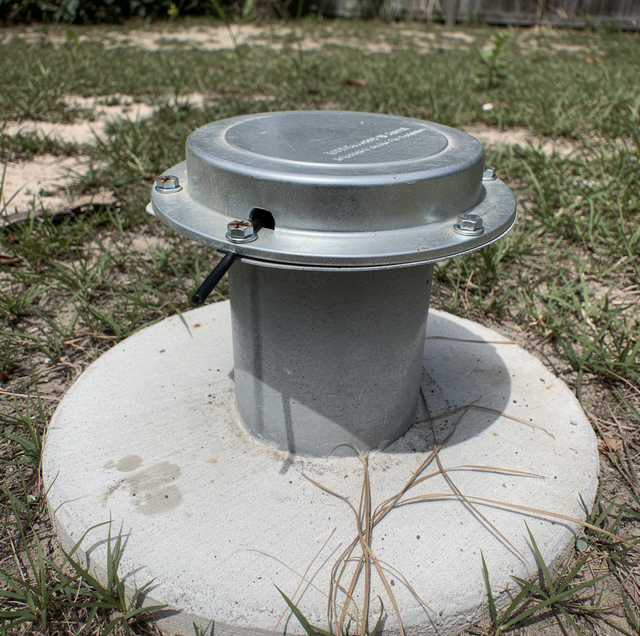
The top of a well casing has three jobs to do at the same time. It has to let the pump's wire, and on some wells the water pipe, pass through. It has to let air move in and out as the level inside the casing drops while the pump runs, and rise back up when it stops. And it has to keep insects, rain runoff, leaves, grit, and small animals out of the column of water the house drinks from. A cover that sits over the opening handles the first two jobs and leaves the third to chance, since whatever fits through the gap can fall into the water. A sealed cover handles all three, and the two designs differ in a handful of physical details, laid out point by point here.
| Point | Standard well cap | Sanitary well cap or seal |
|---|---|---|
| How it fastens | Set screws press against the casing and hold the cap in place loosely | Bolts draw the cap or seal tight so it clamps onto the casing |
| Seal against the casing | No gasket; a small air gap remains between the rim and the casing | A rubber gasket or ring is compressed against the casing wall |
| Wire and conduit entry | An open notch or loose opening for the wire | A fitted hole that takes a conduit connector or a sealed grommet |
| Venting | Air passes through the rim gap or an unscreened opening | A dedicated vent covered by fine screen |
| What it keeps out | Rain and larger debris from directly above | Insects, runoff, debris and small animals from every side |
| What a failed one looks like | Cap shifted or tilted, rim rusted thin, nesting material under it | Hardened or split gasket, torn screen, loose conduit fitting, cracked body |
| What a service visit checks | Whether the cap still covers the opening and the casing is intact | Gasket compression, bolt condition, vent screen, conduit seal and cap body |
Where a Standard Cap Leaves Gaps
A standard cap is a cover and little more. The cap body rests on the rim of the casing, and a few screws threaded through its skirt bear against the outside of the pipe to stop it sliding off. Nothing between the cap and the casing is designed to close the joint. Metal meets pipe at a few points, and the rest of the circle is a thin air gap.
That gap is small, but the things that get into wells are small too. Spiders, earwigs, and beetles move in because the space under the cap is shaded and still, and some of them fall or climb down the wire into the casing. Rainwater from a hard downpour can wick along the underside and run in at the gap, and mice or other small animals can squeeze through once the screws have loosened.
The wire entry adds a second opening: a notch in the skirt or a hole the cable passes through with room to spare, so there is a path in right beside the path out. Where a standard cap has an air slot, that slot can be bare.
A standard cap is also held on by friction alone. A mower deck that clips it or a pet that knocks into it can push it sideways until one edge sits off the casing, leaving the well open on that side while a cap still appears to be in place.
How a Sanitary Cap or Seal Closes the Casing
A sanitary cover works by compression. A rubber gasket or ring sits between the cover and the casing, and bolts pull the parts together until that rubber is squeezed hard against the pipe wall all the way around, filling the small irregularities in the casing surface so no continuous gap remains. The seal holds only as long as the gasket stays pliable and the bolts stay tight.
The sealed designs come in two broad forms, and they close the casing in opposite directions.
Sanitary cap: This version fits over the outside of the casing. Its gasket seals against the pipe's outer wall, and the cap body closes over the top. It suits a well where the water line leaves through the side of the casing below ground, so the only things passing through the top are the pump wire and the air exchange.
Sanitary well seal: This version fits inside the casing at the top. Two plates sandwich a thick rubber ring, and tightening the bolts squeezes the plates together, causing the ring to bulge outward against the casing's inner wall. The water pipe comes up through a hole in the plate; the wire passes through a separate sealed hole; and, in this design, the pump and its drop pipe hang from the seal itself.
Which of the two a particular well carries depends on how its water line leaves the casing and how its pump is hung, and that is settled at the wellhead by the contractor working on it. Either one closes the casing when it is the right fit and properly installed.
The Vent: Why a Sealed Well Still Breathes
Sealing the top does not mean sealing off the air. When the pump runs, the water level in the casing falls, and air has to come in above it; when the pump stops and the level recovers, that air has to go back out. A casing closed tight with no vent would pull a partial vacuum as the pump drew the level down, and that vacuum draws air, with whatever it carries, through the weakest point it can find, such as a worn gasket edge or a loose conduit fitting.
So a sanitary cap or seal has a dedicated vent covered by fine mesh, which lets air pass while keeping insects out. With that screen whole, the well breathes through one controlled opening instead of through gaps nobody chose.
The mesh can tear when something strikes the cap, corrode through, or clog with dust and spider silk, preventing air from passing. A missing screen turns the vent into an open hole leading down to the water, and a clogged one pushes the air exchange back toward the gasket and the fittings, which defeats the reason for sealing them.
Sealing the Wire and Conduit Entry
The pump's power wiring enters the well through the top. On a sanitary cap or seal, that entry is a fitted hole sized for a conduit connector or a rubber grommet that grips the cable. The conduit runs from the cap down into the ground or across to the pressure switch, and the connector at the cap is threaded or clamped to ensure the joint closes.
Conduit that is bumped, pulled by settling soil, or struck by a trimmer can loosen at the connector, crack just below it, or separate from the fitting. The sealed cap then has an open tube leading into it, one that can channel rainwater and insects into the casing. Ants that travel along an unsealed conduit can also reach the pump's electrical enclosures, which is a separate problem with its own repair.
A sealed entry also keeps water from standing inside a loose conduit or dripping onto the wire splices under the cap, so closing it protects the wiring and the water at once.
The pump's supply wiring passes through the well cap and remains live whenever the breaker is on, so opening the cap, loosening its bolts, or moving the conduit poses a risk of electric shock. That work belongs to the licensed well contractor.
Signs the Top of the Well Is Open
A walk-around look, touching nothing, is enough to spot the failures that open a well:
- A cracked or broken cap body: Sun-aged plastic can split from a single knock, and metal can corrode until the rim is thin or holed.
- A missing or torn vent screen: Look for a vent opening with no mesh, a flap of torn screen, or a vent packed with debris.
- A loose or separated conduit: A conduit that wobbles, leans away, or shows a gap at the connector is an open path.
- Insects around or under the rim: Ant trails up the casing, wasps entering at the cap, or webs crowding the edge show that something has found a way in.
- Mower or trimmer damage: Scuffs, gouges, or a chipped edge on the cap or conduit can mean the seal was knocked out of true even if nothing looks broken.
- A cap sitting crooked: A cap that tilts or sits higher on one side has lost contact with the casing on that side.
When the top of a well has been open or damaged, the water deserves attention too. Water that turns cloudy or changes in taste or smell after the cap is damaged or left open is a reason to stop drinking it untreated and have it tested. Chlorine poured down the casing as a home remedy is off the table; the water test comes first, and the next step follows from its result.
Bringing the Wellhead Back to Closed
Cap-and-seal repair brings the top of the well back to a closed condition. With the power off, the contractor removes the cap or seal, looks inside the casing top for insects, nests, or debris, and checks the casing rim for damage. From there, the work depends on what failed: a new gasket where the old one has hardened or split; a new sanitary cap or seal where the body has cracked; a loose standard cap being replaced; a new vent screen; or a resealed conduit connector at the wire entry. The bolts are then drawn down to squeeze the gasket evenly, and the finished wellhead undergoes a sanitary inspection.
Where the casing top sits too close to the ground, a wellhead extension that raises it can be planned as part of the same work. Well work follows the state's rules, and the licensed contractor handles any permits the job requires.
Frequently Asked Questions
On some models, yes: the cap's bolts come with tamper-resistant heads that need a matching driver, so the cap stays closed to anyone but the contractor servicing the well.
Only one made for that casing's size. Caps and seals are sized to the casing diameter, so the casing is measured before a replacement is chosen. A cap made for a different diameter cannot compress its gasket evenly around the pipe, and an uneven gasket leaves a gap on one side.
No. The cap seals the top of the casing, but water can also travel down the outside of the pipe through the annular space between the casing and the drilled hole. On a well built with a grouted annular seal, that space is filled with grout; an older well without one has only the soil around the casing, and ground that slopes away from the casing in every direction keeps surface water from pooling against it.
A vent that opens toward the ground sheds rain and keeps falling leaves and dust from dropping directly into it. The screen keeps insects out, and the downward turn prevents the opening from collecting water. A vent that has been knocked upward or sideways loses that protection.
A hollow cover can sit over a wellhead as long as it leaves room for air around the vent and lifts off without disturbing the cap. Soil, mulch, or gravel piled up against the cap can bury the vent and hold moisture against the gasket, and anything heavy or fixed in place slows down every future service call.
It does, because any job that lifts the pump means removing the cap or seal first. On reinstallation, the gasket is checked and replaced if it has taken a permanent set, because a gasket that has flattened and hardened in its old position no longer rebounds to grip the casing when reinstalled.
Contract wellhead cap-and-seal repair — a new gasket or sanitary cap, a screened vent, a resealed conduit entry, and a sanitary inspection of the wellhead. Perry-Pump Repair Service LLC serves Lake Butler, Gainesville, Alachua, and Lake City. Call (352) 320-2412.