
Sub-Turbine vs. Line-Shaft Turbine: Access vs Service Life
Quick Answer: The choice between a sub-turbine and a line-shaft turbine comes down to where the motor lives — submerged at the bottom of the well for a sub-turbine, or above ground at the surface for a line-shaft. Sub-turbines run cooler and last longer, but require a full pull to service the motor; line-shafts are easier to service but have more wear points and don't handle deep settings as well.
Send a light down a cased irrigation well, and the two turbine designs stop looking alike the moment it passes the water line.
In a sub-turbine well, the whole machine is down there. Hanging off the bottom of the column pipe is a stack of bowls, each one holding an impeller that adds pressure and a diffuser that straightens the water before handing it up to the next stage. Underneath that stack, below the suction inlet, hangs the motor: a slim sealed cylinder, liquid-filled, turning the entire assembly from beneath. A power cable runs the full length of the column, strapped to the pipe, spliced above the motor and sealed against the water it sits in. The motor never sees air. It runs submerged, and the water it moves is the same water carrying its heat away.
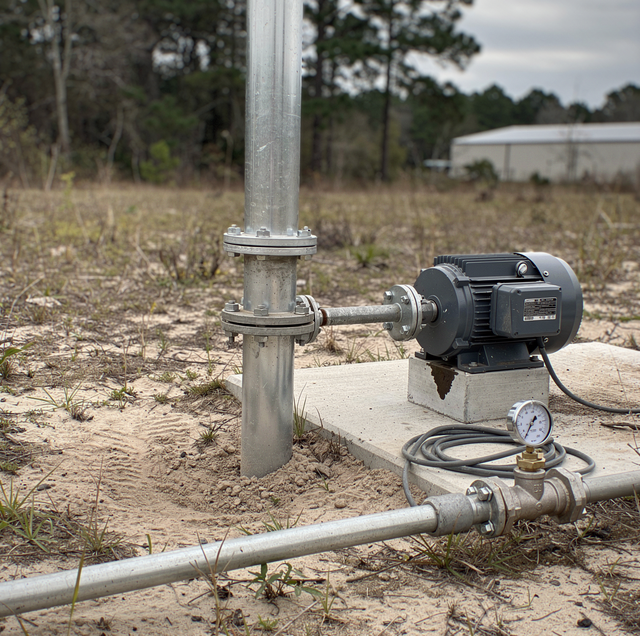
In a line-shaft well, the bowls sit in the same place and do the same work, but there's no electrical equipment in the hole at all. From the top bowl, a shaft rises the full height of the column, supported by bearings spaced along the way, and ends at a motor bolted to a base directly over the top of the well. The water still travels up the column. The torque comes from above rather than below.
Everything an operator eventually deals with, good and bad, follows from that one difference in where the motor lives.
Two Places to Put a Motor
A submerged motor gets something no surface motor gets: a bath of moving water at aquifer temperature, running past it every minute the pump is on. That constant heat removal is why sub-turbine motors tend to log long, uneventful service lives. Heat is what ages electrical insulation, and a motor that never gets hot is a motor that keeps its insulation. The trade is not paid in service life at all. It is paid in reach. The motor is at the bottom of a column of pipe that has to be raised from the ground before anyone can lay a hand on it.
A line shaft is a driveshaft stood on end, and it behaves like one. The motor sits in the open where a technician can reach it, inspect it, uncouple it, and replace it while the bowls and the column stay right where they were installed. Nothing goes down the hole to service that motor. In exchange, the design accepts a long rotating shaft with bearings distributed down its length, plus a motor sitting up in the weather, in the dust, and in reach of every power surge that comes down the service line.
Selection: The Well Casts the First Vote
Depth settles most of this before preference gets a say. Most large irrigation pulls draw from the Floridan Aquifer through submersible turbine pumps set deep in cased wells, roughly 100 to 400 feet down. At those settings, the sub-turbine is the default, and for good reason: the deeper the setting, the more shaft, bearings, and alignment a line-shaft design has to carry, and the more the whole surface-motor advantage gets eaten by the length of the connection between motor and bowls.
The line-shaft turbine shows up when the operator specifically wants the motor above ground. That is a legitimate preference, not a compromise. A grower who wants the electrical end of the pump where it can be looked at without a rig on site has a real reason to ask for one. Setting depth, casing size, how the well is used, and which service the operator wants to be simple all get weighed together. Short-coupled turbine work is one thing the shop does not take on and instead refers out.
One more selection factor has nothing to do with the water. A line-shaft turbine's shaft comes out the top, so it can be turned by something other than an electric motor: a right-angle gear drive coupled to an engine is a normal arrangement where grid power is limited, unreliable, or simply not there. A sub-turbine has no such option. Its motor is electric; it sits at the bottom of the well, and it runs on what the service line delivers, or it does not run. Where engine drive is part of the plan, that alone can settle the question.
Routine Service, Year over Year
Day-to-day, the two feel very different to own. With a sub-turbine, almost everything a technician touches in a normal year is at the surface: the starter panel, the discharge plumbing, the check valve arrangement, the pressure controls, the wiring, and the readings that indicate whether the pump down the hole is still doing what it did last season. Amperage, pressure, and delivered flow are the window into the machine, because the machine itself is not visible. That sounds like a limitation, and sometimes it is, but it also means there is very little to physically maintain: no exposed rotating assembly to lubricate, adjust, or shelter.
A line-shaft turbine asks for more attention, and rewards it. The shaft bearings along the column need periodic care. The shaft adjustment at the top of the assembly has to be set correctly so the impellers run where they belong inside the bowls, and it can drift. The surface motor requires its own bearing service and must stay clean and dry. All of that is work, but it's work a technician can do standing on the ground next to the well.
Keep a written record of the pump's setting depth, model, motor rating, and install date somewhere other than the pump house. That single page saves guesswork on the day the well needs service.
The Day It Has to Come Out
Eventually both designs need pulling. That is where the two split hardest.
On a line-shaft turbine, a failed motor is a surface job. The motor comes off the base, a replacement goes on, and the column, bowls, and shaft never leave the ground. Only a bowl or shaft problem forces a full pull.
On a sub-turbine, a motor problem and a bowl problem look identical from the surface: both mean the column comes out. The pipe is lifted in sections, the cable is unstrapped as it rises, and the whole assembly is brought up, laid down, and opened. A well that is a few hundred feet deep is a substantial amount of pipe and water weight, handled over an open hole, with equipment matched to it.
This is not homeowner work or farm-crew work, and it is not something to attempt with a loader bucket or a borrowed hoist. A pipe dropped into a cased well is a serious problem to recover from, and the electrical side is handled by a technician who works on pump panels for a living.
Never open, probe, or work inside an energized pump panel or control box, and never attempt to lift a column of pipe from a well without proper equipment. Both risks are severe, and both are avoidable.
What Wears First in Each Design
Wear does not land in the same places, which is why the two age differently.
On a sub-turbine, the usual suspects are the parts sharing the hole with the water. Sand and fine sediment moving through the bowls slowly erode the impellers and their passages, and delivered flow drops off before anything sounds wrong. The cable and its splice live permanently underwater, where insulation damage from installation abrasion or a lightning event can show up long after the fact. The motor's thrust load runs continuously whenever the pump runs. When any of it fails, the whole assembly comes out, because there is no way to reach one part without reaching all of them.
On a line-shaft turbine, the bowls face the same sand, but the shaft system adds a second wear path that the sub-turbine simply does not have. Bearings along the column wear. Shaft couplings and alignment matter over the full length. The surface motor is exposed to heat, humidity, dust, insects, and the electrical surges that come with open country. None of that is fatal, and most of it is visible or audible before it becomes a failure, which is a genuine advantage of having the machinery where a person can hear it.
Side by Side
| Sub-turbine | Line-shaft turbine | |
|---|---|---|
| Motor location | Below the bowls, submerged | Above ground, over the well |
| Motor cooling | The water being pumped | Surrounding air |
| Typical motor service life | Longer, thanks to steady cooling | Typically shorter; surface heat, dust and surge exposure age it faster |
| Servicing the motor | Requires a full pull | Done at the surface |
| Servicing the bowls | Requires a full pull | Requires a full pull |
| Routine maintenance items | Very few; mostly surface controls | Shaft bearings, shaft adjustment, motor bearings |
| Depth tolerance | Comfortable at deep settings | Grows harder as depth increases |
| Failure diagnosis | Read from surface measurements | Often visible or audible at the well |
Choosing Between the Two
Because the trade runs both directions, the sane way to choose is setting depth first, service preference second. Deep wells push hard toward a sub-turbine. An operator whose main concern is motor access, at a depth where a shaft is still reasonable, has a real case for a line shaft. Both get pulled, both get rebuilt, and both do better on a maintenance rhythm than a failure rhythm.
Frequently Asked Questions
Sometimes, but it is rarely a straight swap. The column on a line-shaft installation is not simply drop pipe: it carries the shaft, its enclosing tube, and the bearing retainers inside it, so most of it cannot be reused as-is. The surface base carrying the motor also comes off, replaced by a wellhead arrangement that passes the cable. A technician will want the well's original construction record first, because casing diameter at depth decides whether a submersible assembly will even fit.
Not automatically. Cooling depends on water actually flowing past the motor, not merely surrounding it. If the pump sits inside a casing much larger than the motor, or below the well's screened interval where water enters above the pump, the motor can sit in nearly still water while running. The fix is a flow sleeve, sometimes called a shroud: a tube fitted around the motor that forces incoming water down past it before the suction draws it in. It is a common oversight on wells where the pump was later reset deeper.
It matters more than most expect: a long shaft tolerates only so much deviation before its bearings begin carrying side load they were never meant to carry. The wear shows up as unusual noise and vibration at the surface, often years into service. Before a line-shaft installation goes into an older well, a plumbness and alignment check of the borehole is the standard way to confirm the well can carry one. Sub-turbines are far more forgiving of a crooked hole, since there is no rigid shaft spanning it.
The bowls show about the same wear, mostly at the wear rings and shaft sleeves inside the bowl assembly. The difference is what sand does outside them. A line shaft with open, water-lubricated bearings meets whatever the water carries, so sandy wells accelerate bearing wear along the column. That is one reason enclosed, oil-lubricated shaft designs exist and are often chosen for abrasive water. A sub-turbine has no equivalent second wear path, since nothing rotates up the column.
When the motor stops, the column of water above the bowls falls back down through them and spins the pump in reverse. On a surface-motor turbine, that backspin can loosen threaded shaft couplings and damage the assembly if the motor restarts against it. Vertical motors for this service are normally fitted with a non-reverse ratchet, a mechanism that allows the shaft to turn in one direction only. If a well has repeated power interruptions and the ratchet is worn or missing, damage accumulates quietly.
Look at the wellhead from a safe distance, without opening anything. A line-shaft installation has a vertical hollow-shaft motor sitting up on a discharge head, and where the shaft passes out of that head there is a packing gland or mechanical seal, occasionally with a slow, deliberate drip. A sub-turbine wellhead has no motor on top at all: just the discharge piping, a sealed cap, and a power cable entering the well. If a large motor is standing over the casing, it is a line shaft. If the only thing above ground is pipe and wire, the machine is at the bottom.
Have a turbine pump inspected before the next irrigation cycle — you get an honest read on where it stands and what service it will need next. Perry-Pump Repair Service LLC serves Lake Butler, Gainesville, and Alachua. Call (352) 320-2412.
