
How a Lightning Strike Can Damage Your Well Pump
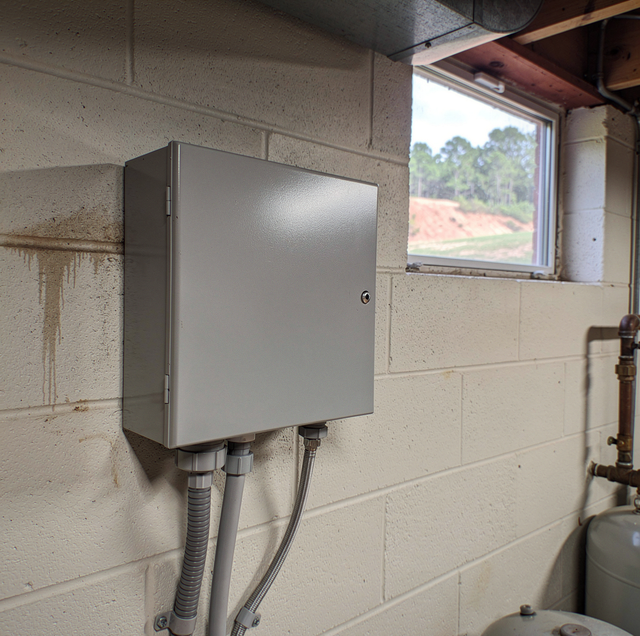
That flash on the horizon and the crack of thunder a few seconds later usually means the strike landed somewhere close, maybe a mile or two away, not on your property at all. Yet the well pump can still go quiet that same night, or the breaker can trip and refuse to reset the next morning. A strike doesn't have to hit a house directly to wreck the electronics that run a pump. It just has to hit the nearby power grid, and from there the damage travels in on the same wires that normally deliver ordinary household current.
How a Surge Reaches a Well Pump
Lightning doesn't need a direct hit on a structure to cause electrical damage. A bolt striking a transmission line, pole-mounted utility equipment, or even open ground near a utility pole can inject a massive, momentary voltage spike into the electrical grid. That spike travels along overhead and underground lines like any other electrical signal, just at a voltage and speed normal wiring was never designed to handle. By the time it reaches a house, it moves through the meter, into the electrical panel, and out along whatever circuits are connected, including the one dedicated to the well pump.
A well pump's electrical path is usually simpler and more exposed than most other circuits in a home. Power runs from the panel, sometimes through a separate disconnect box near the wellhead, down a length of wire (often buried) to the pump itself, and into a control box or capacitor housing that manages the motor's start and run cycles. Every one of those connection points- the disconnect, the splices, the control box components- is a spot where a surge can find resistance and convert that electrical energy into heat, arcing, or outright component failure.
Why Well Pumps Are Especially Exposed
Several aspects of how a well pump is wired make it more vulnerable to surge damage than many other household appliances. First, the pump is often on its own dedicated circuit running straight from the main panel, with no other appliances sharing the line to help absorb or diffuse the surge. Second, the wire run itself tends to be long, sometimes several hundred feet from the panel or a wellhead disconnect down to a submersible pump sitting deep in the casing. A longer conductor can act something like an antenna, picking up induced voltage from a nearby strike even without a direct hit on the line itself.
Buried wire adds another layer of exposure. A strike that hits the ground near a buried run, or even a fence line or metal pipe running close to it, can induce a surge into the wire through the surrounding soil rather than through a direct electrical connection at all. That's a different mechanism than a surge riding in on the utility line, but the outcome at the pump end is the same kind of stress on the motor windings and control components.
The motor windings themselves are copper coils wrapped in a thin layer of insulating varnish, and that insulation is only rated to handle normal operating voltage with some margin built in. A surge that spikes well past that margin, even for a fraction of a second, can punch through the insulation between windings or between a winding and the motor's grounded frame. Once that insulation is compromised, the motor can short internally, draw excessive current, or fail to start at all, and there's no way to re-insulate those windings in the field. A control box tends to fail even more easily, since it houses relays, capacitors, and sometimes circuit boards built with far less voltage tolerance than the motor's copper windings.
What Surge Damage Looks Like Inside the Pump System
A submersible pump's control box, whether it's a simple capacitor housing on a smaller system or a more complex control panel on a constant-pressure setup, is usually the first thing to fail in a surge event. The capacitors and relays inside are built to handle the pump's normal starting current, not a spike measured in thousands of volts, and a surge that gets past the panel and any surge protection in place often finds its way to that box before it reaches the motor.
If the control box survives, the surge can still travel on to the motor itself. Submersible motors are sealed and designed to run underwater indefinitely, which means a winding failure inside one usually isn't something a technician can repair on site. The whole motor and pump end assembly typically needs to come out of the well and get replaced, since there's no practical way to rewind or reseal a submersible motor in the field the way a shop might rewind an open, above-ground motor.
Jet pumps mounted above ground fail a little differently. Their motors sit in open air rather than sealed underwater, so a winding failure is sometimes repairable. However, a surge strong enough to damage windings has often also damaged the pressure switch, the start capacitor, or wiring at the same time, and replacing the whole unit tends to make more sense than piecing together individual repairs.
Recognizing the Symptoms
A pump that goes silent right after a storm rolls through, especially one where a strike landed close enough to rattle windows or set off a car alarm, is the clearest signal to look for surge damage first before assuming something else failed on its own. A few specific symptoms point fairly reliably to an electrical surge as the cause rather than routine wear:
- The pump won't start at all, with no humming, clicking, or any sign of the motor attempting to run, which suggests the control box or motor windings took the brunt of the surge.
- A breaker trips and won't reset, or resets and trips again within seconds, which often means a winding has shorted internally and is drawing far more current than the circuit is rated for.
- A burning smell coming from the control box or disconnect, sometimes with visible discoloration or a melted look to wiring insulation, which points to arcing or a component that overheated and failed during the surge.
- The pump runs, but pressure never builds, which can mean the motor survived, but a capacitor or relay inside the control box didn't, leaving the motor unable to reach full speed.
- Visible pitting, scorch marks, or a cracked capacitor inside the control box or disconnect when it's opened up for inspection.
Any one of these after a nearby storm is worth treating as an electrical issue rather than a mechanical one, and a breaker that won't reset is not something to keep flipping. Repeated attempts to force a tripped breaker back on can push more current through an already-damaged winding and turn a contained failure into a bigger one.
How Surge Protection Devices Help
A dedicated surge protection device installed at the electrical panel, or a smaller one installed at the well pump's disconnect, works by providing a controlled path to ground for that spike of excess voltage before it can reach sensitive components downstream. These devices sit quietly in the circuit doing nothing under normal conditions, then activate in a fraction of a second when voltage crosses a threshold, diverting the surge away from the motor windings and control box electronics.
A surge protector rated correctly for a well pump's circuit meaningfully reduces the frequency and severity of storm-related damage, and plenty of systems with one installed ride out storms that would otherwise have taken out a control box. What a surge protector cannot do is guarantee complete immunity. A strike close enough, or one that induces voltage through buried wire in the ground rather than through the overhead service line the protector is watching, can still push more energy through the system than any single device is rated to absorb. Surge protection reduces risk; it does not eliminate it, and no honest technician will claim otherwise.
Whole-house surge protection at the main panel and a point-of-use device closer to the pump's disconnect work better together than either one alone, since each is watching a different point in the electrical path for a different kind of spike. Neither one replaces a solid grounding system, either. A well casing, a disconnect box, and the pump's control components all need to be properly grounded for a surge protector to have anywhere effective to send that excess voltage in the first place.
What to Do After a Nearby Strike
After any close strike, a quick check at the pressure switch or control box, without opening anything up, can tell a lot. Listen for the pump attempting to start, check whether the breaker has tripped, and note any smell of burning plastic or ozone near the electrical panel or disconnect. If the breaker won't stay reset after one try, stop there and leave it off rather than repeating the attempt, since a shorted winding pulling excessive current can do more damage the longer it's allowed to run in that condition.
A technician checking a system after a suspected surge typically tests the motor windings for resistance and insulation integrity, inspects the control box for scorch marks or failed components, and checks the wiring at the disconnect and wellhead for damage that might not be obvious from a visual look alone. That diagnosis matters because a control box replacement and a full motor pull are very different jobs, and guessing which one is needed usually costs more time than having it properly tested.
Storm-related surge damage is one of the more common reasons a well pump fails without warning, and it's rarely something a homeowner could have prevented entirely on their own. Understanding how the surge travels, why the pump's own wiring makes it a likely target, and what symptoms point to electrical rather than mechanical failure puts you in a better position to react quickly and get the right fix the first time.
Frequently Asked Questions
Yes. A strike on a nearby transmission line, on pole-mounted utility equipment, or even on open ground near a utility pole can send a surge through the grid and into a home's wiring without ever directly touching the property. Induced voltage through buried wire runs near a strike is a separate mechanism that can cause the same kind of damage.
The surge itself passes through the wiring in a fraction of a second, faster than any mechanical protection could react. Whatever damage occurs, whether it's insulation breakdown in the motor windings or a failed capacitor in the control box, happens essentially instantly during that single voltage spike.
Not always, but a breaker that trips during or right after a storm and then won't hold when reset is a strong indicator that a winding or component shorted internally. A breaker that trips once and resets normally, with the pump running fine afterward, is less concerning than one that won't stay on.
Many homeowners policies include coverage for lightning and power surge damage to home systems, though terms vary by policy and insurer. Checking the specific policy language and documenting the damage, including any burn marks or a technician's diagnosis, helps support a claim if one is filed.
Surge protection devices have a finite capacity to absorb voltage spikes over their lifespan, and a device that has already diverted one or more significant surges can have reduced capacity left for the next one. Many models include an indicator light or a serviceable module specifically to allow capacity to be checked periodically.
Not on its own. A generator changes the power source but doesn't filter out a surge that's already present on the circuit, and some transfer switch setups can even pass a surge through from the utility side before switching over. Surge protection and generator backup solve different problems and work best installed together rather than as substitutes for each other.
Schedule a post-storm electrical inspection — a technician can test the motor windings and control box before a small surge issue turns into a full pump replacement. Perry-Pump Repair Service LLC serves Lake Butler, Gainesville, and Alachua. Call (352) 474-7142.
