
Air Sputtering From Well Water Faucets? 6 Real Causes
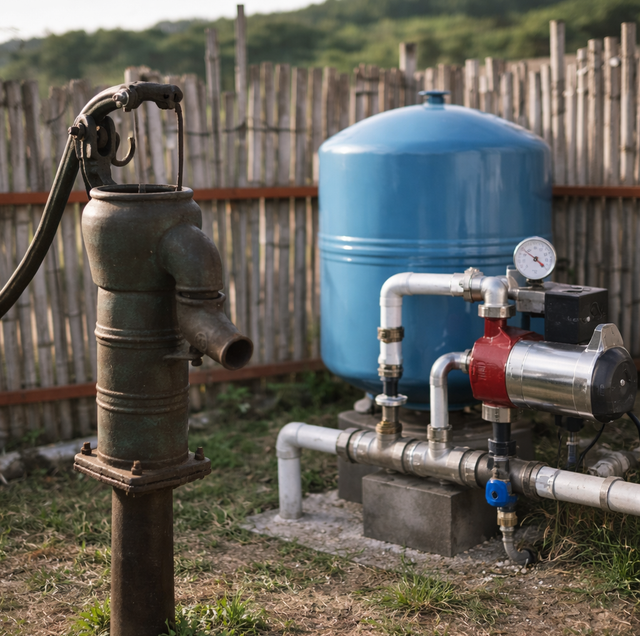
Quick Answer: Air sputtering from faucets on well water means air is entering the plumbing somewhere between the water in the ground and your fixtures. Common causes are a dropping water level letting the pump gulp air, a suction-side leak on a jet pump, a failing foot or check valve, a waterlogged pressure tank, or a cracked drop pipe. A one-time burst after a repair is normal; a persistent problem needs a pro to trace.
You turn on the kitchen tap, and instead of a steady stream you get a cough, a spray, then a burst of air, then water again. On a well system, that stutter almost always means air is getting into a line that should carry only water. It is annoying, and it usually points to something that will get worse if it is ignored.
What Air Spitting Actually Tells You
Water is nearly incompressible, so a healthy well system delivers it in a smooth, solid stream. When you get sputter instead, pockets of air ride along with the water and expand as they hit atmospheric pressure at the spout. That air had to enter somewhere upstream, and where it enters is the whole diagnosis.
There are two broad patterns worth separating right away. Air at every faucet, hot and cold, points to a source shared by the whole house, usually the well, the pump, or the pressure tank. Air at only one fixture points to something local to that fixture, like a failing aerator or a water heater issue on the hot side, and is usually not a well problem at all. The rest of this covers the whole-house pattern, because that is the one tied to the well.
Air right after a service call, a power outage, or a filter change is usually just trapped air. Run every faucet for a few minutes, and it should clear, but if the sputter returns on its own or keeps coming back, that is a live fault worth tracing.
The Water Level Drops Below the Pump Intake
A submersible pump sits down in the well and pushes water up. It is built to move water, not air, and it only makes a solid column when it stays fully submerged. When the water level in the well falls to near the pump intake, the pump starts catching a mix of water and air, and that mix is what you taste as sputter at the tap.
The level can drop for a few reasons. A heavy-draw period, like filling a pool, running irrigation, and doing laundry on the same afternoon, can pull the level down faster than the aquifer refills it. A drought stretch can lower the standing water table over weeks. And a well that was drilled to a marginal depth, or one whose yield has declined as the screen silts up, can simply run short during normal use. A well that recovers after it rests for an hour, then sputters again once you draw hard, is showing you classic draw-down, not a broken part.
The important point for any month of the year is that the level moving is one possible cause among several. A dry spell can drop it, but a leak or a failing valve produces the very same sputter with a perfectly full well, so the season alone never tells you which fault you have.
A Suction-Side Air Leak on a Jet Pump
Not every well uses a submersible. Shallow and deep jet-pump systems sit above ground and pull water up through a suction line, and that suction side is under negative pressure whenever the pump runs. Anything on the negative-pressure side that is not perfectly sealed will draw air in rather than leak water out, which is why a suction-side fault is sneaky. You may see no puddle at all.
The usual suspects are a loose or corroded threaded fitting on the suction piping, a dried-out gasket at the pump, a hairline crack in the suction line, or a pump seal that has started to weep. Because air is being pulled in rather than pushed out, the tell is often a pump that loses its prime between cycles, or one that has to be re-primed to run at all. Think of a straw with a pinhole near the top: you can suck all you want, but you pull in air through the hole instead of drinking through the bottom. That pinhole is what a suction-side leak does to a jet pump.
A Failing Foot Valve or Check Valve
Your system depends on a one-way valve to hold the water column in place when the pump shuts off. On a jet system, that is the foot valve at the bottom of the suction line; on many submersible setups, it is a check valve up in the line. Either way, its job is to stop the water from draining back down into the well between cycles.
When that valve wears out or gets a bit of grit stuck in it, it stops sealing, and the column drains back down after each run. The empty pipe fills with air, so the next time the pump starts, it has to push that slug of air through the whole system before water arrives. The signature here is timing tied to rest. If the first draw after the house has sat quiet overnight comes out full of air and spitting, then runs clear once it has purged, a leaking foot or check valve is high on the list. A pump that short-cycles, snapping on and off rapidly, can point the same direction because the drained column keeps tripping the pressure switch.
A Waterlogged or Failed Pressure Tank
Your pressure tank is not just a reservoir. It holds a cushion of compressed air, usually behind a rubber bladder or diaphragm, and that air cushion is what delivers smooth, steady pressure between pump cycles. When the tank works, you never notice it.
A tank becomes "waterlogged" when it loses its air charge or the bladder fails, so water fills the space the air cushion should occupy. With no cushion left, pressure swings wildly, the pump kicks on and off constantly, and the churning water can pick up and deliver air to the taps. On a bladderless tank, the air and water sit in direct contact, and the air slowly dissolves into the water and gets carried off, which is the classic path to waterlogging. A quick homeowner tell, with the system off and depressurized: a healthy bladder tank sounds hollow when you tap the top and dull-solid near the bottom, while a waterlogged one sounds solid most of the way up.
Checking the tank safely: You can look and listen, but leave the electrical and the pump itself alone. If you are comfortable, note whether the pump cycles far more often than it used to, and whether the tank feels unusually heavy or full-solid when tapped. Checking the tank's air valve should only be done with the pump power off and the system pressure released first. Anything involving pump wiring, or pulling the pump or drop pipe, is heavy, specialized work and belongs to a technician, not a Saturday project.
A Cracked Drop Pipe
The drop pipe is the run of pipe that carries water up from a submersible pump to the surface. Over years of pressure cycling, thermal movement, and the sheer weight of a hanging column, that pipe or one of its couplings can crack or separate. Once it does, water escapes back into the well through the breach on the way up, and air gets drawn into the column through the same gap on the pump's suction stroke.
A cracked drop pipe often reads like a mix of the other faults, which is part of why it is hard to self-diagnose. You may see reduced flow, air spitting, and a pump that runs long or cycles oddly, all at once. Because reaching the drop pipe means pulling the pump out of the well, confirming and repairing it is squarely professional work. It is worth naming here so you understand why a tech may need to pull the system rather than adjust something at the surface.
How a Pro Diagnoses the Real Cause
A good technician does not guess. Rather than swap parts and hope, they run a few measurements that cleanly separate these causes.
Draw-down and recovery: By running water at a known rate and watching how the well behaves, a tech can tell whether the level is falling to the intake. A well that draws down and sputters under load, then recovers on rest, points to level or yield rather than a leaking valve.
Pressure and cycle test: Watching the pressure gauge through a full on-off cycle shows a pro whether the tank is holding its cushion. Rapid short-cycling and a pressure needle that snaps instead of glides point to a waterlogged tank or a check valve that will not hold.
Well level and static check: Measuring the standing (static) water level and comparing it to the pump's set depth tells the tech whether there is enough water over the intake in the first place, which sorts a genuine level problem from a leak that mimics one.
Isolating the suction side: On a jet pump, a tech can pressure- or vacuum-test the suction line to find a leak that never drips a drop, then trace it to the fitting, gasket, or crack that is pulling air.
Put together, those checks tell a tech whether they are chasing a dry well, a bad valve, a tired tank, or a failed pipe, without pulling the pump until the evidence says they must.
One-time air versus a real problem: Keep the two cases separate. If you just had the filter changed, lost power, or had work done and now get a burst of air, run every faucet for a few minutes and it should clear. If the sputter returns on its own, keeps coming back, or is paired with pressure swings, dropping flow, or a pump that cycles oddly, that is a fault worth tracing before it strands you without water.
Frequently Asked Questions
Yes. A submersible pump relies on the water around it to carry away heat, so running it while it gulps air lets it overheat, and repeated air ingestion can accelerate wear on the bearings and seals. Jet pumps that keep losing prime run dry in bursts too. Sustained air is one of the faster ways to shorten a pump's service life, which is why chasing the cause early is cheaper than replacing a burned-out motor later.
The air itself is harmless, but the reason it is entering can matter. A suction-side leak that pulls in air can, in some setups, also pull in surface contaminants around the wellhead, and a system that keeps depressurizing loses the positive pressure that helps keep contaminants out. If the sputter is persistent, a bacteria test after the repair is a reasonable precaution, especially on a shallow well.
That pattern points strongly to a check or foot valve that is not holding. Overnight, while no one draws water, the unsealed valve lets the column drain back, and air fills the pipe. The first morning draw pushes that air through, then runs clear once purged. The giveaway is that it happens after any long quiet stretch, not just mornings, so it will do the same after a weekend away.
Indirectly, yes. A badly clogged sediment filter or a silted-up well screen restricts flow enough that the pump can pull harder than the supply allows, which can draw the level down at the intake and introduce air, much like an over-draw. Fine sand and sediment are common culprits for clogging screens and cartridge filters, so a restriction of that kind is worth ruling out before assuming the well itself is short.
A waterlogged tank has lost its air cushion and cycles constantly no matter its size; an undersized tank has a healthy cushion but simply too little storage for the household's demand, so it also cycles often but for a different reason. A pro distinguishes them by checking the tank's pre-charge against its rating: correct pre-charge with fast cycling means undersized, while lost pre-charge means waterlogged.
Opening several fixtures can purge trapped air faster after a repair or power event, which is useful in that one-time case. It does nothing for an active fault, though, because a leaking valve, a dropping level, or a suction-side hole keeps feeding new air in as fast as you flush the old air out. Use the multi-faucet flush to confirm which case you have: if it clears and stays clear, it was trapped air; if it comes right back, you have a live problem.
Get the sputter traced to its real cause — a fast, honest diagnosis before it strands you without water. Perry-Pump Repair Service LLC serves Lake Butler, Gainesville, and Alachua. Call (352) 474-7142.
