
Sprinkler Pump Tripping the Breaker or GFCI? Don’t Reset It
A breaker that trips is a breaker that worked. The pump stopped because a protective device decided that letting the circuit keep running would be worse than shutting it down, and it made that call in a fraction of a second. Standing over a silent pump with three dry zones waiting is a bad morning. The trip itself, though, is the most useful piece of information the system will ever hand you.
It gets more useful the moment you notice which device dropped out.
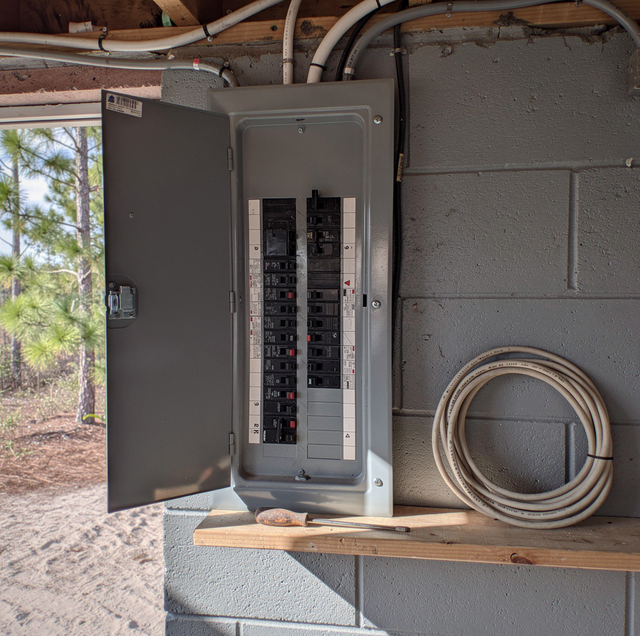
A sprinkler pump on a residential circuit usually sits behind two guards that watch for completely different things. One is the breaker in the panel, which monitors how much current is flowing. The other is a GFCI, either a receptacle the pump plugs into or a special breaker in the panel, which monitors whether current is leaving the circuit somewhere along the way. They shut the pump off for opposite reasons, so knowing which one acted cuts the suspect list roughly in half.
Resetting a breaker that keeps tripping is the one move to avoid. The trip is a protection mechanism working against a real fault, and repeatedly forcing power back through it can damage the motor or the circuit itself.
What a Breaker Is Protecting, and What Trips One on a Pump
A standard breaker is guarding the wire. Its job is to make sure the conductors feeding the pump never carry more current than they were chosen to carry, because current a wire cannot shed as heat is how a wire becomes a fire.
It does that two ways at once. A slow, heat-sensitive mechanism responds to a moderate overload that persists, taking seconds or minutes to let go. A fast, magnetic mechanism responds to a violent surge of current, the kind a dead short produces, and opens almost instantly.
On a sprinkler pump, the slow path is the common one. A motor draws current in proportion to how hard it is working. Every centrifugal pump motor pulls a large gulp of current at startup, and that inrush is normal, brief, and something the breaker is built to ride out. What it will not ride out is a motor that keeps pulling startup-level current because it never got up to speed, or one grinding against mechanical resistance the whole time it runs. Grit in the impeller, worn bearings, a shaft that no longer turns without binding, a start component not doing its share at startup: all of these reach the breaker as current the circuit was never meant to carry.
Breakers also wear. One that trips and resets dozens of times can weaken and start letting go below what it should tolerate, turning the protective device into a second problem on top of the first.
What a GFCI Is Protecting, and Why Sprinkler Circuits Trip Them
A GFCI is not protecting the wire. It is protecting a person.
It keeps a ledger. Every bit of current that flows out on the hot conductor is supposed to return on the neutral, and the device continuously compares the two columns. When the numbers stop balancing, some current has found another way home, and the most alarming version of another way home is a path through somebody standing on damp ground. A very small imbalance is enough to open the circuit, and it does so quickly.
That is why sprinkler pumps trip GFCIs far more often than appliances inside a house do. An above-ground pump lives outdoors. It gets rained on, sprayed by its own heads, heated in the sun and cooled at night, and every one of those cycles pulls damp air in and out of anything not perfectly sealed. Motor insulation ages under that treatment. Terminal connections corrode. Water finds its way into the inside of a junction that used to be dry.
None of that produces a short big enough to interest the breaker. It produces a small, steady current leak to ground, exactly what a GFCI is designed to catch. Outdoor receptacles on modern homes are commonly GFCI-protected, so a leakage fault that an older installation would have lived with now stops the pump cold.
The Faults That Will Trip Either Device
Some problems present at either guard, depending on how far they have progressed; those are the ones worth naming.
Motor winding failure after water intrusion: Water inside a motor rarely announces itself all at once. Early on, it degrades the insulation between the windings and the motor frame, resulting in leakage and tripping the GFCI. Later, when the insulation between the windings gives out, the motor draws hard, and the breaker takes it. Water in a pump motor usually traces back to a failed seal, a repair story of its own.
Moisture or corrosion at the pressure switch and wiring junction: The switch that starts and stops the pump has contacts inside a small enclosure at the pump, often within reach of spray. Pitted or damp contacts arc, and arcing draws current in ways neither device likes. It is a frequent culprit in pumps that trip inconsistently, and it is easy to overlook because the switch may still be doing its mechanical job.
Mechanical drag: Sand and grit are abrasive, and a pump that has been drawing sediment for a season will have worn clearances, a scored shaft, or debris packed where the impeller needs room. The motor answers by pulling more current.
Damaged conductors: A buried feed nicked by a shovel, a cord chewed by rodents, insulation split by a string trimmer. Damage that exposes copper to soil moisture trips a GFCI. Damage that lets two conductors touch trips the breaker instantly.
Damaged control components: Surge events take out capacitors, relays, and controller electronics, and insects nesting in a control box can keep a contactor from closing. Both have their own articles, and both can end at a tripped device.
What the Timing of the Trip Tells a Technician
The pattern is diagnostic, and observing it requires nothing more than attention.
A trip that happens instantly, every single time, before the motor even makes a sound, points at a hard fault: a dead short or a solid path to ground that exists whether the pump is running or not.
A trip that occurs after the pump has run for a while and comes sooner on the second attempt than the first is thermal. Something is loading the motor or the circuit beyond what it can shed as heat, and heat accumulates.
A trip that occurs only after rain, only in heavy early morning dew, or only once the yard has been watered for a while is a leakage fault that closes when things are damp and opens again when they dry. That pattern almost always belongs to the GFCI, and it is why a pump can behave perfectly for a technician standing in front of it at two in the afternoon.
A trip at the moment of startup that never happens during a run points to the start circuit and the inrush period rather than the running load.
Write down which device tripped, what the pump was doing at the time, and how long it ran before it quit. That short record narrows the search before a technician ever puts a hand on the pump.
Why an Above-Ground Sprinkler Pump Fails Differently
A submersible well pump sits underwater at the bottom of a cased well, out of reach of most of the things that break surface equipment. Its electrical failures follow their own logic and deserve their own reading.
An above-ground sprinkler pump has the opposite life. It sits on a slab in the open air, and the motor is cooled by a fan that draws air across the housing. That fan pulls in grass clippings, dust, and mulch, and a motor whose vents are packed runs hotter, pushing it toward the thermal limit that trips a breaker. The wiring, the pressure switch, and every connection point sit exposed to the same rain and lawn chemicals that reach the beds around it.
The circuit differs too. A submersible installation usually gets a dedicated circuit and a proper control box. A sprinkler pump added to a house years after it was built may be fed by whatever outdoor circuit was closest.
How a Technician Works Through a Tripping Pump
Every diagnostic step below the panel belongs to a pump technician, and every step at or inside the panel belongs to a licensed electrician. Neither is a homeowner task. There is no version of this where opening a control box, handling a capacitor, or probing wiring is a reasonable thing to try, and no reason to keep resetting the device in the meantime.
What a technician does is eliminate in order. Confirm which device is tripping and under what conditions. Separate the mechanical question from the electrical one by checking whether the pump shaft turns without binding and whether the impeller and seal area are clean. Inspect the pressure switch and the junction at the pump for moisture, corrosion, and heat marks. Assess the motor for signs of water intrusion. When the evidence points above the pump, at the circuit, or at the panel, that work goes to a licensed electrician.
The outcome is usually specific: a switch, a seal, a start component, a bearing, or a motor. Knowing which one before the pump is torn down is the whole value of reading the trip properly instead of fighting it.
Frequently Asked Questions
Yes. GFCI devices contain sensing electronics with a finite service life, and outdoor humidity shortens it even under a weatherproof cover. One GFCI also protects several receptacles wired after it, and sees the leakage from all of them added together. A pump with a tiny leak plus a yard light fixture with another tiny leak can trip a device neither one would trip alone. A licensed electrician confirms a failed device by substitution.
No, and it removes protection rather than adding capacity. The breaker is sized to the wire feeding the circuit, not to the pump, so a larger one lets the conductor carry more current than it was chosen to handle, usually where overheating goes unseen inside a wall or underground. If a pump actually needs more circuit, the answer is a correctly sized one installed by a licensed electrician.
Because that is the heaviest load the pump ever sees. A zone with more heads open offers less resistance to flow, and a centrifugal pump moving more water draws more current from the motor. A pump already near its limit fails on the widest zone first and behaves normally on smaller ones. Splitting an oversized zone in two lowers peak demand and sometimes ends the tripping, though it will not rescue an already degraded component.
These run in opposite directions, which surprises people. Running a centrifugal pump against a fully closed discharge reduces the current the motor draws because the pump is moving almost nothing. It is still harmful because trapped water heats up quickly, but it rarely trips a breaker. A restricted suction is the likelier troublemaker: it starves the pump, causes cavitation, and produces an erratic, noisy load. If tripping tracks valve position, the fault probably lies elsewhere.
It matters a great deal, and it is one of the fastest clues to collect. If the garage outlets or the porch light go dark with the pump, the pump is sharing a circuit rather than sitting on its own. That means its startup surge lands on top of whatever else is drawing, and the fault could belong to one of those other loads. Naming what else went dead saves a round of elimination.
It does, through a mechanism most homeowners never think about. Voltage drops over distance, and a motor receiving less voltage draws more current to do the same work, which builds heat in the windings and pushes the circuit toward a thermal trip. Extension cords are a common shortcut and a common cause: thinner than the permanent wiring they replace, they worsen the drop, and their outdoor connection point is another place for moisture to create a leakage path.
Call a pump specialist before the next reset — get the fault identified properly instead of forcing power back through it. Perry-Pump Repair Service LLC serves Lake Butler, Gainesville, and Alachua. Call (352) 320-2412.
