
Newberry Watermelon Irrigation Pump: The 5 Season Windows
The Crop's Own Clock
A watermelon plant does not consult a service schedule. It runs on its own clock: root growth in the first weeks after it goes into Newberry ground, a bloom window a few weeks later, then a stretch of fruit fill that either happens on time or not at all. In Newberry, that clock starts when growers plant between April and July and closes when the last melon is pulled between July and August. Nothing about those dates moves because a pump needs attention, because wiring work got pushed back a week, or because a grower's own schedule got full.
The plant sets the terms. The irrigation system behind the field either meets them stage by stage, or the crop absorbs the gap, in the field, in stand and in yield. That is the frame for what follows here: not what a grower should expect from a service call, but why the calendar itself, not convenience, decides when irrigation work on a Newberry watermelon field has to happen, and what a failure at each stage actually costs the plant.
The Pre-Plant Window: The Only Slack in the Season
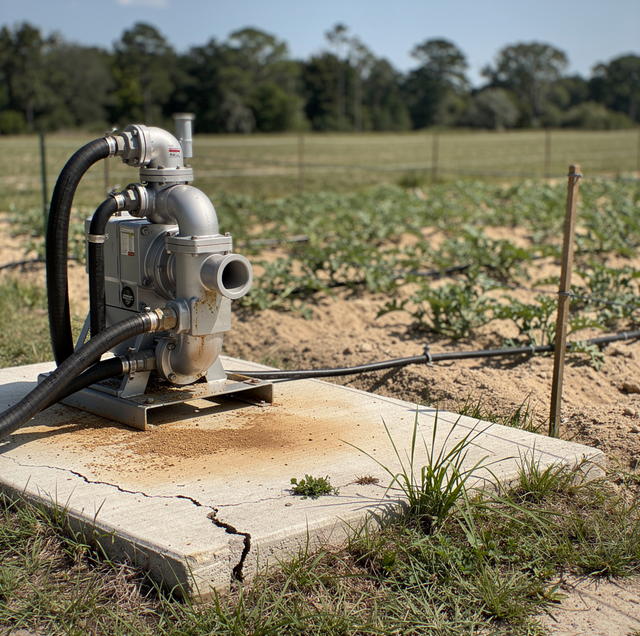
Before the first seed or transplant goes into Newberry ground in April, the field sits idle, and the irrigation system is not yet carrying a live crop. That gap, the weeks ahead of planting, is the one stretch in the entire watermelon calendar where a pump, a pressure switch, or a control box can be worked on without cutting water to something that is actively setting fruit. Once planting begins, that slack disappears until the last melon comes off the vine.
A system already showing early wear- a pressure switch that hesitates before it cycles, wiring in a control box that looks more corroded than it should, a pump that surges instead of running steady- is worth addressing in the pre-plant window rather than waiting to see if it holds. Deferring that kind of repair does not make it optional. It just moves the work into a stretch of the season where the field can least recover from the downtime.
The pre-plant window is also the easiest time to catch a slow leak or a weeping fitting, before peak-season pressure swings hide the symptom inside what looks like normal daily cycling.
Establishment: Getting Roots Down Before Demand Climbs
Once seed or transplant is in the ground, the plant spends its early weeks putting down roots rather than running vine. Water needs during establishment are lower than those later in the season, but consistency matters more than volume at this stage. A young root system that gets a real gap in water does not simply wilt for a day and bounce back; it can end up shallower or less developed than it should be, and the plant carries that limitation into every stage that follows, long after the gap itself is forgotten.
A watermelon field's water need over the season behaves less like a faucet that gets turned on and off and more like a relay handoff: the baton does not stop moving between April and August; it just changes hands from root growth to bloom to fruit fill to harvest, and dropping it at any one exchange costs ground the plant cannot fully make up at the next leg.
Peak Demand: May Through July, When Afternoons Decide the Season
By May, the plant has shifted from building roots to running vine, setting bloom, and sizing fruit, and its daily water need climbs with it. This stretch, May through July, carries the heaviest and steadiest draw on the irrigation system all season. It is also when pump failures tend to show up: on hot afternoons, when the field's pull on the system is at its highest, and there is no slack left in the day to absorb a problem before it reaches the vine.
A missed set at this stage does not look like a slow decline a grower can catch and correct the following week. A bloom that goes unwatered while it is trying to set can drop. Fruit that is mid-fill and loses steady pressure for an afternoon can size unevenly. The plant does not pause and wait for the system to catch up; it responds to what it got that day, and by the time harvest starts, the field is carrying the results of every afternoon in May and June, whichever way they went.
Peak-season afternoons give a struggling pump the least room to fail quietly. A component already weakening in spring often waits until a July afternoon's full draw to actually stop, right when the field has the least room to recover.
Harvest: The Water Discipline Doesn't End When Pulling Starts
Growers begin pulling melons in July, and the harvest window runs into August. That does not mean the field's irrigation needs are finished the moment the first melon comes off. Watermelon plants set fruit over a period rather than all at once, so a field partway through harvest usually still has later-set melons sizing on the same vines that already gave up their earliest fruit.
Treating harvest as the finish line for irrigation, the way it functionally is for labor, leaves that later fruit shortchanged right before it is picked. The irrigation system has to keep meeting the same standard it held in June for as long as there is unpicked fruit still filling out on the vine, even as the rest of the operation's attention shifts to pulling and hauling. The pump does not get to stand down until the field does.
The Off-Season Window: Before the Clock Starts Again
Once the last melon is off the vine in August, the field goes idle again, and that idle stretch, running until the next planting window opens in April, is the other point in the calendar where irrigation work can happen without cutting water to a live crop. It is not identical to the pre-plant window. It is longer, and it is the one time a grower can address anything that peak season exposed without racing a bloom or fruit-fill deadline.
That kind of true off-season is not something every irrigated piece of ground in the area gets. Alachua County horse paddocks need water year-round, with no dormant stretch to plan around. Hay ground in Bradford and Union County runs multiple cuttings from spring through fall, so its irrigation system stays in near-continuous use as well. Watermelon's idle window between August and the next April is comparatively rare ground in this part of North Central Florida, and that scarcity is exactly why it is worth using deliberately, rather than letting it slide toward the next planting date unused.
Frequently Asked Questions
No, and what differs is how the plant responds to the shortage. At bloom, a stressed plant sheds what it cannot carry, so a short set can cost flowers and newly set fruit outright, and that count does not come back later in the season. At fruit fill, the melons are already on the vine, so the same shortage shows up in size and in uneven filling rather than in how many are out there, which is a loss the plant can partly make up if the following sets come through clean.
It varies by property. Many fields in this part of Alachua County draw from a pond, ditch, or shallow well rather than a municipal line, and when sediment or debris causes trouble during peak pull, the intake point itself, not just the pump, is often where the problem actually starts.
A pressure tank that has gone waterlogged, so the pump short-cycles on and off in quick bursts instead of holding pressure between cycles, is one of the first components to show strain once peak-season draw sets in.
Each cutting is followed by a push to get the field back under irrigation so the next growth cycle can start, which means the system supporting hay ground cycles through repeated demand spikes all year rather than settling into one long idle stretch, as a Newberry melon field does after August.
Yes. Control boxes that sit unused for weeks in North Florida are common sites for fire ants to build nests, and a colony working through the wiring and electronics inside can cause damage unrelated to the pump itself wearing out.
Not as readily. A plant still in the establishment stage has a smaller, shallower root system with less buffered access to soil moisture, so it has less capacity to ride out a missed set than a mature vine whose roots have already spread through more of the bed.
Schedule irrigation pump service around your field's calendar — before the next stage puts it to the test. Perry-Pump Repair Service LLC serves Lake Butler, Gainesville, and Alachua. Call (352) 320-2412.
