
Well Drawdown Exceeded: Why the Irrigation Pump Struggles
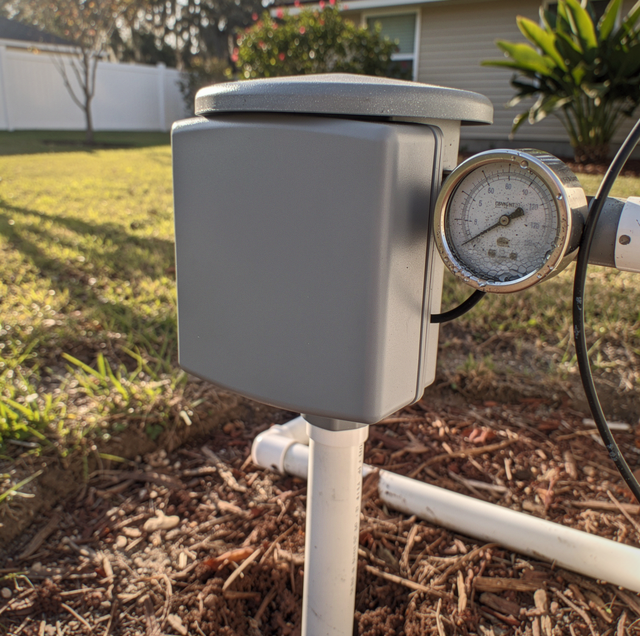
Every well has a ceiling on how many gallons a minute it can put out, no matter how strong the pump bolted to it is. That ceiling functions like a budget: the aquifer refills the casing at some rate, and every irrigation zone that opens on the controller pulls against that rate. As long as what the zones take stays below what the ground can replace, the cycle runs from start to finish without incident. Add a zone, stretch a run time, or let the recharge rate drift lower over the years, and the math flips.
When that happens, the pressure drop mid-cycle is often blamed on the pump first, because it is the part sitting in plain view during the service call. But "well drawdown exceeded" is a named cause in its own right: the source side simply cannot keep up with what the schedule requires. A pump in good working order cannot deliver water the well has not sent it. Telling the two apart, source versus pump, is the actual diagnostic question, and it starts with looking at supply and demand separately before touching equipment.
What the Well Can Actually Deliver
A well's output is not a fixed number stamped on the casing; it is a function of how quickly the surrounding ground refills the space the pump just emptied. In this part of Florida, wells typically draw from the Floridan aquifer through limestone rather than a uniform sand bed, so water moves through cracks and channels in the rock rather than filtering evenly. That means recharge can vary from one property to the next, even over a short distance, depending on which channels a given well intersects. A well that recharges quickly can absorb a demanding schedule without complaint; one that recharges slowly has a lower ceiling, and nothing about the pump changes that number.
This is also why a well's delivery rate is not permanent. Construction, age, and the condition of the screen all play a role, and none of those show up by looking at the pump itself. The well is a separate system from the equipment that pulls water out of it, and its condition sets the upper limit that everything downstream has to live within.
What the Irrigation Schedule Asks of It
Demand is the other half of the equation, and it tends to grow quietly. A controller programmed for four zones years ago becomes six after a landscaping addition. A runtime set to twenty minutes stretches to thirty because a bed on the edge of a zone always looks a little dry. None of these changes touch the well, but each one raises the draw the well is expected to support, cycle after cycle, without anyone re-checking whether the source can still keep pace.
A schedule that worked well when it was first set does not remain valid forever. Added zones, longer run times, and new plantings all quietly raise demand, while the well's ceiling can move in the opposite direction at the same time.
That gap between what the well can deliver and what the schedule asks for is where drawdown-exceeded problems live. Neither side has to change dramatically for the two to stop matching; a modest rise in demand meeting a modest decline in supply produces the same symptom as a large shift in either one alone.
What Happens at the Pump When Supply Falls Behind
When draw-outpaces recharge, the water level inside the casing keeps falling throughout the cycle instead of holding steady. A submersible pump sitting below that level is working against a moving target: as the column above it drops, the pump has to push harder for the same output, and the pressure a homeowner or grower sees at the tap starts to sag partway through a run rather than at the very start.
Pressure that fades only partway through a cycle can look identical to a worn pump end or a failing pressure tank. Replacing parts before confirming which side of the system is actually short risks paying for equipment that was never the problem.
The pressure switch and pump end up chasing a moving target, cycling more than they should for the load. From the yard, that symptom set overlaps almost completely with a tired pump nearing the end of its life, which is exactly why the two get confused. The fix for a genuine pump failure and the fix for a source shortfall are not the same thing, and applying the wrong one leaves the actual cause untouched.
What Changes Over a Season
Demand for a well is not flat across the calendar; it varies for more than one reason. A dry stretch pushes zones to run longer and more often, while recharge often slows, stacking two pressures in the same direction. But demand rises for reasons unrelated to dry weather, too: new sod or a fresh planting needs frequent, shallow watering to establish roots regardless of the season, and that establishment period can fall in any month. Treating dry weather as the whole explanation misses half the picture, because a well that struggles in a wet month with heavy new planting shows the same underlying math as one struggling in a dry month.
Because the mismatch tends to build gradually rather than announce itself all at once, a schedule set once and left alone rarely gets re-matched to what the well can currently deliver. The symptom shows up as a slow drift, not a sudden failure, which is part of why it gets misread as a pump wearing out over time.
How a Technician Tells Source From Pump
Separating the two starts with a drawdown test: drawing the well under a controlled load and watching how the water level responds, rather than guessing from symptoms at the tap. That test is run before a pull-and-replace is recommended on any pump that appears to be losing capacity, because swapping a healthy pump changes nothing if the well itself is the limit.
If the test shows the well cannot sustain the demand being placed on it, that is a well-yield question, not an irrigation pump problem, and it routes to the well-inspection side of the business rather than being treated as a repair on the irrigation line. A well that cannot keep up with a schedule is not something a new pump fixes, and it is not something this shop drills or deepens a well to solve; that scope stays with evaluating the well as it exists. If the test instead shows the well recovering as a healthy source should, and the shortfall is happening at the pump end, that remains squarely an irrigation pump repair.
Either way, the point of testing first is the same: fix the side of the system that is actually short, instead of replacing the part that was easiest to reach.
Frequently Asked Questions
Floridan aquifer wells in this part of Florida typically run roughly 100 to 400 feet, and that range itself explains why two properties a few miles apart can behave very differently. A shallower well may sit near a productive channel and recharge quickly, while a deeper well moves water through a longer, slower path even though both draw from the same aquifer.
Yes. North Central Florida sits on karst limestone, and over years of gradual dissolution and settling, the underground channels that feed a well can shift, changing that well's drawdown profile even though nothing above ground was touched. A well that performed fine a decade ago can behave differently now for reasons that have nothing to do with the pump on it.
Not always, and the rest is what separates the two. A worn pump end delivers the same reduced flow whether it has just started or has been running for an hour, and shutting it down overnight does not bring the missing gallons back, because the loss lives in eroded impellers and opened-up wear rings. A source limit does the opposite: output sags as the run continues and comes back, at least partly, once the well has sat idle long enough to recover its level.
Yes. A submersible sits down in the well and pulls against a falling water column, so it tends to cycle more and trip its own protection as the level drops. A jet pump draws suction from above ground, so when the water level falls below the intake line's reach, it loses prime, which is a distinct failure mode from a submersible running short.
Yes, and the distinction matters. A well that dips during a long run but fully recovers by the next scheduled watering usually points to a timing or zone-sizing issue rather than a true shortfall in the well's capacity. A well that never fully recovers between cycles is the stronger signal of an actual capacity limit.
It examines the well as a structure rather than the equipment hanging in it. That means the condition of the screen or open-hole interval and whether it has plugged with mineral encrustation or fine sediment, the integrity of the casing and its joints, including whether a compromised section is admitting water or sand from a shallower zone, and the current static and pumping levels measured against the depth, casing diameter, and tested yield written on the well's original construction record. None of those readings come off a pump.
Schedule a drawdown test before replacing an irrigation pump — get a clear answer on whether the source or the pump is the real limit. Perry-Pump Repair Service LLC serves Lake Butler, Gainesville, and Alachua. Call (352) 320-2412.
