
What a Well Pressure Tank Does and Why It Matters
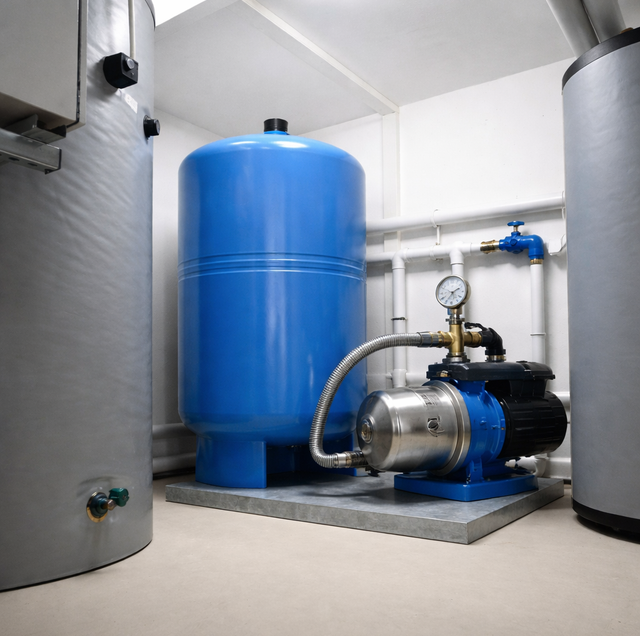
Quick Answer: A well pressure tank stores water under pressure using a cushion of compressed air, delivering water on demand between pump cycles and holding household pressure in a set range (commonly 40 to 60 psi). This means the pump runs less often, which extends its life and gives you steady flow at the tap.
A well pressure tank is the quiet component that keeps your water flowing steadily and keeps your pump from running itself into an early grave. Most homeowners never think about it until the faucet starts sputtering or the pump kicks on and off in rapid bursts. Understanding the pump-tank relationship first makes everything else about your water system easier to follow.
Your well pump does not push water directly to your faucets on demand. Instead, it fills a tank that stores water under pressure. When you open a tap, that stored water flows out first, using pressure from a cushion of compressed air inside the tank. Only when the stored supply runs low does the pump switch back on to refill. So the tank acts as a buffer between the pump and the plumbing, smoothing out demand so the pump runs in controlled cycles rather than firing every time someone rinses a cup.
What a Well Pressure Tank Actually Does
The tank has three jobs, and they work together every time you turn on the water.
It holds a reserve of pressurized water: Inside the tank, a volume of compressed air sits against the water. That trapped air is what stores energy. As the pump fills the tank, the air is squeezed into a smaller space, and squeezed air wants to push back. That push is what sends water to your fixtures without the pump needing to run.
It delivers water on demand between pump cycles: For short draws (a glass of water, a quick hand wash, a toilet refill), the tank supplies everything you need on its own. The pump stays off entirely. Only sustained use, like a long shower or a running sprinkler, pulls the level down far enough to wake the pump.
It keeps house pressure inside a set range: Rather than pressure swinging wildly, the system holds it between two points: a lower cut-in pressure where the pump turns on, and a higher cut-out pressure where it shuts off. A common factory setting is 40/60, meaning the pump starts at 40 psi and stops at 60 psi.
The result is water that feels consistent whether the pump is running or resting.
How a Well Pressure Tank Works
Most modern tanks are bladder or diaphragm tanks. A flexible rubber membrane inside physically separates the air from the water, so the two never mix. The bottom (or one side) holds water; the other side holds a pre-charged pocket of air.
Here is the cycle in motion. The pump runs and pushes water into the tank. As water enters, it presses against the membrane and compresses the air behind it. Pressure climbs. When it reaches the cut-out point, a pressure switch senses the reading and shuts the pump off. Now the tank is charged and ready.
When you open a faucet, the compressed air expands and pushes water out through the plumbing. As water leaves, the air has more room, so pressure drops. Once it falls to the cut-in point, the pressure switch closes the circuit, the pump restarts, and the tank refills back to cut-out. That loop repeats for the life of the system.
A useful way to think of the trapped air is a spring under a weight. Compress it, and it stores force; release the load, and it pushes back. The air pocket behind the membrane is that spring, and your household demand is the load that lets it push water out.
The Parts You Should Know
The tank shell: The steel or composite body that holds pressure. Larger tanks store more usable water, which matters for how often the pump cycles.
The air charge and Schrader valve: Near the top sits a Schrader valve, the same type of air valve found on a car or bike tire. This is where the factory sets the air pre-charge and where a technician checks or adjusts it. It controls the tank's starting air pressure.
The pressure switch and gauge: The switch is the brain that turns the pump on and off at the cut-in and cut-out points. The gauge shows current system pressure so you can read what the system is doing at a glance. These usually sit on the pipe near the tank rather than on the tank itself.
Why the Pressure Tank Matters
Fewer pump starts mean a longer-lasting pump: Every time a pump motor starts, it draws a surge of current and takes mechanical strain. A properly sized and charged tank lets the pump run in longer, less frequent cycles instead of stopping and starting constantly. That reduction in start-ups is the single biggest thing protecting the pump from premature wear.
Steady pressure at the tap: Because the tank delivers water from stored air pressure, you get even flow instead of the pump chasing every small demand. Showers hold temperature better and fixtures behave predictably.
A reserve for brief use. The stored volume covers everyday short draws without the pump running at all, and gives you a small buffer of water for quick tasks between cycles.
The Air Pre-Charge Rule
The air pre-charge is the pressure of the air pocket when the tank has no water in it. The rule most technicians follow: set the pre-charge about 2 psi below the pump's cut-in pressure. So for a 40/60 system with a 40 psi cut-in, the pre-charge is set near 38 psi.
That difference matters because it lets the tank empty its usable water right down to the cut-in point before the pump restarts. If the pre-charge is too high, water is pushed out early, and the tank holds less usable volume; too low, and the membrane can be over-stretched.
The pre-charge is always checked with the tank empty of water, because water pressure in the tank will otherwise mask the true air reading. Doing this safely means cutting power to the pump and relieving the water pressure in the system first. That is not optional. You are working around live electrical connections and a pressurized vessel, and both can injure you. Never over-pressurize the air charge trying to force more performance; you will stress the membrane and can rupture it.
Checking or adjusting the pre-charge means working around live electrical connections and a pressurized vessel, and both can injure you. Cut power to the pump and relieve the water pressure first, and never over-pressurize the air charge to force more performance, which can rupture the membrane.
Signs of a Failing or Waterlogged Tank
A tank is called waterlogged when it loses its air charge and fills almost entirely with water. With little or no air cushion left, it can no longer store pressure, and the symptoms show up fast.
Rapid pump cycling, also called short-cycling: The pump snaps on and off every few seconds during use. Without an air cushion to absorb demand, even a small draw drops pressure to cut in almost instantly. Short-cycling is the clearest warning, and it is hard on the pump, so it should be addressed quickly before the motor burns out.
Pressure that fluctuates: Flow that surges and fades at the faucet, or a gauge needle that jumps around, points to a tank that is no longer smoothing demand.
With the system off, a quick tell for a waterlogged tank is weight and sound. A healthy tank feels light and hollow toward the top where the air sits, while a waterlogged one feels solid and heavy top to bottom because it is packed with water.
Water spitting from the air valve. Press the Schrader valve, and you should get air. If water comes out instead, the internal membrane has failed, and water has crossed into the air side. That tank needs replacement.
Tank Types
Bladder and diaphragm tanks. These use an internal rubber membrane to keep air and water apart. They are the standard on modern systems because the separation keeps the air charge stable for years and resists the water absorbing the air.
Older air-over-water tanks: In older setups, air and water share the same space with no barrier between them. Over time, the water absorbs the air, the cushion shrinks, and the tank becomes waterlogged more easily. These systems often needed an air-volume control or periodic recharging to keep the cushion topped up. A membrane tank sidesteps that maintenance, which is why replacements almost always use one.
Sizing and Drawdown
Drawdown is the amount of usable water a tank delivers between cut-out and cut-in, before the pump restarts. It is not the same as the tank's physical size, since only part of the tank's volume is usable water.
A bigger tank holds more drawdown, so it delivers more water per cycle, and the pump starts fewer times per day. That is easier on the motor and can mean quieter, steadier operation. A smaller tank costs less space but cycles the pump more often. Correct sizing balances the pump's flow rate against household demand so the pump runs long enough each cycle to avoid short-cycling but not so long that it overheats.
Because pump and pressure-switch wiring involves live electrical connections, sizing, wiring, and pre-charge work is best left to a qualified technician. The mechanical concept is simple, but the shock hazard around the switch and the pressurized water in the tank are real.
Frequently Asked Questions
A quality bladder tank commonly lasts somewhere in the range of 5 to 15 years, depending on water chemistry, how hard the pump cycles, and whether the pre-charge was kept correct. Tanks paired with an oversized or short-cycling pump wear out faster because the membrane flexes far more times per day. A tank that outlives its membrane can sometimes fail suddenly rather than gradually, which is why an annual pressure check is worthwhile.
Not well. Without a tank, the pump would have to start every single time water is called for, even for a trickle, and it would hunt constantly to hold pressure. That constant starting overheats the motor and destroys it quickly. A few systems use a constant-pressure variable-speed pump that reduces the need for a large tank, but even those typically keep a small tank to prevent rapid cycling.
Once a year is a reasonable interval, and any time you notice short-cycling. Tanks can lose a pound or two of air pressure slowly through the Schrader valve or a slow membrane seep. Checking annually catches a low charge before it becomes a full waterlog. Remember the reading is only accurate with the tank drained and the pump powered off.
The switch keeps trying to do its job, cutting the pump in at the low setpoint and out at the high one. The problem is that a waterlogged tank hits both setpoints almost instantly, so the switch rapidly chattering the pump on and off. The switch itself is not broken; it is faithfully reacting to a pressure that now swings too fast because the air cushion is gone.
If pressure at the tap feels normal but you hear the pump clicking on frequently, the tank has likely lost much of its drawdown while still holding some cushion. You still get flow, but the usable reserve between cut-in and cut-out has shrunk, so the pump refills more often than it should. It is an early stage of the same waterlog problem and worth checking before it worsens.
No. Pressure is set by the pressure switch's cut-in and cut-out points, not by the tank's size. A larger tank does not raise your psi; it increases how much water you draw between pump starts. If you want different pressure, that is a switch adjustment (done with power off), not a bigger tank. Sizing changes cycle frequency, not the pressure range you feel.
If you hear your pump click on and off too often, get the tank and pressure switch checked before the motor fails. Perry Pump Repair Service serves Gainesville, Alachua, and Lake City. Call (352) 474-7142.
