
Wrong-Size Sprinkler Pump: 4 Signs It Was Never Right
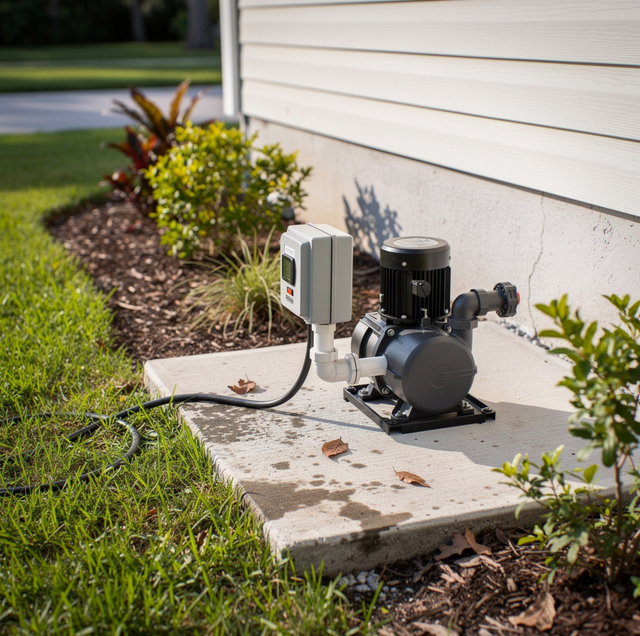
A sprinkler system that suddenly performs worse than it used to is easy to explain: something broke. A worn part failed, a fitting cracked, a switch stuck. But a system that has never quite worked right (weak coverage in the back rows since the week it was installed, zones that seem to fight each other for pressure, a pump that labors no matter what gets repaired) tells a different story. There is a real chance it was wrong from the day it went into the ground, and no amount of fixing the same parts will correct a pump that was never matched to the system it feeds. Homeowners tend to read both problems the same way and chase a repair for a condition only a different pump will resolve.
When the Trouble Was Never a Repair Problem
The distinction matters because it changes what gets fixed. A broken pump has a history: it worked fine for a stretch, then something changed. A part wore down, a component failed, performance dropped off a cliff you can date. A wrong-size pump has no such history. It has always struggled with the same zones, always run longer than it should, always left the same corner of the yard thirsty. Nothing failed; nothing was ever correct in the first place.
A pump that's wrong from day one behaves less like a part that wore out and more like a shoe that never fit: the sore spot shows up early, in the same place, no matter how new the surrounding components are. Chasing that wear with repairs treats the shoe, not the fit. A wrong-size pump is second only to a bad foot valve as the reason a sprinkler system underperforms, so it is worth ruling out early rather than after a string of repairs that don't hold.
Tells of a Sprinkler Pump That's Too Small
An undersized pump is fighting the system every time it runs, and that fight shows up in a handful of repeatable ways. Pressure sags noticeably whenever a second zone or a nearby appliance draws water at the same time. Zones run their full cycle, and the ground still looks under-watered, so the controller ends up set for longer run times than the system's label ever called for. The pump itself sounds strained: a labored motor note, more heat coming off the housing than seems normal, or a control box that feels warm to the touch after a routine cycle.
If you've extended run times more than once to get the same coverage you started with, that's a sizing complaint, not a scheduling one. A technician can usually confirm it in a single visit.
The pump may also short-cycle (switching on and off in rapid bursts instead of running a clean, steady cycle) because it can't build and hold the pressure the system requires. That pattern is worth separating from a bad pressure switch, which does the same thing for a different reason.
Tells of a Sprinkler Pump That's Too Large
An oversized pump announces itself at the heads rather than at the motor. Water leaves the nozzles hard enough to break up and drift instead of landing as droplets; the near heads pop up and reach full arc almost the instant a zone opens, and a rushing or hissing sound carries from those heads in the first seconds of the cycle, distinct from a strained motor note. Pavement beside a bed can come up soaked while the far rows still finish short. One downstream consequence follows the rest: fittings, joints, and valves absorb pressure they were never built for, so leaks surface earlier and recur in the same runs.
The reportable part is the history. A system like this has sprayed hard since the week it was turned on, the leaks cluster in the same stretch of lateral year after year, and no repair has ever changed either pattern. Owners tend to read fast water as strong performance, so the key detail to pass along is that the force was there from the start and the far zones never caught up.
What Both Undersized and Oversized Pumps Do at the Far Zones
Both directions of mismatch tend to converge on the same visible symptom in the parts of the system farthest from the pump: the zones nearest the pump look fine, while the far zones receive little water regardless of which way the sizing error runs. An undersized pump simply runs out of capacity by the time water reaches the last heads on the line. An oversized pump can overwhelm the near zones with pressure while the far zones, working against more friction loss over distance, never see their fair share. Either way, "near zones fine, far zones starved" is a named pattern worth describing exactly that way to whoever diagnoses it, because it points straight at a system-wide mismatch rather than a single bad head or a clogged nozzle out at the far end.
Multi-zone overlap on a single pump is a related, separately named fault: if the system was designed assuming zones would run one at a time but the controller (or a manual override) lets two zones open together, even a correctly sized pump can produce these same far-zone symptoms. A technician checks the controller programming before ruling sizing in or out.
What Short-Cycling Sounds Like From the Yard
Stand near an undersized pump during a normal thirty- to sixty-minute zone and the rhythm gives it away. Rather than a single steady motor note that holds for the duration of the set, the pump comes up, runs briefly, drops out, and restarts on a loop. The heads answer in time with it: a rotor throwing a full stream pulls back to a dribble, recovers, and pulls back again. The motor housing and the control box run warmer than anything else on the pad by the end of the cycle. One consequence is worth naming, since it is what usually ends the pump: every restart draws a current surge a motor built for steady running was never meant to take repeatedly.
Which zones does it matter in, as far as the sound goes? The pattern is worst on the zones carrying the most heads, eases on the smallest zone, and often disappears entirely when a single zone runs alone, and it has been that way on those same zones since the system's first season. A pressure switch that has gone bad produces similar cycling but arrives late, with a date attached, and it does not sort itself by zone size. Timing the interval between drop-out and restart and noting which zones trigger it gives a technician most of the diagnosis before anything gets opened.
How a Technician Separates "Wrong From Day One" From "Worn Out Since"
Timeline is the discriminator. A pump that has behaved the same way since installation, with no clear point at which performance dropped, points to sizing. A pump that ran fine for years and then gradually fell off points toward internal wear, which carries its own symptom pattern and diagnosis path. Confirming the right size is a measurement a technician takes on site.
Do not assume a new motor or a rebuilt pump will fix symptoms that have been present since installation. Swapping parts on a pump that was never the right size for the system usually just reproduces the same complaint with new equipment.
What Happens After the Diagnosis
Once a technician confirms the mismatch is sizing and not wear, the fix is a pump swap to a unit matched to the system's actual zone layout, not another repair cycle on the existing pump. That evaluation also checks the pressure tank, the pressure switch, and the controller programming, since any of those can mimic a sizing problem on their own and would waste a pump replacement if the real cause sits elsewhere. A system that has never worked right deserves a full look before a new pump goes in, so the replacement actually solves the complaint rather than repeating it under a different name.
Frequently Asked Questions
Not necessarily. A single misbehaving zone more often traces to a stuck or partially closed zone valve, a cracked lateral line, or a clogged head than to pump sizing. A true sizing mismatch usually shows a pattern across most or all zones, particularly in the zones farthest from the pump, rather than a single isolated trouble spot.
Yes. A low-yield well can starve even a properly matched pump, particularly late in a dry stretch, because the pump can only move the water the well can supply. When this is suspected, a technician typically checks the well's drawdown and recovery rate before assuming the pump needs to be resized again.
It varies by direction of the error. An oversized pump can run for years before the added stress on fittings and valves shows up as leaks or cracked joints, while an undersized pump's short-cycling pattern is often noticeable within the first irrigation season or two.
On larger properties with heavy simultaneous zone demand, some setups add a second pump dedicated to a specific zone group rather than upsizing a single pump. That's a system redesign a technician evaluates case by case; it is not a standard fix for a typical residential lot.
Yes. A waterlogged pressure tank or a pressure switch set with too narrow a cut-in and cut-out spread can produce the same short-cycling pattern as an undersized pump. That's why a technician checks the tank and switch before condemning the pump itself.
Somewhat. Rotor heads apply water more slowly over a wider arc and tend to mask a mild mismatch longer, while spray heads release water quickly and expose an underpowered pump's pressure drop almost immediately.
Schedule a sprinkler pump evaluation — find out whether the trouble started on day one or arrived later, because only one of the two is fixed by a repair. Perry-Pump Repair Service LLC serves Lake Butler, Gainesville, and Alachua. Call (352) 320-2412.
