
Pre-Season Irrigation Pump Inspection: Catch It Early
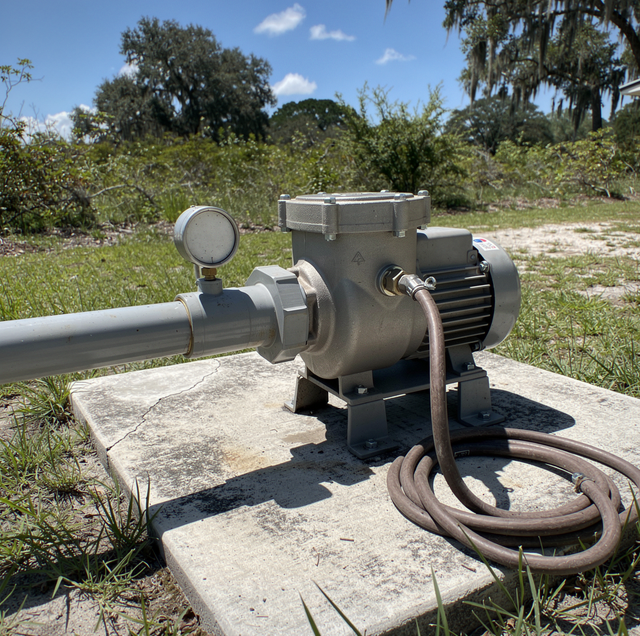
A pump that quits with the field dry takes a phone call and a morning. A pump that quits twenty minutes into a set, with a block of hay or watermelon holding its place in a schedule that does not move, takes the window with it, and a zone that sat dry under a North Florida summer sun does not get that day back. A pre-season inspection is not a promise that nothing will break. What it does is move the moment a fault gets found to a week where finding it changes the plan and nothing else.
The faults worth hunting before a season are not the broken ones. Broken is easy: the pump won't prime, the zone won't come on, the breaker won't stay in. What ends a set in July is what still works today. It primes. The gauge still climbs. The zone still opens. It only crosses over once real hours get put on it, which is why the useful way to organize a pre-season walk is not by where a part sits in the system but by what it takes to make that part show itself. Some faults hide from a static check. Some hide from a short one. Some hide until a second zone opens, and some hide until the equipment gets hot.
Hides From a Static Check, Shows Under Vacuum
The suction side is where this category lives, and the foot valve is its clearest example. A foot valve holds water in the suction line when the pump is off, so a technician can watch a gauge hold a static prime for several minutes and read that as a healthy valve. Vacuum is a different test than standing water. A seat with a fine crack, a poppet seal that has stiffened, or a threaded fitting a quarter turn loose will each hold against gravity and still let air past the moment the pump starts pulling on it.
In season, that does not arrive as a no-prime call. It arrives as a pump that primes normally, runs well for twenty or forty minutes, and then slides off as air accumulates ahead of the impeller, by which point whoever comes out to check has already lost the set. What catches it beforehand is a vacuum reading held over time rather than a glance at a still gauge, plus a hand run over every suction joint while the pump is under pull.
A foot valve doesn't have to fail outright to cause trouble. One that holds a static prime but weeps slowly under vacuum reads fine at rest and only shows the fault once the pump has been running for a while.
Hides From a Short Run, Shows Under Sustained Load
Two very different parts share this hiding place: the intake screen out at the source and the impeller inside the pump. Neither one fails an inspection. A strainer basket carrying warm-season fouling on a pond, ditch, or canal still passes enough water to satisfy a five-minute test, and rounded impeller vanes still build enough head to make a gauge at the pad look reasonable. The shortfall is a volume shortfall, and volume only comes back on you once it is what's being asked for.
Put the system under a real zone for an hour, and both reveal themselves the same way: pressure that starts about where it should and settles lower as the run goes on, with the far heads giving up first because they hold the least reserve to spend. Grit is what does the impeller damage in this part of the state, and an ag pump running four to eight hours a day through the season gets an enormous number of passes at those vane edges. Where the loss registers is what separates the two, at the intake or across the pump itself, which is why both get read rather than one.
Hides Behind One Open Zone, Shows With Two
Some parts fail only under resistance, and a single open zone does not provide much of it. The run capacitor is the standard case. Enough charge remains in a weak capacitor to bring a motor up against one zone, reliably enough to look sound all afternoon. Open a second valve, hand the motor more work than the capacitor can push it through, and the start turns into a hum, a slow spin-up, or an overload trip that has already cleared itself by the time anyone walks out to look.
Zone valves belong in this category from the other direction. Scale from iron and hardness builds on the seat until a valve seats slowly and bleeds a little pressure through when it should be shut. Run that zone by itself, and nothing looks wrong. Run it alongside a neighbor, and the bleed-through comes from a pressure budget that no longer has room for it, so one section finishes short while the rest look normal. Checking each zone only in isolation is what lets both of these sit undetected right through spring.
Hides Cold, Shows Once the Equipment Is Hot
Heat is the condition a cool-morning check cannot reproduce. Contacts, capacitors, and windings all read within spec at eight in the morning and drift as the enclosure warms through a long afternoon set. A contactor with pitted faces carries a light load fine and begins to chatter once resistance and heat climb together. A capacitor already down on capacitance loses more of it warm than cold, so the same motor that started cleanly in the morning starts hard at three.
The control box offers a second reason to open it before the season rather than during it. A closed housing that gives off a little warmth is exactly what a fire ant colony is looking for, and by the time an intermittent fault gets traced back to the box, the nest has usually been in there a while.
Fire ant colonies are drawn to the warmth and enclosed space inside a control box or controller housing, and a nest built against live contacts can cause an intermittent short that looks electrical until someone actually opens the box.
What "Still Works" Is Actually Worth
Every fault above passed a check. That is the entire category. What a pre-season inspection is worth comes down to applying the conditions the season is going to apply anyway, on a day when nothing is riding on the answer: vacuum held long enough to find a leak, a run long enough to expose a volume loss, a second valve opened, and equipment given time to get hot. A finding that comes back that way is a reading that has drifted rather than a part that has failed, and drift is a scheduling problem. That is the difference between deciding when to replace a foot valve and learning in the middle of a set that the decision has already been made for you.
Frequently Asked Questions
A pump that sits mostly idle through the off-season can accumulate settled sediment in the casing and lower sections of the suction line, which then gets stirred back into the flow the moment the pump restarts and runs at full demand, rather than showing any symptom while it was sitting still.
A failing foot valve typically shows up as a slow reprime each time the pump stops and restarts, while an air leak at a suction fitting tends to show up as a steady loss of flow and an audible cavitation sound that continues the whole time the pump runs, without ever fully repriming.
A technician checks the capacitor's stored charge against its rated microfarad value rather than assuming the motor itself is at fault, since a motor with a bad capacitor will often still spin under a light load and only stall or hum once real resistance is added.
Clearing the nest removes the ants but not the pheromone trail embedded in the housing, and the conditions that drew them there remain unchanged. The durable change is to close the way in: seal the conduit entry and the gap where the conduit meets the enclosure. An unsealed conduit run is a protected path into the box from underneath, which is why a box that keeps getting reinfested is usually a sealing problem rather than an ant problem.
Yes: when only some zones run weak while others perform normally, that pattern points toward the distribution side rather than the pump, and a technician can often confirm it by closing zones one at a time and watching how the discharge pressure responds to each change.
It does. A surface-source strainer basket can accumulate floating debris like duckweed and algae mats that a downhole well screen never encounters, so a surface intake is typically pulled and cleared by hand rather than inspected the way a submerged well screen would be.
Schedule a pre-season irrigation inspection — before the field is counting on it. Perry-Pump Repair Service LLC serves Lake Butler, Gainesville, and Alachua. Call (352) 320-2412.
