
What a Well Pressure Switch Does: The Part That Runs Your Pump
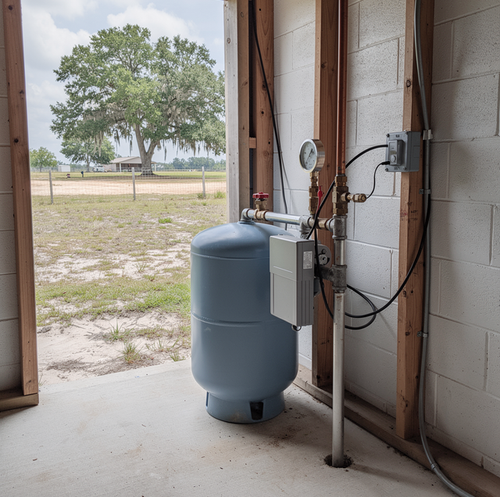
Quick Answer: A well pressure switch is an electrical switch that turns the pump on when water pressure in the system drops to a set low point (the cut-in) and turns it off when pressure climbs to a set high point (the cut-out). It keeps household pressure inside a band, commonly 30/50 or 40/60 psi, without you ever touching a control.
A well system has no city main behind it, so something has to decide when the pump runs and when it rests. That job falls to a small gray box, usually mounted on the pipe near the pressure tank, called the pressure switch. It is one of the least expensive parts in the whole setup, and it is also the part most likely to leave you standing at a dry faucet. Understanding what it does, and how it does it, makes almost every water pressure problem easier to read.
The Cut-In And Cut-Out Loop That Runs Everything
Before any of the other parts make sense, the basic control loop has to be clear, because everything else is built on top of it.
The switch monitors the water pressure in your plumbing and keeps it within a two-number band. The lower number is the cut-in pressure: when pressure falls to this point, the switch closes its contacts, power flows to the pump, and the pump starts pushing water. The higher number is the cut-out pressure: once pressure climbs to this point, the switch opens its contacts, power stops, and the pump shuts off.
A common factory setting is 40/60, meaning the pump kicks on at 40 psi and off at 60 psi. Another common one is 30/50. That gap between the two numbers, usually around 20 psi, is the differential. It exists on purpose. If cut-in and cut-out were only a couple of psi apart, the pump would flick on and off constantly with every small draw of water. The 20 psi spread lets the pump run long enough to do real work, then rest.
Here is the loop in motion. You open a shower. Water leaves the system, pressure drops. When it hits 40, the switch cuts in and the pump runs, refilling the tank and the pipes while you shower. You finish and close the tap. The pump keeps running until pressure reaches 60, then cuts out. Now the stored water in the pressure tank feeds the next few draws, a hand wash, a toilet flush, until pressure sags back to 40 and the cycle repeats. That quiet, automatic handoff between pump and tank is the whole point of the switch.
How The Switch Actually Senses Pressure
The switch has no computer and no sensor chip. It works on simple mechanical force.
Inside the housing is a diaphragm or a small piston exposed to the water pressure in the line. Water pressure pushes up on one side of that diaphragm. On the other side sits a stack of springs pressing back down. Those springs are what the two adjustment nuts control.
When water pressure is high, it overcomes the springs, the diaphragm lifts, and that movement pops the electrical contacts open, stopping the pump. When you use water and pressure falls, the springs win, the diaphragm drops back, and the contacts snap closed again to restart the pump. So the switch is really a tug-of-war between water pressure and spring pressure, and the contacts ride along on the moving part in the middle. The snap you hear, that sharp click when a pump starts or stops, is the contacts making or breaking that connection.
This is also why the switch and the tank have to be looked at together. The switch only knows what pressure it feels at the pipe. It cannot tell the difference between healthy pressure and a problem upstream. It just reacts to the number.
Why The Switch And Pressure Tank Are A Team
The pressure tank is not just a storage jug. It holds a cushion of compressed air over a rubber bladder, and that air is what stores energy so the pump does not have to run for every glass of water. The switch and the tank are tuned to each other: the tank's air pre-charge is normally set about 2 psi below the switch's cut-in number.
When the tank is healthy, the pump runs in long, calm cycles. When the tank loses its air charge, it becomes waterlogged, meaning water has filled the space where the air cushion should be. Now there is almost no stored water to draw from. The instant you open a tap, pressure collapses to cut-in, the pump starts, pressure shoots straight to cut-out, and the pump stops, all in a couple of seconds. That is short-cycling, and from the switch you hear it as rapid chatter, click-click-click, the pump slamming on and off.
The trap here is blaming the switch. The switch is doing exactly what it was built to do, reacting to real pressure swings. The actual fault is usually the tank losing its charge or its bladder failing. Short-cycling is brutal on a pump motor and pump start components, so a chattering switch is a signal to check the tank pre-charge, not just to swap the switch.
Rapid clicking or chatter at the switch usually means a waterlogged tank rather than a bad switch. Check the tank pre-charge first, which is normally set about 2 psi below the switch cut-in number, before replacing the switch itself.
Think of the switch as a thermostat and the tank as the room: a thermostat that cycles the furnace every ninety seconds is rarely broken; it is usually reacting to a room that cannot hold its temperature.
Signs Your Pressure Switch Is Failing
Because the switch carries the pump's full electrical load and snaps thousands of times a month, its contacts wear. Watch for these patterns.
The pump will not start at all: If pressure is low and the switch contacts stay open, the pump never gets power, and you get no water. Sometimes the contacts are burned or stuck; sometimes debris or an insect nest has fouled the switch.
The pump will not shut off: If the contacts weld themselves closed or the sensing port is clogged, the switch never tells the pump to stop. The pump keeps building pressure past cut-out. This one is dangerous, covered below.
Rapid clicking or chatter: As noted, this often points at a waterlogged tank, but worn contacts or a cracked diaphragm can also make the switch hunt and click.
Burned, pitted, or blackened contacts: With the power off, a switch that is arcing badly shows dark, rough, or melted contact points inside, and often a faint burnt smell. Pitted contacts make poor connection and let the motor stumble.
No water with the pump silent: A dead switch, a tripped safety, or a lost pressure signal can all leave the pump idle. The switch is one of the first, cheapest things a technician checks, but it is not always the culprit.
A clogged sensing port: Iron, sand, and sediment can pack the small tube or port that lets water reach the diaphragm. A blinded switch reads the wrong pressure and behaves erratically no matter how good its contacts are.
The Low-Pressure Cut-Off Safety Version
Some switches add a spring-loaded safety feature: a low-pressure cut-off, sometimes stamped with numbers like "40/60 FSG" and a low trip point around 10 psi.
Its job is to protect the pump from running dry. If the well runs low, a pipe breaks, or the system loses prime, pressure can fall far below the normal cut-in. A standard switch would simply hold the pump on, running it against no water. A pump that runs dry overheats fast and can be ruined in short order, because the water it moves is also what cools it.
The low-pressure cut-off trips off below that low threshold and locks the pump out instead of letting it run dry. Many of these switches use a manual reset lever you have to hold up to restore power once the cause is fixed. If yours trips repeatedly, that is the safety doing its job, and the real problem, low well level, a leak, or lost prime, needs to be found before you keep resetting it.
Why Adjusting Or Replacing One Is Careful Electrical Work
A pressure switch looks harmless, but it is a live electrical device, and on most residential deep wells it is switching 240 volts. That is the detail that changes everything about touching one.
On most residential deep wells the pressure switch is switching 240 volts, and the contacts arc every time they open. Opening the cover while power is on exposes energized terminals, so the pump breaker at the panel must be switched off and confirmed dead, not just switched at the well, before the cover comes off.
Two failure modes make this more than a comfort issue. A switch stuck closed, one that never cuts out, keeps the pump building pressure with nowhere to send it. Pressure can climb until something gives, and a tank or a fitting that lets go under pressure is a real hazard. And a pump allowed to run dry can be destroyed in minutes.
Adjusting the springs is finicky too. The tall center nut moves both cut-in and cut-out together; the shorter offset nut changes only the differential. Turn them without a gauge and you can easily set a band the pump or tank cannot support, or push pressure past what the plumbing is rated for. Between the 240-volt shock risk, the arc-scarred contacts, and the pressure hazards, switch and wiring work is best handled by a licensed pump professional who can test the tank, the pump, and the switch as one system rather than guessing at a single part.
Frequently Asked Questions
Most last several years to around a decade, but lifespan depends far more on cycle count than age. A switch on a system with a waterlogged tank may snap tens of thousands of extra times a year and burn out its contacts in months, while a switch paired with a healthy tank can run many years untouched. High iron or sediment water also shortens life by fouling the sensing port. If a switch fails early, the tank is the first thing to inspect, not the switch brand.
You can raise the band somewhat, but there are hard limits the body of the article does not spell out. Most standard pressure tanks and residential switches are rated to a ceiling around 75 to 100 psi, and many pumps cannot maintain a very high cut-out without running constantly. Pushing cut-out toward 70 or 80 also stresses fittings, the water heater, and appliance valves. A modest bump, say from 30/50 to 40/60, is usually safe; chasing much higher pressure often trades one problem for several.
A buzz at the switch with no pump usually means the contacts are trying to close but cannot make a clean connection, often from pitting, corrosion, or a weak spring, so current stutters instead of flowing. It can also signal a control issue further down, such as a failing pump start capacitor drawing power without turning the motor. This is a stop-and-call sign: leaving a buzzing, non-starting switch energized can overheat the contacts and the wiring.
It controls only pressure, never flow rate. The switch decides when the pump adds pressure to the system, but how fast water comes out of a given tap is set by pipe size, fixture design, and any filters or softeners in the line. So a house can have perfect 40/60 switch operation and still feel like weak flow at a faucet if a clogged filter or an undersized line is the real bottleneck. Diagnosing flow and diagnosing pressure are two separate jobs.
The gauge only displays the current pressure; it makes no decisions and carries no pump power. The switch is the part that acts on pressure by opening and closing the pump circuit. They are often mounted inches apart on the same tank tee, which leads people to confuse them. A dead gauge is a five-minute cosmetic swap, while a dead switch stops your water, so it helps to know which one you are actually looking at before ordering a part.
Surge protection helps the pump's motor and any electronic controls more than the switch itself, since a bare mechanical switch has no circuit board to fry. What a nearby strike can do to a switch is weld its contacts shut or pit them from the current spike, which is one more reason to keep the safety low-pressure cut-off in good order. Surge protection at the well and the panel is worthwhile because a lightning event usually takes out the pump or its capacitor first, and the switch damage rides along with it.
Get your switch, tank, and pump checked as one system before a dry faucet turns into a burned-out pump — an honest diagnosis, done right the first time. Perry-Pump Repair Service LLC serves Lake Butler, Gainesville, and Lake City. Call (352) 474-7142.
