
Well Pump Keeps Tripping Breaker? 7 Causes to Check
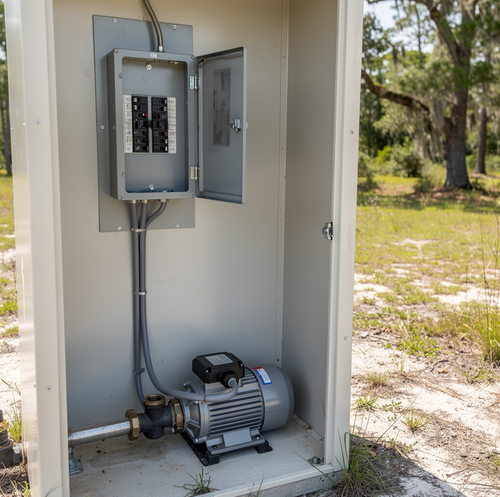
Quick Answer: A well pump breaker trips for one of two reasons: the motor is pulling too much current (overcurrent) or current is escaping to ground through a fault. Overcurrent comes from a straining or seized motor, a waterlogged tank that makes the pump run nonstop, a stuck pressure switch, or short-cycling. A ground fault comes from water in a connection or a damaged cable. Reset it once. If it trips again, leave it off and call a well professional or electrician.
You flip on a faucet, nothing comes out, and a trip to the electrical panel shows the well pump breaker snapped off. You reset it, water returns for a while, then the breaker trips again. A breaker that keeps doing this is not being fussy. It is a safety device doing exactly its job, cutting power because something in the pump circuit is drawing more current than it should or sending current somewhere it should not go. Understanding the two ways that happens makes the likely causes easier to follow, and it explains why repeatedly forcing the breaker back on is a mistake.
Overcurrent Versus Ground Fault: The Two Reasons Any Breaker Trips
A circuit breaker watches for two different problems, and a well pump can produce either one.
Overcurrent means the motor is drawing more amperage than the circuit is rated to carry. Every pump motor has a normal running current. When something forces the motor to work harder, or forces it to run far longer than it should, the current climbs past the breaker's threshold and the breaker opens to protect the wiring from overheating. The motor itself is fine electrically in many of these cases; it is simply being asked to do too much.
A ground fault is different and more urgent. Here, electricity is leaking out of its intended path and finding a route to ground, often through water or damaged insulation. A ground fault can trip a standard breaker when the leakage is large, and it is the situation that makes a wet, live well circuit truly dangerous. Water conducts electricity, and a submersible pump lives at the bottom of a water-filled casing, so any breach in insulation gives current an easy detour.
Almost every tripping-breaker complaint traces back to one of these two conditions. The clues that separate them are things you can safely observe, which is covered further down.
The Common Culprits Behind a Tripping Well Pump
A failing or locked-up motor: The motor is the heart of the system, and a motor near the end of its life often trips the breaker on startup or shortly after. Bearings that have worn rough, a rotor dragging against the stator, or sand and grit that have worked into the pump end all increase the load. In the worst case, the pump is mechanically seized, so the motor stalls the instant it gets power and pulls locked-rotor current, which is several times the normal running amperage. That surge trips the breaker almost immediately, often the moment you reset it.
A waterlogged or failed pressure tank: The pressure tank is meant to hold a cushion of air above the water so the pump can shut off and rest between draws. When that air charge is lost, the tank becomes waterlogged, and the pump can no longer build a reserve. It kicks on for every small demand and, in a badly waterlogged tank, runs almost constantly. A motor built for intermittent duty that is forced to run without rest overheats, and an overheating motor draws rising current until the breaker trips. This is one of the sneakier causes because the pump seems to work, right up until it does not.
A stuck or worn pressure switch: The pressure switch is the small device that tells the pump when to start and stop based on system pressure. Its internal contacts can pit, weld, or stick from years of arcing every time they close. A switch stuck closed keeps the pump powered when it should have shut off, so the pump runs dead-headed or overheats and the breaker eventually trips. Burned or corroded contacts can also arc in a way that a sensitive breaker reads as a fault.
A ground fault from water or a damaged cable: This is the electrical side of the problem. The drop cable that runs down the well to a submersible pump can be nicked during installation, chafed against a rough casing, or degraded over many years underwater. Once the insulation is breached, water reaches the conductor and current leaks to ground. The same thing happens at connections: a wire nut or splice sitting in a wet junction, a corroded terminal in the control box, or moisture that has crept into the pressure switch enclosure. A ground fault frequently trips the breaker the instant power is restored, before the motor even has a chance to run.
A run capacitor on some pump controls: Many single-phase submersible and jet pumps rely on a capacitor, housed in a control box or the pump body, to help the motor start and run smoothly. A run capacitor that has failed or drifted out of spec leaves the motor struggling to reach speed, and a motor that cannot come up to speed keeps pulling high starting current. That sustained draw looks like overcurrent to the breaker. A failed capacitor is a common finding when a motor hums, strains, or trips the breaker without ever spinning up.
Short-cycling and clogging: A pump that rapidly switches on and off, called short-cycling, punishes the motor with repeated high-current startups. Each start pulls a surge, and dozens of starts in a short span build heat the motor cannot shed. Short-cycling often stems from the same waterlogged tank described above, or from a clogged screen, a blocked filter, or scale narrowing the plumbing so pressure swings too fast. The added mechanical resistance from a partial blockage also raises the running load. Cold weather can stiffen grease and thicken water slightly, adding to startup strain, though heat and constant summer cycling stress the same motor just as hard the rest of the year, so this is not a one-season issue.
An undersized breaker or storm damage: Sometimes the breaker itself is the weak link. A breaker rated below what the pump actually needs, or one that has weakened internally from age and repeated tripping, will nuisance-trip even when the pump is healthy. Separately, a nearby lightning strike or a power surge during a storm can damage the pressure switch, the control box electronics, or the motor windings. Storm-damaged components often show up as a breaker that will no longer hold, and this can happen after a summer thunderstorm or a winter ice storm alike, since surges are not seasonal.
An everyday way to picture it: The breaker behaves like a person carrying buckets up a hill. Ask them to carry a reasonable load, and they go all day. Pile on too much weight, or make them run up and down without a break, and eventually they stop and refuse to go on. That refusal is not stubbornness; it is protection against getting hurt. The breaker stops the pump for the same reason, and forcing it back to work does not fix why it quit.
What a Homeowner Can Safely Check
There are a few observations you can make from outside any wiring that help a technician arrive prepared. None of them require opening the panel beyond the breaker face, opening the control box, or touching the pump.
Reset the breaker one time only: Move it fully to off, then back to on. If it holds and water returns, note how long it lasts. If it trips again right away, stop.
Notice the timing of the trip: A breaker that trips the instant you reset it, before any water moves, points toward a hard short, a ground fault, or a seized motor. A breaker that holds for a while and trips only after the pump has run for a stretch points more toward overheating, a waterlogged tank, or a straining motor. That single detail narrows the diagnosis considerably.
Look, do not touch, for obvious water: If you have an accessible above-ground junction box, a pressure switch, or a control box in a well house or basement, look for standing water, dripping, or corrosion around it from a safe distance. Water where the electrical connections live is a strong sign of a ground fault. Do not open the cover and do not reach inside.
Listen at the pressure tank and switch: A tank that feels completely full and heavy, or a pressure switch that chatters rapidly, hints at the waterlogged-tank and short-cycling problems above.
Write down what you saw. Those notes save diagnostic time and help the technician bring the right parts.
Why repeated resets are dangerous: It is tempting to keep flipping the breaker to buy a little water. If the cause is a straining or seized motor, each reset drives another high-current surge through windings that are already overheating, which can turn a repairable problem into a burned-out motor that has to be pulled and replaced. The breaker tripped for a reason. Overriding that protection repeatedly risks both a person and the equipment.
Every reset on a faulted circuit is a gamble. If the cause is a ground fault, you are re-energizing a circuit that is leaking current into water, and water plus electricity can be lethal to anyone near the wellhead, the tank, or a wet basement floor. Reset once, and if it trips again, leave it off and call a professional.
Why Diagnosis and Repair Belong to a Professional
Pinning down which of these causes is at work takes measurement, not guesswork. A well professional or licensed electrician uses a clamp meter to read the motor's actual running and starting current, an insulation-resistance tester to find a ground fault in the drop cable or windings, and pressure gauges to judge the tank and switch. They can tell a waterlogged tank from a failing capacitor from a shorted cable, because each leaves a different signature on the instruments. That is work that involves live electrical connections and, in some cases, the submersible components themselves.
This is deliberately not a do-it-yourself repair. Opening the control box, handling the drop cable, or pulling the pump exposes you to live conductors, stored charge in a capacitor, and the sheer weight and depth of well equipment. A capacitor can hold a dangerous charge even after the power is off. The safe and effective path is to make your observations, leave the breaker off once it has tripped a second time, and bring in someone equipped to test the circuit properly.
Frequently Asked Questions
Yes. A ground-fault breaker or receptacle trips on a tiny imbalance between the outgoing and returning current, far smaller than the overload it takes to trip a standard breaker, so a GFCI-protected pump circuit will react to a minor moisture problem long before a plain breaker would. That sensitivity is a feature: a GFCI trip is often the earliest warning of water intrusion in a connection, and it should never be swapped for a non-GFCI breaker to stop the nuisance.
It can, indirectly. When the water level drops below the pump intake, the pump runs dry and loses the water that normally cools it, so it heats up fast and the thermal load can trip the breaker or a built-in overload. Many systems use a low-water cutoff or pump-saver device precisely to shut the pump down before that damage happens, and a tripped protector like that can look identical to a tripped breaker at the panel.
An insulation-resistance test, sometimes called a megohm test, is the deciding measurement. A technician disconnects the leads and reads the resistance between each conductor and ground; a healthy motor and cable read very high resistance, while a failing winding or a water-breached cable reads low. Combined with a separate reading taken at the wellhead versus the control box, this isolates whether the fault is in the buried cable, a splice, or the motor itself without pulling the pump first.
No, and it is unsafe to try. The breaker is sized to protect the wire feeding the pump, not to accommodate a struggling motor, so installing a larger breaker lets the fault current keep flowing and allows the conductors to overheat, which is a fire risk. If a pump legitimately needs more current than the circuit provides, the wire gauge and breaker must be engineered together, which is exactly why this is professional work rather than a parts swap.
Clustered demand is the clue. First thing in the morning, showers, laundry, and irrigation can call for water all at once, forcing a marginal motor or a system with a weak tank charge to run long and hard enough to cross the trip threshold, while light midday use never taxes it. A pump that only trips under sustained heavy draw is often an early-stage motor or tank problem that still has enough margin to hide during quiet hours.
Yes. A loose lug where the circuit wire lands on the breaker, or a breaker that no longer clamps the bus bar tightly, creates resistance that heats up under load; that heat can trip a thermal breaker and, over time, degrade the breaker so it trips at lower and lower current. A technician checks for discoloration, a burnt smell, or heat at the connection, because a failing termination mimics a pump fault while the pump is actually fine.
Get the trip diagnosed before it burns out your motor — one tested visit tells you the real cause and the fix. Perry-Pump Repair Service LLC serves Lake Butler, Gainesville, and Alachua. Call (352) 474-7142.
